




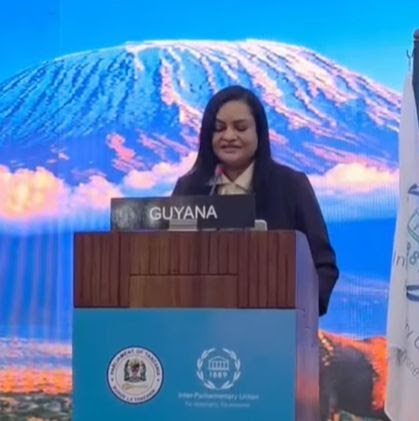
Guyana’s approach to inclusive governance, public accountability and people-centred development was presented on the international stage as Minister of Human Services and Social Security, Dr Vindhya Persaud, addressed the 153rd Assembly of the Inter-Parliamentary Union (IPU) in Arusha, Tanzania.

Speaking during the recent general debate themed “Enhancing good governance and empowering communities through inclusivity, trust and opportunities for all,” Minister Persaud outlined how Guyana is advancing a governance model that places citizens at the centre of decision-making, expands access to opportunities and promotes confidence in public institutions.
She described Guyana’s efforts to bring government closer to the people, including direct engagement with the president and cabinet, digital platforms for public feedback, and consultations that extend from coastal villages to Indigenous and riverine communities.
The approach creates avenues for young people, women, persons with disabilities, the private sector and civil society to contribute to national discussions and policy decisions.
A key example is the National Toshaos Council (NTC) Conference, which brings together leaders from 253 indigenous villages to discuss community priorities directly with the president and cabinet.
Minister Persaud also pointed to the allocation of 15 per cent of revenue from Guyana’s carbon credit sales to Indigenous villages, supporting locally determined development.

“The Government of Guyana’s purpose is clear. Every citizen must share in Guyana’s cause,” she emphasised.
Dr Persaud outlined Guyana’s development agenda, including housing for 53,000 families, free university education, technical and vocational training, scholarships, access to medicines and robotic surgery, and expanded socioeconomic support for senior citizens.
Investments in roads, infrastructure and digital connectivity are also improving access to essential services and markets, while creating opportunities for businesses and communities to participate more fully in the country’s economic growth.
On parliamentary governance, Dr Persaud outlined the role of legislative scrutiny, national consultations and oversight institutions in ensuring transparency and accountability.
She referenced the contribution of parliamentary committees to the legislative process and the work of the Ministry of Parliamentary Affairs and Governance (MPAG) in coordinating accountability initiatives, supporting oversight bodies and monitoring Guyana’s international anti-corruption commitments.