






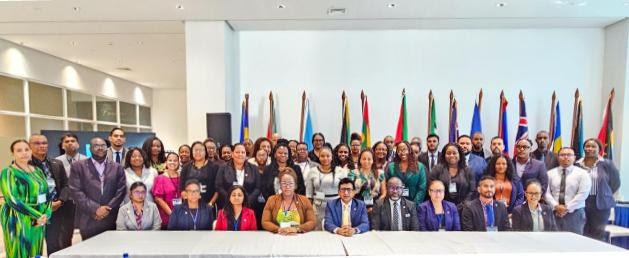
Guyana has hosted a regional training programme aimed at strengthening the technical expertise of Caribbean officials responsible for evaluating measures against money laundering, terrorist financing and the financing of proliferation.
The five-day Caribbean Financial Action Task Force (CFATF) Assessors’ Training Programme was held in Georgetown from November 9 to 13, 2026, under the auspices of the Government of Guyana through the Attorney General’s Chambers and Ministry of Legal Affairs.
Approximately 50 participants from 16 countries and territories, including Guyana, attended the programme, which focused on developing the regional expertise required to assess the effectiveness of national systems in addressing financial crimes.
Attorney General and Minister of Legal Affairs, Mohabir Anil Nandlall, SC, MP, addresses participants at the training programme.
Attorney General and Minister of Legal Affairs, Mohabir Anil Nandlall, SC, MP, visited the programme and met with representatives of the CFATF Secretariat, facilitators and officials participating in the sessions.
During the engagement, Nandlall highlighted the importance of building specialised regional knowledge and strengthening the institutional capabilities needed to identify and respond to increasingly complex financial crimes.
The CFATF is responsible for monitoring how Caribbean jurisdictions implement international standards established by the Financial Action Task Force (FATF). Its Mutual Evaluation process examines not only whether countries have the necessary laws and regulatory institutions in place, but also how effectively those systems operate in practice.
The training was therefore structured to provide public-sector officials with the technical understanding and practical skills required to participate in these assessments and evaluate the performance of national anti-financial crime frameworks.
Guyana had nine representatives drawn from several key public institutions, including the Financial Intelligence Unit, the Office of the Director of Public Prosecutions, the Bank of Guyana, the Gaming Authority, the Special Organised Crime Unit of the Guyana Police Force and the Cooperatives Department within the Ministry of Labour.
Successful completion of the programme could also create opportunities for participants to be selected as assessors on future CFATF Mutual Evaluation teams, allowing Guyanese officials to contribute directly to regional assessment exercises.
The programme was delivered by five CFATF Secretariat officials and technical specialists: Deputy Executive Director Wendell Lucas; Law Enforcement Advisor Christopher Lahourie; Legal Advisor Camille Renie; Financial Advisor Knalidi Jackson Frederick; and Junior Financial Advisor Nalita Seenath. Jadelle Holder-Remy and Kimberly Cyril also attended on behalf of the Secretariat.
The exercise comes as CFATF member countries transition from the Fourth Round to the Fifth Round of Mutual Evaluations. The new assessment cycle places significant attention on the practical effectiveness of national systems, including their ability to investigate and prosecute financial crimes, disrupt criminal networks, recover illicit proceeds and address identified risks.
For Guyana, the training coincides with ongoing efforts to strengthen its compliance with international anti-money laundering and counter-terrorist financing requirements. The country is continuing to implement measures arising from its Fourth Round Mutual Evaluation while preparing for its November 2026 follow-up reporting process.
Further technical compliance improvements are also being pursued, with additional re-rating considerations anticipated in November 2027.
The government has maintained that strengthening the country’s legislative and institutional arrangements remains a priority, particularly in areas involving financial intelligence, regulatory supervision, law enforcement investigations, prosecutions, confiscation and asset recovery.
Through its engagement with the CFATF, FATF and other regional and international partners, Guyana is seeking to maintain an effective financial crime prevention framework that meets evolving international standards and strengthens the country’s capacity to respond to illicit financial activities.