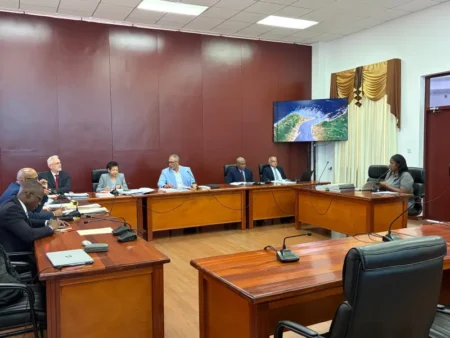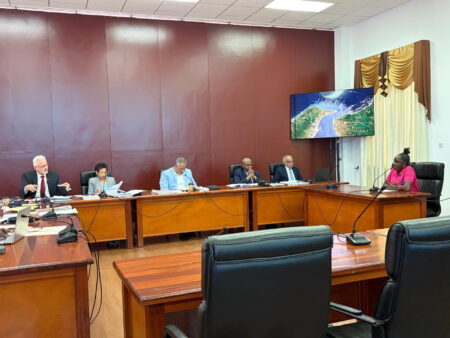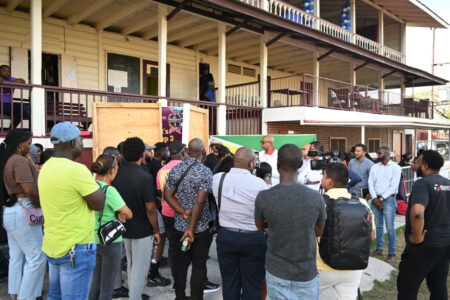








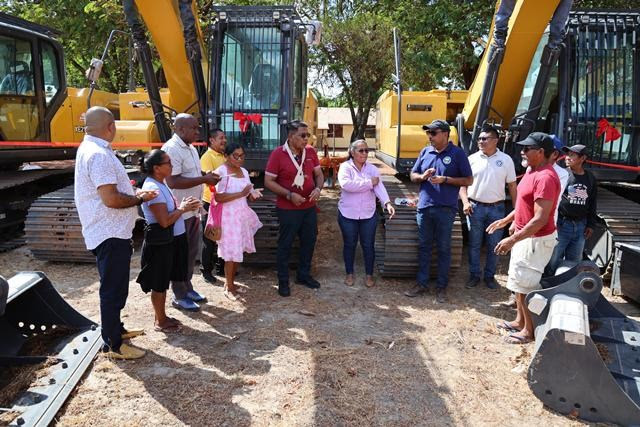
Farmers and communities across Region Nine received more than $200 million worth of equipment and supplies on Saturday, as the government made good on commitments to bring serious agricultural machinery to one of Guyana’s most remote regions.
Minister of Agriculture Zulfikar Mustapha travelled to the Upper Takutu-Upper Essequibo region to personally hand over the package, which is designed to shift hinterland farming from subsistence-level operations toward commercially viable, large-scale production.
The centrepiece of the delivery is five long-reach excavators, valued at $175 million, fulfilling a promise the government made at this year’s National Toshaos Council Conference to provide one additional excavator to each of Region Nine’s five sub-districts. For communities where land preparation and drainage work can determine whether a farming season succeeds or fails, the addition of heavy equipment to the local fleet is not a minor upgrade — it is the difference between what is possible and what is not.
Rounding out the equipment package are three all-terrain vehicles, a 4×4 vehicle, a boat, an outboard engine, five water pumps, two chainsaws, and four spray cans. The delivery also included a range of agricultural supplies: chain-link fencing, shade nets, shade plastic, planting material, barbed wire, fertilisers, and — notably — beehives.
That last item points to one of the more striking ambitions embedded in Saturday’s handover. Minister Mustapha used the occasion to signal that the government sees Region Nine as a future engine of Guyana’s rapidly growing honey industry. The numbers behind that ambition are worth pausing on: national honey production has grown from approximately 2,000 gallons in 2020 to 50,000 gallons today — a twenty-fivefold increase in just a few years. “There is a lot of potential here in Region Nine to increase that production,” Mustapha said.
To back that up, the ministry is providing not just beehives but also protective gear, essential supplies, and specialised training so that farmers have both the equipment and the knowledge to run productive apiculture operations. The goal is to build a genuinely competitive industry, not simply hand over materials and walk away.
The broader philosophy behind the intervention is one the government has articulated consistently in its hinterland programmes: that remote communities deserve the same access to economic opportunity as coastal ones, and that getting there requires real investment in machinery, resources, and technical capacity — not just small-scale grants. Saturday’s delivery, Minister Mustapha said, is part of a strategy to give hinterland farmers the tools to move beyond feeding their own families and start feeding markets.
Minister Mustapha was accompanied by the Ministry of Agriculture’s Director General Dhaneshwar Deonarine, NDIA Chairman Lionel Wordsworth, NAREI Chief Executive Officer Jagnarine Singh, and Hinterland Coordinator Raymond Latchman.