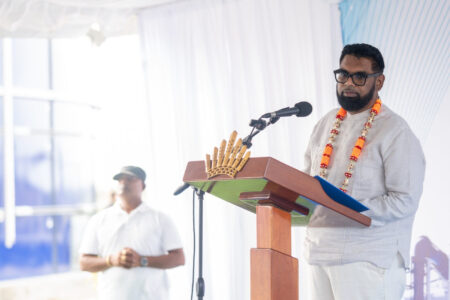
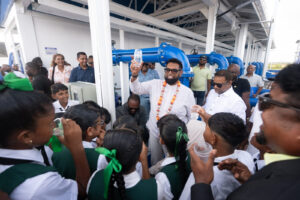
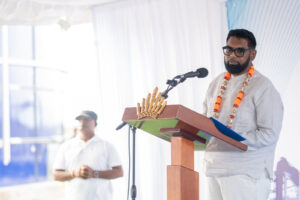





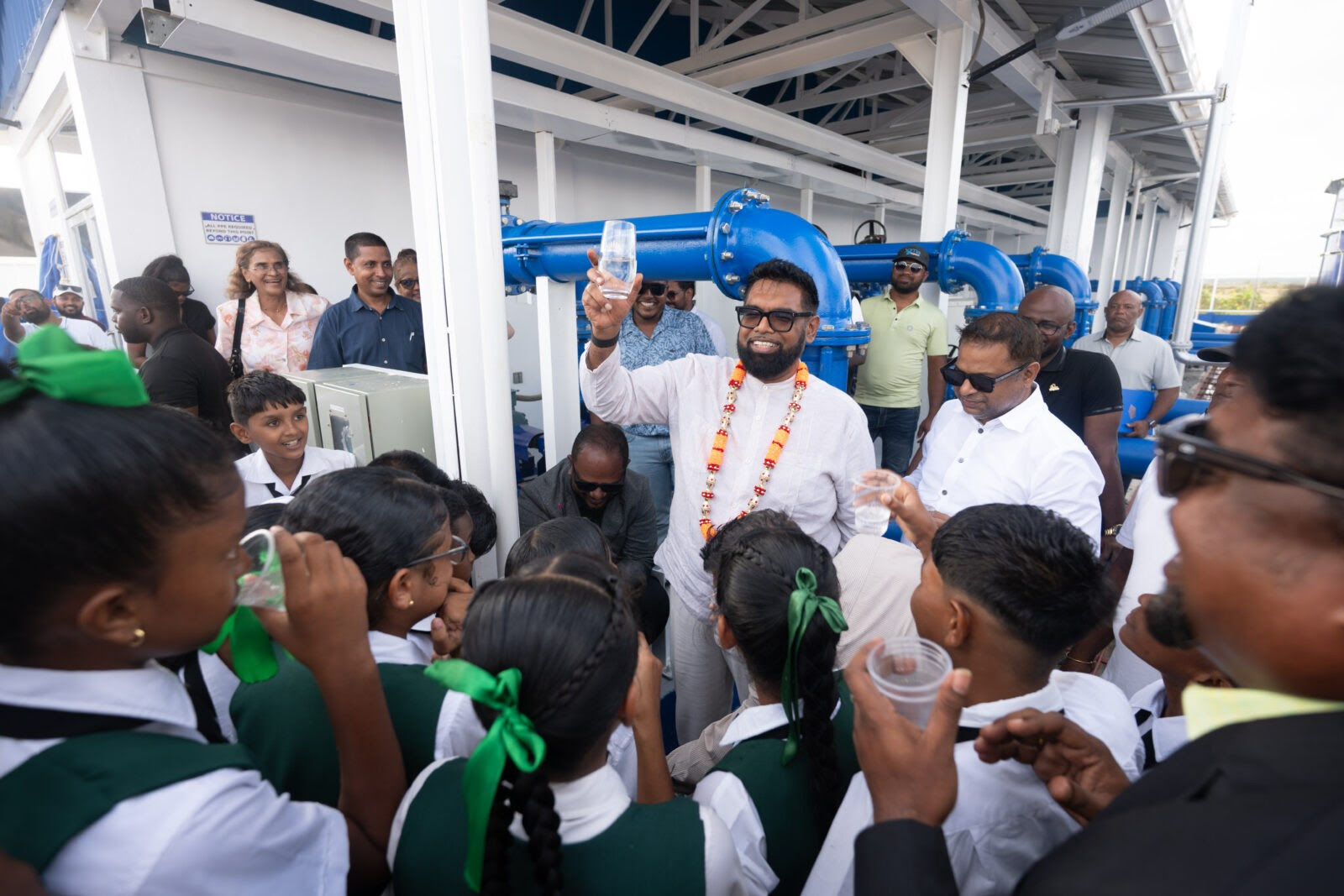
For years, families on Leguan island made do with whatever came out of the tap — often discoloured, sometimes foul-tasting, never quite right. That changed on Sunday, when President Dr Mohamed Irfaan Ali commissioned a brand-new $700 million water treatment plant that officials say is the most technologically advanced of its kind in the country.
The facility is the first in Guyana to feature an activated carbon filter tank, a system that strips out even the finest sediment, neutralises odours, and dramatically improves the taste and clarity of drinking water. It produces two million litres of treated water every single day — enough to serve Leguan’s roughly 3,300 residents and then some.
Guyana Water Incorporated Chief Executive Officer Shaik Baksh spelled out just how clean that water now is. Iron content in the treated supply currently measures 0.05 milligrams per litre — a figure that sits well below the World Bank’s safety guideline of 0.3. For a community that has historically struggled with water quality, the numbers tell a meaningful story.


But the infrastructure upgrades do not stop at the plant itself. Beginning in January, crews will begin laying new 8-inch transmission lines extending across the island, designed to push water pressure higher and ensure that every corner of Leguan receives consistent, treated supply — not just the areas closest to the facility.
Baksh also used the occasion to share a broader snapshot of where Guyana stands on water access nationally. In 2020, just 46 per cent of hinterland communities received a GWI water supply. That figure has since climbed to 95 per cent, and Baksh said the country will hit 100 per cent coverage next year. On the coast, coverage is approaching 80 per cent and is expected to reach 90 per cent shortly.
One detail from the ceremony stuck out. When Baksh spoke with Leguan residents, he learned that many are currently paying $700 for a single 5-gallon bottle of water. In response, he announced plans to establish a small water filling station on the island — a practical fix that would give families an affordable alternative while the broader distribution network is completed.
Minister of Public Utilities and Aviation Deodat Indar acknowledged that the construction process had not been without its inconveniences for the community, but said the disruption was unavoidable given the scale of what was being built. The finished product, he suggested, speaks for itself.
President Ali framed the investment in terms that went beyond pipes and filtration systems. “The success of this investment must be felt every time a family turns on its tap,” he said. “We want every Guyanese to have clean water, because it’s a matter of dignity.” Clean water, in his view, is not a luxury — it is a basic condition of a decent life, and one that the government intends to extend to every household in the country.
The Leguan plant is the first of five facilities slated to come online under the government’s Water Supply Improvement Project, meaning this is only the beginning. The island’s broader development plan also includes farm-to-market roads, drainage and irrigation upgrades, and an already-upgraded stelling. Government representatives are expected to return soon to consult with the community on whether to prioritise a drainage canal or an all-weather access road connecting Cane Field to Uniform.
Looking further ahead, President Ali said he hopes that with clean water and reliable power now in place, Leguan could soon host an agro-processing facility — one that would allow the island’s agricultural produce to be properly bottled and packaged, adding value locally rather than shipping raw goods off the island.
For the people of Leguan, Sunday was more than a ribbon-cutting. It was a signal that the island is being taken seriously.