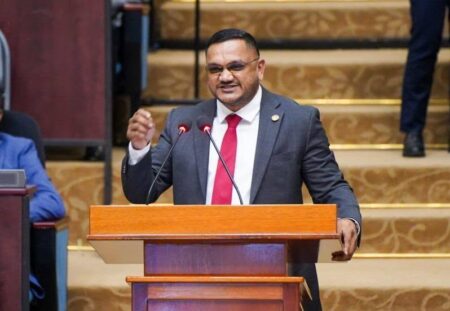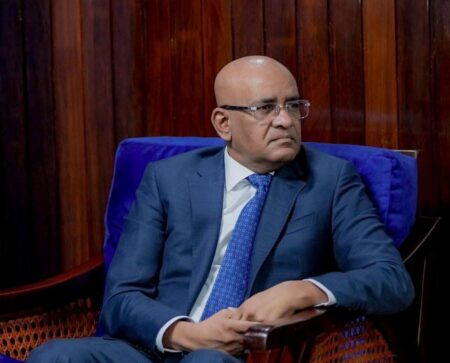









Vice President Dr Bharrat Jagdeo raised a few eyebrows at Thursday’s Guyana Manufacturing and Services Association awards ceremony when, responding to an audience question, he said the country may eventually need to consider nuclear power to keep its lights on for generations to come.
It was not a proposal for next year or even the next decade. But Jagdeo was clear that, in a country seriously planning its energy future, nuclear belongs in the conversation. “It is something we have to think about — because there are small, very safe facilities that could be built now, and we may have to consider it not just now but in 20 years, or even 30 or 40 years from now, if the gas doesn’t flow. We may have to think about nuclear because what do we substitute with? I think it’s a good idea,” he said.
The logic behind the remark is straightforward. Guyana’s immediate energy strategy centres on natural gas from the Stabroek Block to fuel the Gas-to-Energy plant at Wales. That project is expected to come online next year and will eventually add 600 megawatts of generating capacity in two 300-megawatt phases. Add roughly 100 megawatts of planned solar installations, and by 2030 the VP estimates Guyana’s total generating capacity will reach around 800 megawatts — a dramatic leap from the current 255 megawatts against a peak demand of 216 megawatts.
The government is also pursuing the Amaila Falls Hydropower Project, with a minimum installed capacity of 165 megawatts under a Build-Own-Operate-Transfer model. Bids are currently being evaluated, and financing support is being sought.
But Jagdeo was candid about the limits of renewable energy for meeting continuous, uninterrupted electricity demand. He noted that wind and solar cannot reliably serve as baseload power sources without expensive battery storage systems. Even hydropower, traditionally considered baseload, becomes variable during droughts and with shifting weather patterns. By contrast, nuclear and fossil fuel plants can generate electricity steadily around the clock regardless of weather conditions.
That is the gap nuclear could eventually fill — not today, but in the decades when Guyana’s gas reserves may be declining, and the country needs a stable anchor for its electricity system. Thirty-two countries already operate commercial nuclear plants, which together supply roughly nine per cent of the world’s electricity. Modern small modular reactors have made the technology more accessible and considerably safer than the large-scale plants of previous generations.
In the near term, though, the focus is squarely on getting the existing projects built and ensuring the grid can carry what they produce. And that last part, Jagdeo made clear, is an enormous undertaking in itself.
He told the gathering that modernising and expanding Guyana’s electricity transmission and distribution network will cost nearly US$5 billion. The need is clear: Guyana Power and Light’s customer base has grown from 184,000 in 2019 to 231,000 today, driven by rising household incomes, more appliances, the spread of air conditioning, and a booming business sector. The existing infrastructure was simply not built to meet that level of demand.
The upgrade comprises two major components. The transmission backbone — the high-voltage lines that carry power over long distances — is estimated to cost about US$2.3 billion. Contracts for sections of the backbone have already been awarded, including a $422 million contract for infrastructure extending toward the West Bank Demerara area and another worth about $160 million for works reaching toward Kurupukari. The distribution side — the local networks that deliver power to homes and businesses — will require an additional US$2.5 billion, including replacing transformers and upgrading roughly 1,500 kilometres of network lines.
Taken together, Guyana’s energy agenda for the coming years is ambitious: complete the Gas-to-Energy plant, expand solar capacity, advance Amaila Falls, overhaul the transmission and distribution network, and — further down the road — begin a serious conversation about nuclear. For a country that was running on diesel generators and experiencing chronic blackouts not long ago, the ambition is striking. So is the price tag.