





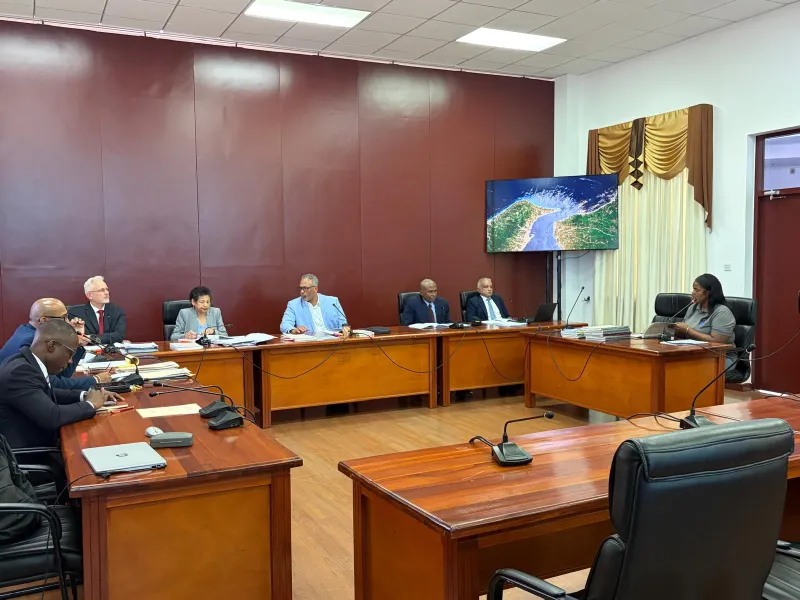
The woman who documented cargo before it was loaded onto the MV Barima has now appeared before the Presidential Commission of Inquiry three times, each time bringing more records and raising more questions about how the vessel’s paperwork was handled in the days before it sank.
Kessa Case, a Clerk III at the Kingston Wharf with the Transport and Harbours Department, spoke quietly as commissioners worked through the details of a handwritten, layered system that governs what gets loaded onto vessels bound for Region One.
The process, as she described it, is straightforward in principle. Cargo arrives at the bond in the days before departure. The checker examines it, records it in a ledger, and issues the customer a slip. The customer takes that slip to the cashier, pays, and comes back with a receipt. The checker notes the receipt number — and only after that is the cargo permitted to be loaded. Different categories of cargo, such as general goods, bags and gas, and perishables, are recorded in separate slip books, with each type arriving on a designated day set by the superintendent.
In practice, however, the system has gaps. Commissioners examining the slip books found multiple entries that carried a slip number but no corresponding receipt number. Case explained that customers do not always return with proof of payment. In those cases, she said, she checks the manifest to determine whether payment was made. For at least one customer, she assumed payment would be collected at Port Kaituma — and under questioning, she acknowledged she did not actually know how the payment process worked at that end.
She also confirmed that cargo can sometimes be loaded before payment is received.
There is a separate procedure for regular customers moving goods from Georgetown to Barima-Waini who are not physically present at the wharf. For these customers, a “to pay” list is prepared — a handwritten collective sheet that goes to the cashier and then to head office — indicating that payment will be collected at the destination, before the cargo leaves the bond on the other side. Case produced earlier versions of these lists, some of which marked individual items as paid or unpaid.
No such list was prepared for 18 July — the day the MV Barima sank. Case said the day was extremely busy, the hours slipped by, and then the tragedy happened. She could not recall any other occasion on which the list had been skipped.
Two other details drew particular attention from commissioners. Case acknowledged removing a carbon-copy page that sat immediately before her first entry dated 14 July. She said she had no specific reason for doing so and that carbon copies are generally discarded. When commissioners inspected the book, the page following the removed one was numbered one, with no visible sign of alteration. Case also corrected a statement she had made on her second appearance, saying that her claim to have worked on 13 July was an error — she began on the 14th.
On her third appearance, late on Friday, Case returned to the commission with additional records, including slip books and past “to pay” lists. She also agreed to provide the WhatsApp communications shared among the checkers. Commissioners asked her to return when the inquiry resumes next week.
The Presidential Commission of Inquiry continues on Monday.