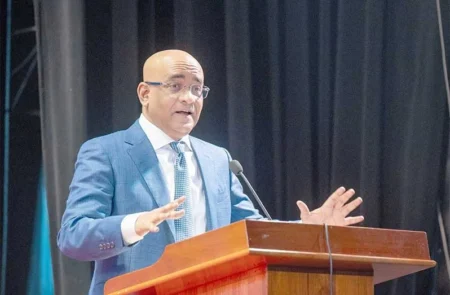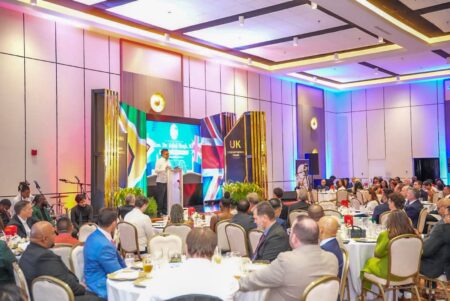
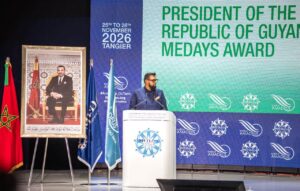





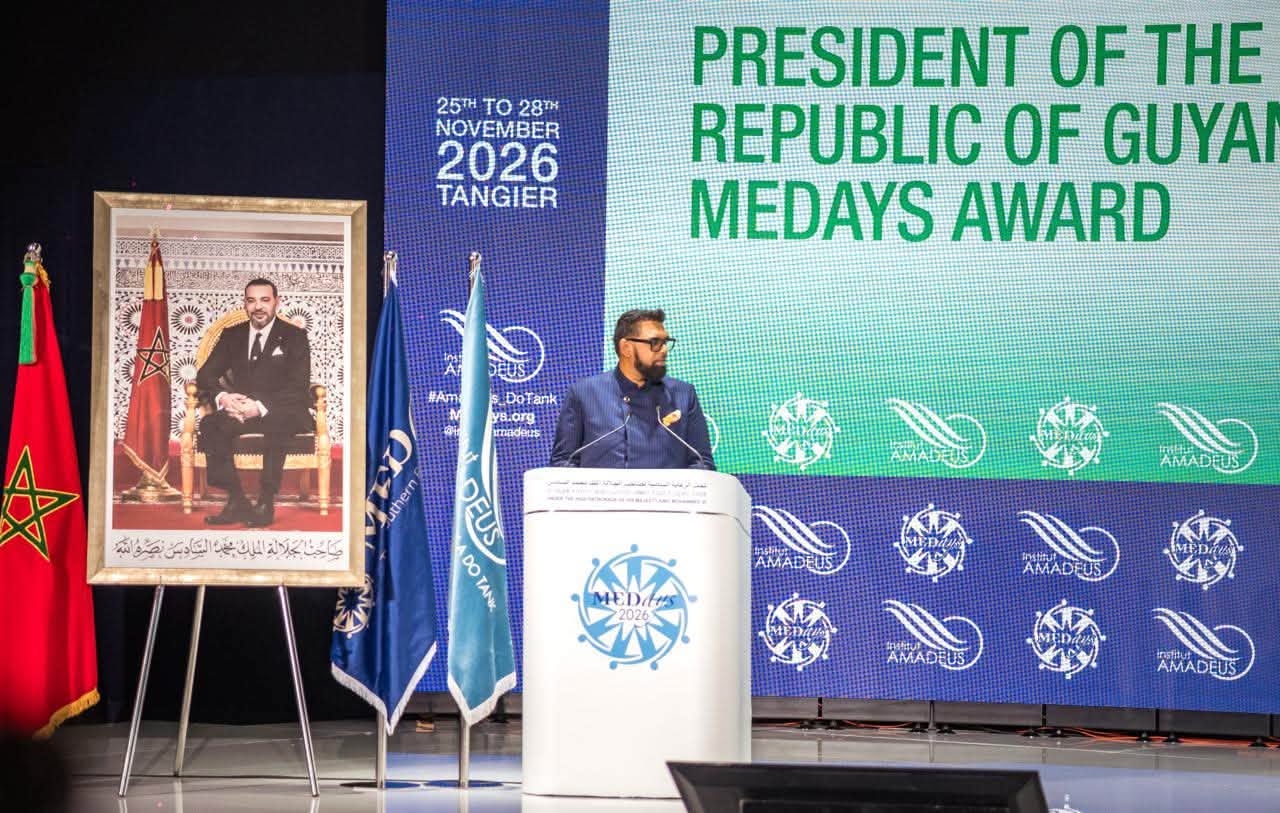
Standing before a high-level international gathering in Morocco, President Dr Irfaan Ali made the case for something that might have seemed ambitious just a few years ago: a direct port-to-port partnership between Guyana and Tanger Med, Africa’s largest harbour, as part of a broader vision to reshape how goods flow between Latin America, the Caribbean, and the African continent.
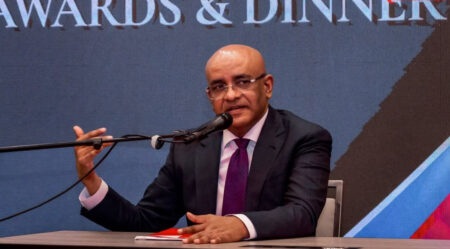
The President spoke at the MEDays International Forum’s Special High-Level Session on Thursday, themed around building a South Atlantic bridge between Africa, the Caribbean, and Latin America. He used the platform to lay out a concrete commercial case for running that bridge, in part, through Guyana.
The numbers he presented were specific and striking. Northern Brazil — the region that Guyana’s planned Berbice deep-water port is designed to serve as a trade gateway — exports roughly US$350 million in soybeans, beef, poultry, and sugar between 2025 and 2026. Meanwhile, Morocco’s trade relationship with Brazil has grown from US$2.6 billion in 2025. These are not abstract flows — they are real commerce already moving between the two regions.
Ali’s argument was straightforward: if even a fraction of that trade were rerouted through an integrated port corridor linking Guyana and Tanger Med, both countries would benefit. “Now, if we reroute 20 per cent of that through the interconnectivity of your port and ours, you will not only save time but also reduce transport costs with the deep-water port we are building,” he told the audience. “But unless we integrate the infrastructure and the project, we will not be able to scale up and benefit from the competitive advantage each of us offers.”
The visit to Morocco was not purely diplomatic. President Ali received a guided tour of the Tanger Med complex, which connects to more than 180 ports worldwide and serves as a model of integrated port and industrial development at scale. During the visit, in a social media post, he described Morocco’s experience as offering “valuable insights into port development, logistics, industrial integration and global trade connectivity” as Guyana advances its own plans.
Those plans are already underway. The US-based Bechtel Corporation has been contracted by the government to conduct a feasibility assessment for a deep-water port at the mouth of the Berbice River in Region Six. Once the study is complete and presented to the President, the government will consider issuing an Expression of Interest to gauge interest from local and foreign investors.
Beyond ports, President Ali used his address to push a broader argument that he has been making with increasing frequency: that countries in Latin America, the Caribbean, and Africa need to stop operating in isolation and start building genuinely integrated systems if they want to compete in a world that rewards scale.
“I believe we need to revisit how we operate and shift from an isolated policy agenda to a more integrated, project-based agenda,” he said, calling for deeper links not only in trade and infrastructure but also in education, healthcare, and financial systems. He pointed to the AfriExim Bank, the Caribbean Development Bank, and CAF — Latin America’s development bank — and asked why these institutions are not working together more deliberately to mobilise capital and crowd in private investment.
He also identified an implementation deficit as one of the most persistent problems holding these regions back — a gap in technology, human capital, and industrial capacity that prevents countries from turning good intentions into actual outcomes. And he drew on the COVID-19 pandemic as a reminder of what that gap costs: “If we cannot operate with scale and if we cannot build a logistics system that is integrated, then we can be easily locked out from the rest of the world.”
On natural resources, Ali was blunt about the paradox these regions face. Latin America, the Caribbean, and Africa collectively hold the minerals, forests, biodiversity, and climate assets the rest of the world urgently needs. “We possess it, we possess human capital, but we lack the ability to transform our raw natural assets into high-value assets that will allow us to optimise the benefits from what we have,” he said.
The speech aligned with a message Ali has been delivering across the MEDays forum: that this moment calls for these regions to trust themselves, leverage their own capital, and stop waiting for the rest of the world to unlock their potential. In that sense, the deep-water port partnership with Morocco is more than a logistics proposal. It is a proof of concept for a different kind of South-South relationship — one built on complementary strengths rather than historical dependency.