







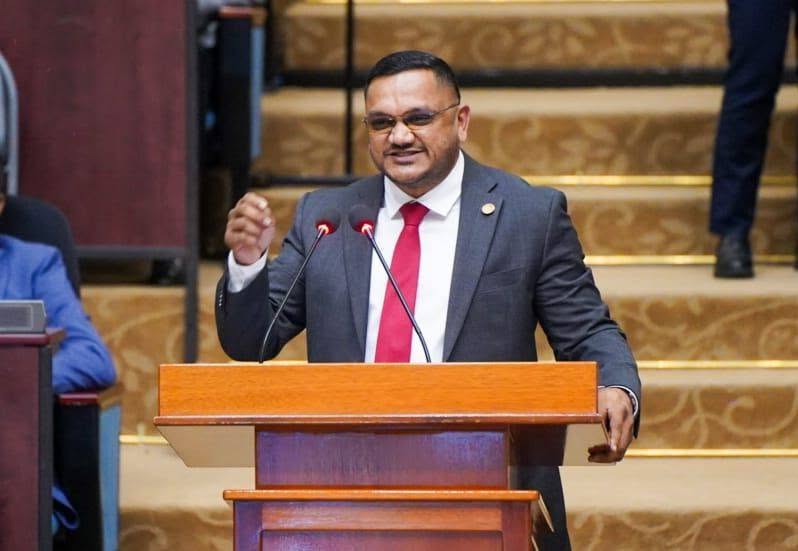
Investor interest in building an oil refinery in Guyana is real — but Minister of Natural Resources Vickram Bharrat says none of it can move forward until the country resolves a more fundamental problem: its rivers are simply not deep enough to handle the kind of tankers a refinery would require.
Speaking on the Starting Point podcast on Saturday, Minister Bharrat was direct about the constraint. He said Guyana’s waterways have a draft of around seven to eight metres at high tide — enough for smaller vessels but nowhere near enough for the large commercial tankers that move crude oil in the volumes a refinery would need. “We grew up thinking these rivers are deep, but unfortunately they’re not, especially for commercial activities,” he said.
The logic follows. A refinery needs crude coming in and refined products going out. If the vessels carrying those cargoes cannot physically enter Guyana’s waterways, an investor is left shuttling product on smaller boats — a move that dramatically increases costs and quickly kills the project’s economics. “If you think about it logically, you can build a refinery, but how will you get the crude into Guyana? How will you get the refined products out? And if you’re going to shuttle it with smaller vessels, it increases your cost,” the minister said. “You have to look at all these factors when you’re deciding on an investment, especially of this magnitude.”
As Minister Bharrat sees it, the solution is tied entirely to one project: the planned deep-water port at the mouth of the Berbice River in Region Six. “Without that port, it would be difficult for an investor to set up a refinery in Guyana. Basically, it’s tied to that project,” he said plainly. “I would say that we will be ready as soon as we make a decision on the deep-water port.”
That decision is still pending. US-based Bechtel Corporation has been contracted to conduct a full feasibility assessment of the Berbice deep-water port. Once the study is complete and presented to President Dr Irfaan Ali, the government will consider issuing an Expression of Interest to gauge interest from local and foreign investors. After that, Bharrat said, the government will seek an investor to begin construction based on Bechtel’s proposed design.
The refinery conversation has been simmering for some time. Since February 2025, the government has been in ongoing talks with US-based Curlew Midstream about refining and storage arrangements, but no deal has been finalised. A 2023 Memorandum of Understanding with the Dominican Republic also includes provisions for a 50,000-barrel-per-day refinery in Guyana. The deep-water port itself sits within a broader cluster of transformational projects planned for East Berbice-Corentyne — including a new stadium, a shopping mall, a four-lane highway from New Amsterdam to Moleson Creek, and a transmission line to support potential electricity exports from a second gas plant in the region.
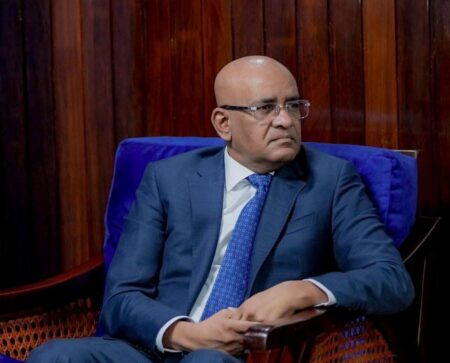
Beyond the refinery question, Vice President Dr Bharrat Jagdeo recently revealed that the government is also considering another option: a large national strategic fuel reserve. Rather than processing crude locally, this approach would involve stockpiling large volumes of fuel to insulate Guyana from price swings and supply disruptions. Currently, the country’s reserve capacity covers roughly six to eight weeks of consumption. Dr Jagdeo said expanding that to as much as eight months could allow Guyana to buy in bulk when prices are low, potentially cutting costs by 20 to 30 per cent. “Even if you have a hurricane or you have up-and-down prices, you can draw on that,” he said.
Whether the answer turns out to be a refinery, a strategic reserve, or some combination of both, the deep-water port at Berbice remains the common thread. Until that piece is in place, the bigger questions around what Guyana does with its own oil stay largely theoretical.