






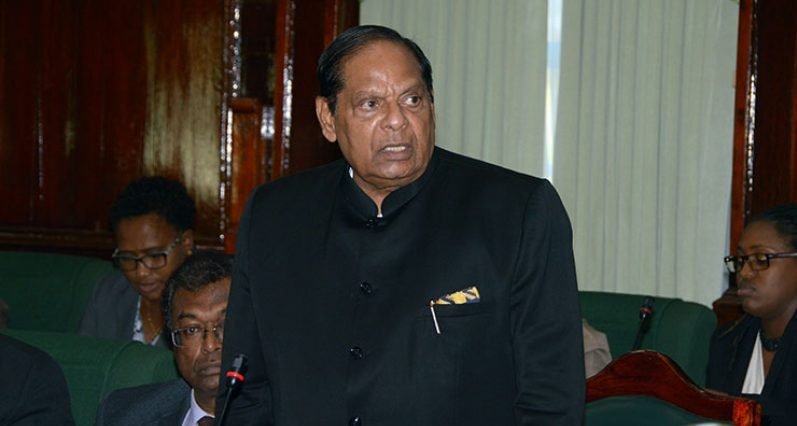
After years away from the centre of Guyana’s political discourse, former Prime Minister Moses Nagamootoo has resurfaced with a poem, “Don’t Tell Me,” in which he uses verse to criticise what he sees as the country’s political and economic direction. The poem has now opened the door to a much larger question: what exactly did Nagamootoo achieve when he had the opportunity to shape Guyana’s future?
Nagamootoo’s political career is certainly long. He entered the PPP as a young man, became a parliamentarian in 1992, served in Cabinet, and eventually became Prime Minister and First Vice-President under the APNU+AFC administration from 2015 to 2020. Parliament’s own biography confirms that he left the PPP in 2011 and joined the AFC. But longevity in politics should not automatically be confused with achievement. After decades in public life and five years as the country’s second-highest political office-holder, Guyanese are entitled to judge the results rather than the résumé.
And that is where the “Don’t Tell Me” poem becomes particularly vulnerable to criticism. Nagamootoo now writes about oligarchy, greed and Guyana’s direction. Still, his critics can quite reasonably respond: don’t tell us what is wrong with Guyana without first accounting for the years he was in government.
The former Prime Minister was not an outsider observing the government from afar. He sat at the Cabinet table. He was part of the administration that governed Guyana between 2015 and 2020. Therefore, when he now returns to lecture the country through poetry, the public has every right to scrutinise his record.
One of the most consequential issues from that period was the sugar industry. Several estates were closed under the APNU+AFC administration, a decision that caused deep concern among sugar-producing communities. Nagamootoo himself defended the closures, arguing that estates including Skeldon, Canje, Rose Hall, LBI and Enmore were no longer viable as producing estates. Whether one agrees with the economic reasoning or not, Nagamootoo cannot now pretend that the consequences of those decisions were someone else’s responsibility. He was part of the government that made them.
The political record surrounding the 2020 elections also remains part of his legacy. The election triggered a prolonged constitutional and political crisis, ultimately leading to the PPP/C’s return to government. Nagamootoo has continued to express his view on the legitimacy of the 2020 outcome, but it remains deeply contested in Guyana’s political history.
Then there is the story of Nagamootoo’s departure from the PPP. He had spent decades in the party and served under several PPP administrations. His political ambitions and his relationship with the Jagan leadership have long been subjects of debate. What is beyond dispute is that Janet Jagan resigned as President in 1999 and announced that Bharrat Jagdeo would succeed her; Jagdeo was subsequently sworn in as President.
For Nagamootoo, that succession became a significant chapter in his political journey. He eventually left the PPP in 2011 and joined the AFC. However, one important correction to the popular narrative is that Nagamootoo did not found the AFC. The Alliance for Change was established in 2005 by Khemraj Ramjattan, Raphael Trotman and Sheila Holder. Nagamootoo joined the party in 2011, after leaving the PPP.
That distinction matters because Nagamootoo’s political story is often presented as if he single-handedly created the alternative political movement that eventually entered government. The historical record is more complicated.
There is also a question of identity that deserves careful attention. Nagamootoo is widely documented as being of Tamil Indian descent, with historical accounts tracing his family roots to Indian immigrants from the Madras region of South India. Critics have, at various times, questioned whether he has fully embraced or acknowledged that ancestral background, particularly when compared with the great pride many Indo-Guyanese express in their Indian heritage, including roots in regions such as Bihar and Uttar Pradesh. In Guyana, where Indian ancestry forms an important part of the nation’s history and cultural identity, there is nothing wrong with having a complex personal or cultural identity. However, politicians, like anyone else, can legitimately be questioned about how they acknowledge and present their ancestry, especially when their public statements intersect with the history, identity and experiences of the wider Indo-Guyanese community.
What should not be done, however, is to turn ancestry into an insult. Nagamootoo should be judged on his political choices, not on whether he identifies strongly with one aspect of his heritage.
That brings us back to the poem.
There is something almost ironic about a former Prime Minister emerging after years of political quietude to warn Guyanese about the country’s problems through a poem. At the same time, much of the public discussion about his own tenure centres on what his government did, what it failed to do, and how little political influence he appeared to exercise within the coalition.
A poem can be clever. A poem can be provocative. A poem can even be a powerful political weapon. But poetry does not erase a political record.
If Nagamootoo wants to re-enter the national conversation, he should be prepared for Guyanese to revisit the entire story: his decades in the PPP, his disappointment with the party’s leadership, his departure, his role in the AFC, his years in the APNU+AFC administration, the sugar-estate closures, the 2020 electoral crisis, and his eventual disappearance from frontline politics.
That is the uncomfortable question raised by his latest literary intervention: after all those years in politics, what enduring achievement can Guyanese point to and say, “This was Moses Nagamootoo’s contribution to the country”?
His defenders may have answers. His critics certainly have theirs. But calling attention to today’s problems does not automatically absolve yesterday’s decisions.
Nagamootoo may have returned with “Don’t Tell Me.” But Guyanese can reasonably respond with their own version: Don’t tell us what he saw from the sidelines. Tell us what he changed when he sat at the table. Tell us what he delivered when he had power. And tell us why, after decades in national politics, his political legacy remains so heavily debated. It is fair to say that Nagamootoo has left no mark on Guyana’s history.