






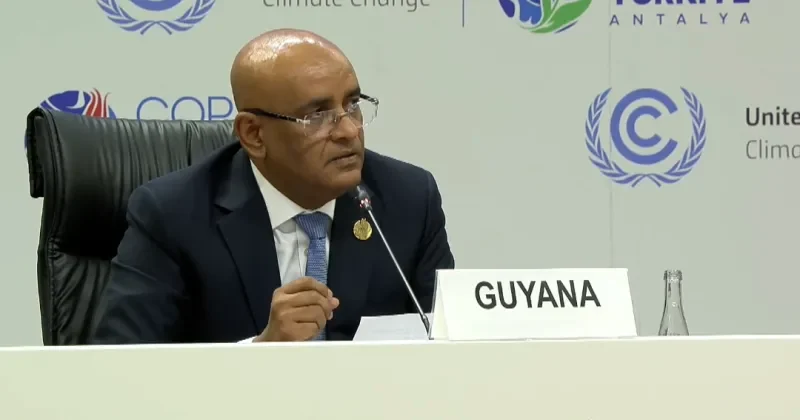
At this week’s COP31 climate summit in Istanbul, Guyana’s Vice President Dr. Bharrat Jagdeo made a case that the world’s leaders have been dancing around for years: if you want countries to protect their forests, you have to actually pay them to do it.
“The key to faster progress is finance,” he told the room — a gathering co-hosted by Guyana, Brazil, Norway, the Republic of the Congo, and the United Kingdom, with UN Secretary-General António Guterres and Turkish President Erdoğan both on hand.
It wasn’t an abstract argument. Jagdeo was speaking from nearly two decades of experience.
Back in 2007, when he was still president, Jagdeo made a bold pitch to the international community: Guyana would protect almost its entire rainforest — which covers roughly 85 percent of the country — if the world was willing to foot some of the bill. Norway took him up on it, pledging up to $250 million. That partnership eventually grew into Guyana’s Low Carbon Development Strategy, and later expanded into carbon markets.
The results have been striking. In 2022, Guyana became the first country ever to earn carbon credits for protecting its forests on a national scale. American oil giant Hess — now part of Chevron — signed on to buy at least $750 million worth of credits over ten years. More than 30 airlines have followed suit. By 2026, the program is expected to bring in over $100 million in a single year.
Meanwhile, Guyana’s deforestation rate has held at around 0.04 percent — one of the lowest in the world. And it’s not just an environmental story. A fifth of all carbon credit revenue goes directly to the country’s 252 indigenous communities, which have used that money to fund more than 3,000 local projects over the past four years.
Standing before world leaders, Jagdeo laid out four things he said were needed to replicate this model elsewhere: political will at the top, clearer rules in carbon markets, steady international partnerships, and more varied ways to channel money to forest-rich nations. He pointed to Brazil’s President Lula as an example of the kind of head-of-state engagement that makes a difference.
He also had pointed words for Europe, criticizing delays in rolling out CORSIA — the international aviation carbon scheme that lets airlines offset emissions using eligible credits. For countries like Guyana, those slow-moving frameworks create real uncertainty. “We cannot ask forest countries to make long-term commitments while leaving uncertain the international frameworks on which they rely,” he said.
His broader message was straightforward: forest conservation doesn’t have to be a sacrifice. It can be an economic strategy — but only if the international community is serious about paying for the services these ecosystems provide to the whole planet.
With the global deadline to halt deforestation by 2030 looming, Guyana’s story offers something rare in climate talks — an example that actually works.