






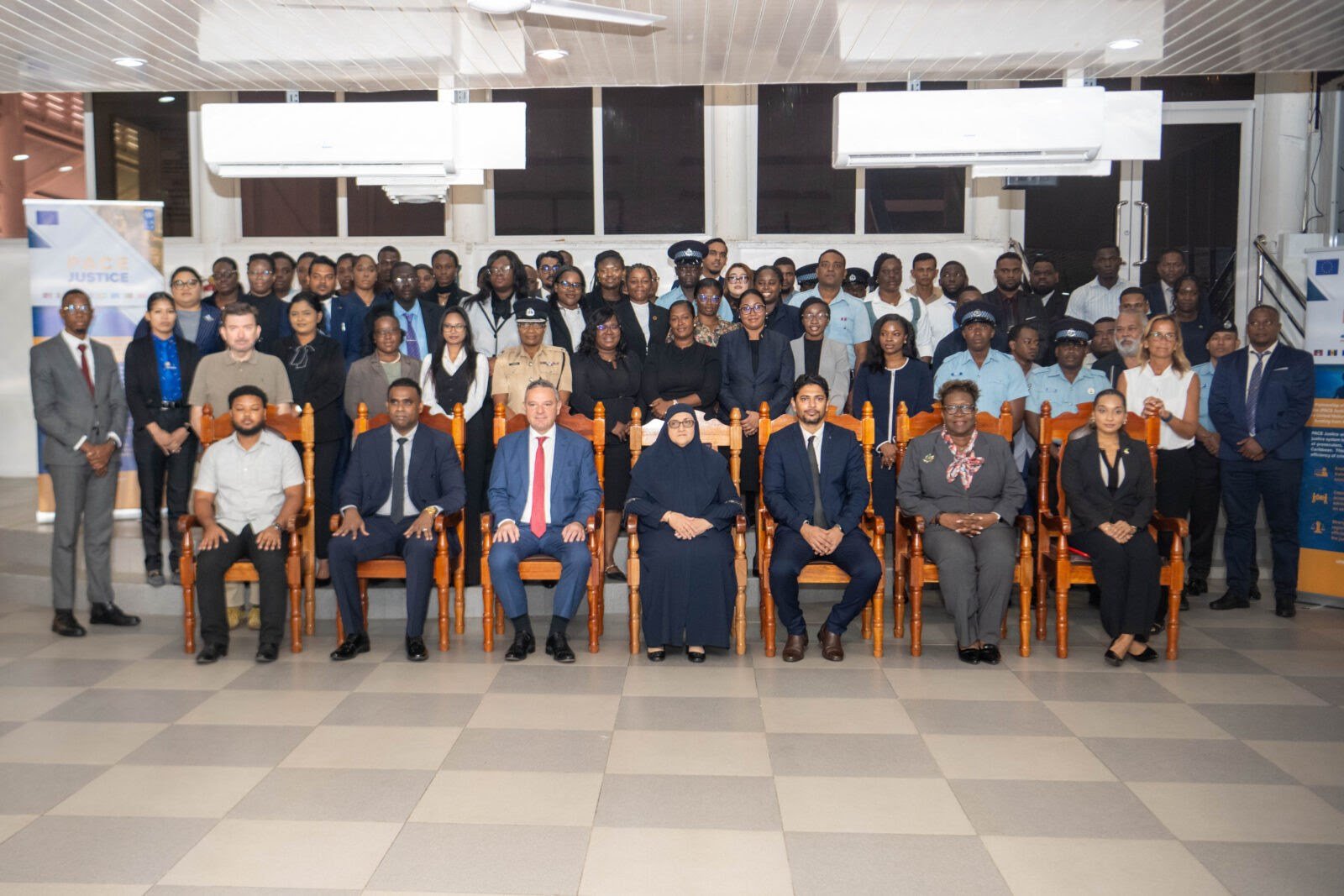
Investigators and prosecutors are being equipped with new tools and strategies to strengthen criminal investigations and prosecutions as Guyana continues efforts to modernise its justice sector.
The two-day training for the Joint Director of Public Prosecutions (DPP) and the Guyana Police Force, which opened on Thursday at the Police Officers’ Mess, Eve Leary, is being conducted under the Partnership of the Caribbean and the European Union (PACE) on the Justice Project.

The training focuses on strategic planning between investigators and prosecutors, best practices in criminal investigations, inter-agency protocols, victim-centred witness care, evidence management and collaborative approaches to case preparation.
Director of Public Prosecutions Shalimar Ali-Hack said the programme forms part of a broader effort to ensure all key actors within the justice system are working towards the same objective.

“When they met with me, I asked for the judiciary and the prosecution to be trained alike, because if the judiciary and the prosecution, which includes the investigators, are not operating from the same perspective or singing from the same hymn book, we will not make progress in the courts with the cases,” she stated.
The director credited the European Union and the United Nations Development Programme (UNDP) for adopting a holistic approach to criminal justice reform that has included legislative changes, technological support and specialised training.
Crime Chief, Deputy Commissioner of Police, Wendell Blanhum, emphasised that stronger cooperation between law enforcement and prosecutors is essential to delivering justice and maintaining public confidence.

“The Partnership of the Caribbean and the European Union on the Justice Regional Programme aims to strengthen institutional capabilities, cooperation and collaboration among our key stakeholders,” he said.
The crime chief explained that while investigators often face criticism when cases are dismissed, many challenges stem from broader systemic issues, including witnesses who are reluctant to testify or difficult to locate.
“That is why a multifaceted approach is absolutely essential to ensure the criminal justice system remains efficient and effective. Today’s gathering is a testament to that approach,” he stated.
Meanwhile, Officer-in-Charge of UNDP Guyana, Dhiraj Singh, described the initiative as a strategic investment in strengthening the justice system.

“What we begin this morning is more than a training. It is an investment in stronger investigations, sounder prosecutions and ultimately better access to justice for the people of Guyana,” Singh stated.
He noted that through the PACE Justice Project, justice sector agencies in Guyana have benefited from specialised equipment, digitisation support and capacity-building programmes designed to improve efficiency and service delivery.
Chargé d’Affaires of the European Union Delegation to Guyana, Spiros Polycandriotis-Van Duynhoven, said the training’s practical focus will help participants translate lessons into improved investigative and prosecutorial outcomes.

“What sets this training apart is its strong operational focus, ensuring that participants gain practical, actionable skills that can be immediately applied in their work,” the EU representative added.
The PACE Justice Project, funded by the European Union and implemented by the UNDP, supports criminal justice reform initiatives across eight Caribbean countries, helping to reduce case backlogs, strengthen institutions and improve access to justice.