






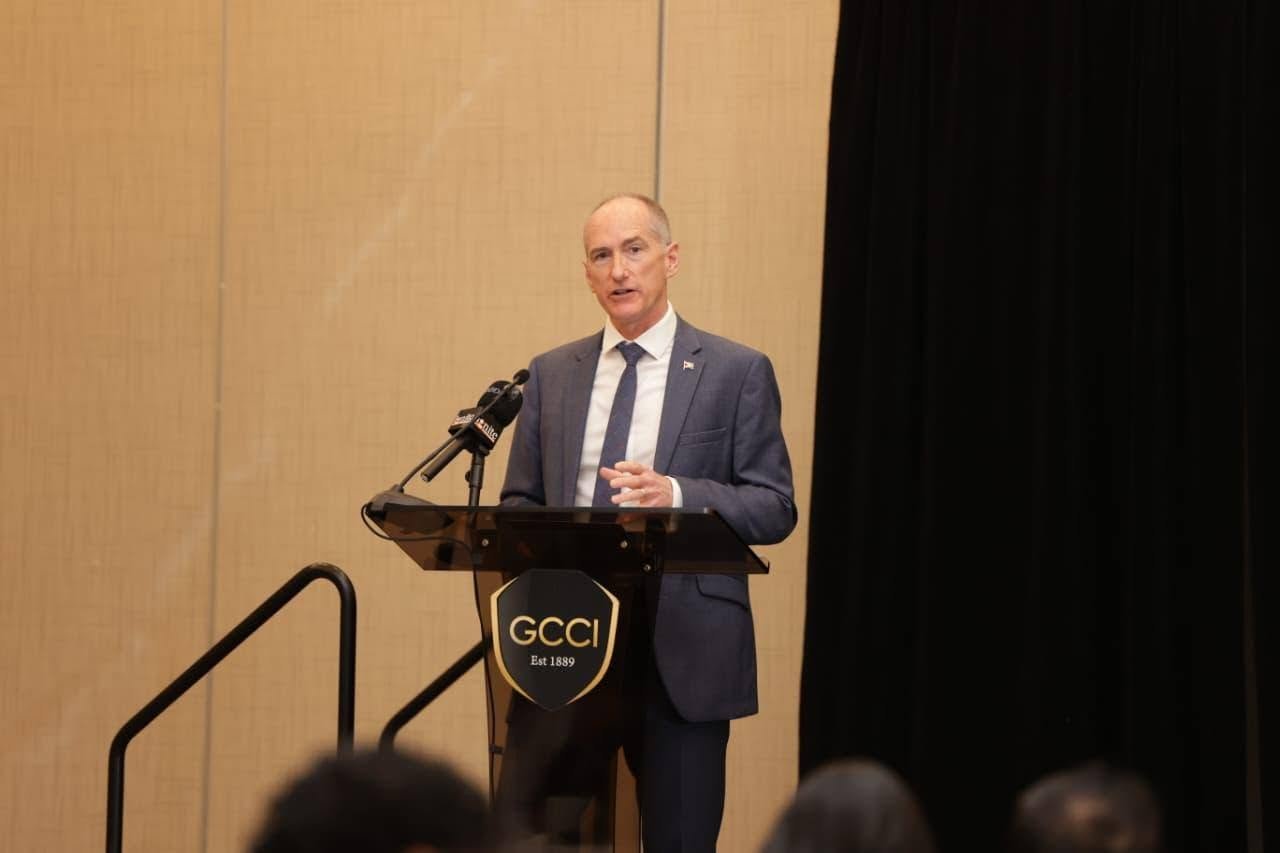
ExxonMobil Guyana President Alistair Routledge has called for greater private-sector involvement as Guyana prepares to enter a new stage of energy development, particularly the expansion and commercialisation of its natural gas resources.
Speaking at the Georgetown Chamber of Commerce and Industry (GCCI) Energy Luncheon on Thursday, Routledge said Guyana must ensure that its finite oil and gas resources translate into lasting economic opportunities and tangible benefits for its citizens.
He said the country is entering this new phase from a much stronger position than when oil was first discovered offshore in 2015.
According to Routledge, Guyana had limited infrastructure and capacity to support a modern offshore petroleum industry at the time of the discovery. More than a decade later, the country has developed major shore-based facilities, a broader industrial ecosystem and a growing network of local companies capable of supporting increasingly sophisticated offshore operations.
He said these developments provide a foundation for Guyana to build its next generation of energy-related industries.
Routledge pointed to the development of Guyanese human resources as one of the industry’s most significant changes.
He said Guyanese now make up more than 70 per cent of the workforce supporting oil and gas activities in the country.
Women have also become a major part of ExxonMobil Guyana’s local workforce, he noted, with women representing more than half of the company’s Guyanese employees.
Routledge described female participation as particularly notable in an industry that has traditionally been heavily male-dominated.
He also highlighted the progress made by domestic companies, many of which have partnered with international firms, brought specialised expertise to Guyana, and invested in their own equipment, facilities and operational capabilities.
In his view, the combination of local skills, infrastructure, business experience and international partnerships provides a stronger platform for Guyana to pursue further opportunities in the energy sector.
As the country considers how best to develop its natural gas resources, Routledge said private-sector organisations will play an important role in ensuring Guyanese businesses are positioned to participate.
He identified the GCCI, the Private Sector Commission and business chambers in Berbice as potential facilitators between international investors, companies with specialised technical expertise, and domestic businesses seeking opportunities.
Routledge said these organisations can help ensure investors with the required capital and expertise can establish operations in Guyana, while also creating pathways for local companies to participate in the emerging gas industry.
He acknowledged that developing a natural gas sector will pose its own challenges. Still, he pointed to Guyana’s rapid transition to an oil-producing nation as evidence of what can be achieved when government, businesses and other stakeholders collaborate.
Routledge highlighted the rapid expansion of Guyana’s offshore industry since the 2015 discovery.
He noted that production progressed from the initial discovery to first oil in about four and a half years, then increased to around 900,000 barrels per day. He also projected that production could reach approximately one million barrels per day by the end of this year.
He said such rapid growth is unusual internationally and reflects the scale of transformation in Guyana’s energy sector.
Routledge credited the Government, private companies, business organisations and educational institutions for helping to build the skills, infrastructure and institutional capacity required to support the industry.
As Guyana looks beyond its current oil production activities and towards natural gas and other energy opportunities, he said the country will need continued cooperation among all stakeholders.
ExxonMobil Guyana, he added, remains prepared to support that process.
“Guyana’s map is going to be unique,” Routledge said, stressing that while other countries have developed natural gas industries, Guyana will have to develop an approach suited to its own circumstances and opportunities.