







Vice President Dr Bharrat Jagdeo says government interventions have helped Guyana keep inflation comparatively lower than regional and global averages, despite rising public expenditure, increased private-sector investment and international price pressures.
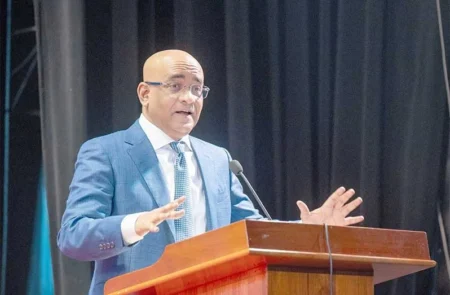
Speaking at the Guyana Manufacturing and Services Association (GMSA) annual awards and dinner at the Marriott Hotel in Kingston, Georgetown, on Thursday evening, Jagdeo referenced International Monetary Fund (IMF) statistics covering the period from 2019 to 2026 to support his assessment of the country’s inflation performance.
He said Guyana’s inflation rate remained below the global average and the average for Latin America and the Caribbean throughout the period he referenced, describing this as a significant achievement amid the country’s rapid economic expansion.
Rising Government Spending and Economic Activity
Jagdeo explained that government expenditure has increased nearly fourfold, with a significant portion of this year’s budget being financed through domestic borrowing.
He said oil revenues cover approximately 40 per cent of the 2026 budget, while the remaining 60 per cent must be financed through other sources, including domestic borrowing, which can contribute to inflationary pressures.
The Vice President also pointed to the expansion of private-sector investments and increased access to credit as factors contributing to greater spending and demand across the economy.
In addition, he noted that Guyana continues to face imported inflation pressures arising from higher international commodity prices and freight costs.
Real Estate Prices Also Contributing to Inflationary Pressures
Jagdeo identified the sharp increase in real estate prices, particularly in Georgetown, as another factor affecting the country’s economic environment.
He pointed to the high prices of land in the capital, noting that some properties have reached valuations that he believes are disconnected from underlying economic fundamentals.
According to the Vice President, these combined pressures make managing inflation increasingly challenging, particularly as the economy continues to grow rapidly and demand for goods, services, construction materials and property expands.
Government Measures to Contain Inflation
Jagdeo attributed the government’s efforts to contain inflation to several targeted interventions designed to reduce the costs faced by households and businesses.
These measures include:
-
Lower mortgage interest rates to ease borrowing costs for homeowners.
-
Electricity subsidies to prevent increases in consumers’ electricity bills.
-
Removal of the fuel excise tax to cushion consumers and businesses against fuel-price pressures.
The Vice President said the government is seeking to balance continued investments in infrastructure, development and economic expansion with measures aimed at protecting consumers from rising prices.
He acknowledged that inflation remains a challenge but said the administration intends to continue addressing price pressures without relying exclusively on conventional economic tools that could slow development and investment.
The government, he said, will continue pursuing interventions aimed at maintaining economic growth while limiting the impact of inflation on Guyanese households.