








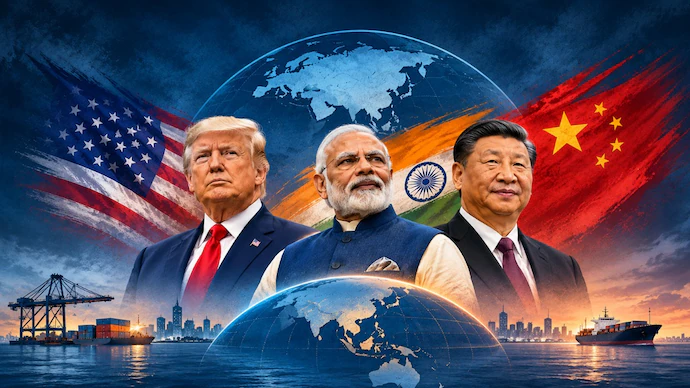
The 2026 report by Australia’s Lowy Institute places the United States, China and India among Asia’s three most powerful countries, with India strengthening its position despite economic challenges. Prime Minister Narendra Modi has also been ranked as the region’s second-most effective leader, behind Chinese President Xi Jinping.
India recorded an overall power score of 40.5 points, improving from 40 points in 2025. The United States secured the first position with 78.9 points, followed by China with 73.6 points. Japan ranked fourth with 38.6 points, while Russia occupied fifth place. The rankings highlight India’s growing importance in the regional balance of power.
The report noted that the gap between India and China has narrowed to its lowest level since the Asia Power Index was first introduced in 2018. However, China continues to maintain a significant advantage, with its overall power estimated to be around 80 per cent higher than India’s. Despite this difference, India’s improving performance reflects its expanding economic, diplomatic and strategic presence across the region.
Prime Minister Narendra Modi’s position also received significant attention in the report. He climbed three places to become Asia’s second-most effective regional leader, behind Chinese President Xi Jinping. The improvement reflects stronger expert assessments of his regional leadership and the continuity of India’s foreign policy approach. However, the report also pointed to a decline in perceptions of his global leadership and strategic ambition during the year.
India’s diplomatic influence remained its strongest area, scoring 70.3 points. The country also recorded improvements in defence networks, cultural influence and regional economic relationships. Its defence networks score increased to 18.6 points, supported by stronger defence cooperation and BrahMos missile sales to Southeast Asian countries. India’s cultural influence also improved to 43.8 points, reflecting greater cultural outreach and people-to-people connections.
Despite these achievements, the report highlighted some challenges for the Indian economy. India’s economic capability score declined slightly to 26.4 points, influenced by the weakening rupee, changes in the International Monetary Fund’s economic measurement methodology and a reduction in outbound investment. However, its future resources score increased to 56.2 points, indicating positive long-term growth potential.
The United States continued to hold the top position, but its advantage over China narrowed to just 5.3 points. According to the report, Washington’s declining diplomatic influence and foreign policy challenges contributed to the change. China’s position remained relatively stable, while India strengthened its standing through improvements in several strategic areas.
The 2026 Asia Power Index evaluates 27 countries and territories using 131 indicators across eight key measures, including economic capability, military strength, diplomatic influence, defence networks, cultural influence and future resources. The findings underline India’s growing role in shaping Asia’s political, economic and strategic landscape.
Overall, the 2026 rankings represent an important milestone for India, which has maintained its position among Asia’s leading powers while narrowing its long-standing power gap with China. Although economic and diplomatic challenges remain, India’s growing regional influence and improved leadership assessment highlight its increasingly significant place in the changing global order.