




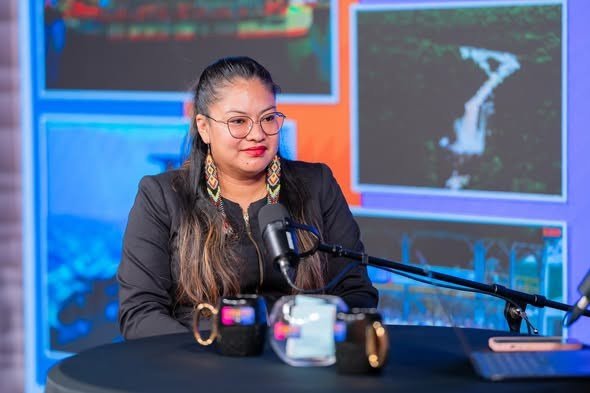
Minister of Amerindian Affairs Sarah Browne-Shadeek, who said her ministry is now working with the Ministry of Education to introduce the Indigenous language of Lokono into the primary school curriculum.
She said out of all of Guyana’s Indigenous languages, Lokono poses the most immediate danger of disappearing.
Minister Browne-Shadeek has spoken openly about the personal dimension of the problem.
Despite growing up in one of the country’s largest Amerindian villages, she never learned to speak the language.

“It’s sad to see, not by choice, but because the people around me didn’t speak it,” she said on the Starting Point podcast streamed last Sunday.
Without deliberate effort to pass on language and tradition, “that little that’s left will die with me,” she said.
Lokono communities are concentrated along Guyana’s coastal areas including Moraikobai, Orealla, Santa Mission, Santa Aratak, and in Region One.
These areas, she said have been especially exposed to outside influence, social media, and closer integration with wider Guyanese society, all of which have accelerated language loss over successive generations.
After Lokono, she ranked Carib and then Warao as the next most at-risk languages.
She said the push for curriculum integration is still in its early stages, with the Ministry treating it as a starting point rather than a finished plan.
The goal, she explained, is to move language preservation from an informal, family-level responsibility into the formal education system, where it can reach children more consistently.
Alongside the language initiative, the ministry continues to support cultural groups directly.
The language and culture push comes as Guyana marks Amerindian Heritage Month, running through September with a cultural exhibition at the Sophia Exhibition Centre, the Heritage Games, the Miss Amerindian Heritage Pageant, and a stage production on the life of Stephen Campbell, Guyana’s first Indigenous parliamentarian, staged this year in his home village of Santa Rosa, Moruca.