






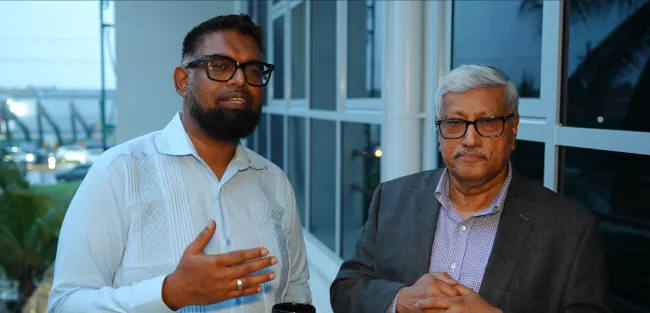
President Irfaan Ali has emphasised that Guyana’s transformation is no longer solely characterised by highways, bridges, and large-scale infrastructure, but increasingly by expanding opportunities for its people—especially young professionals and entrepreneurs.
During the latest episode of his podcast, Tea on the Terrace – Episode 5, the President gathered a diverse group of leaders from the private and financial sectors to analyse the country’s evolving economic landscape. Among those present were Chairman of Demerara Distillers Limited (DDL) and Demerara Bank Limited, Dr Komal Samaroo; Chief Executive Officer Dowlat Parbhu; Head of Operations Kenesha Collins; Chief Internal Auditor La Donna Delon; Camp Street Branch Manager Patrina Sahib-Roshan; and Senior Minister in the Office of the President responsible for Finance, Ashni Singh.
The comprehensive discussion covered private-sector growth, banking-sector reforms, technological progress, and the rising influence of a younger workforce in shaping the country’s future.
Dr Samaroo observed that DDL is expanding its operations to capitalise on the increasing opportunities resulting from government policy and ongoing economic growth. The company is actively pursuing diversification strategies, entering new markets, and launching innovative products, while also enhancing its technological capabilities to remain competitive.
“We see tremendous opportunities opening up based on government policies and the trajectory of the economy,” Dr Samaroo explained.
He added that the company is assessing new ventures, including a proposed dairy project along the Linden Highway corridor, which could boost economic activity and generate jobs in surrounding communities.

From a banking perspective, Parbhu emphasised the importance of strengthening the financial sector, driven in part by supportive national policies. He noted that housing loans now account for nearly half of the bank’s lending portfolio, reflecting rising demand for homeownership among citizens.
He also clarified that increased competition in the banking sector has led to a notable decrease in mortgage interest rates over recent years. This has made borrowing easier, as shown by the more than 6,000 housing loan applications the bank has received.
Parbhu also outlined plans for a significant digital transformation in banking services. New mobile-based platforms are being developed to enable customers to evaluate loan eligibility and access financial products within minutes, streamlining a once lengthy process.
Furthermore, the bank has launched programmes to support entrepreneurship, including a “Shark Tank-style” initiative that has already awarded over $10 million in grants to startups focused on technology, environmental innovation, and new business ventures. Plans are also underway to establish an SME advisory portal to assist small businesses with financial planning, account management, and access to funding.
The conversation also highlighted the growing influence of young professionals in Guyana’s economy. Collins urged young people to make the most of the unprecedented access to education, technology, and innovation.
“You can sit in your living room and empower yourself, learn new skills and build industries that were once only within our imagination,” Collins said.
She emphasised that assets like home ownership can serve as a crucial foundation for long-term financial stability and entrepreneurial growth.
Delon reinforced this viewpoint, observing a notable increase in young entrepreneurs turning to financial institutions for support in establishing small and medium-sized enterprises. She clarified that banks are increasingly positioning themselves as partners in this endeavour, providing guidance alongside funding.
Sahib-Roshan noted a broader shift in the workforce, with younger professionals assuming leadership roles earlier than in previous generations. She observed that many individuals in their 30s and 40s now occupy key management positions within the banking sector.
“You’re seeing younger people accessing house plots earlier and applying for housing loans sooner,” she said, noting that this allows them to establish stability and build long-term wealth at an earlier stage.
Providing a broader policy perspective, Minister Ashni Singh stressed that the country’s development goes far beyond visible infrastructure projects. While roads, bridges, hospitals, and schools are essential, he pointed out that true transformation happens through improved living standards and greater access to opportunities.
He highlighted how increased competition in the financial sector, wider availability of digital services, and a more dynamic business environment collectively reflect the country’s economic progress.
President Ali also shared a personal example to illustrate this transformation—a 30-year-old branch manager at Demerara Bank who began his career as a teller and gradually advanced through dedication, education, and opportunity, ultimately securing his own home.
“This is the story we want for every young person in Guyana,” said President Ali.
The President concluded by emphasising that Guyana’s long-term success depends on empowering its citizens—especially its youth—to develop their talents, seize opportunities, and contribute meaningfully to the country’s ongoing growth and modernisation.