




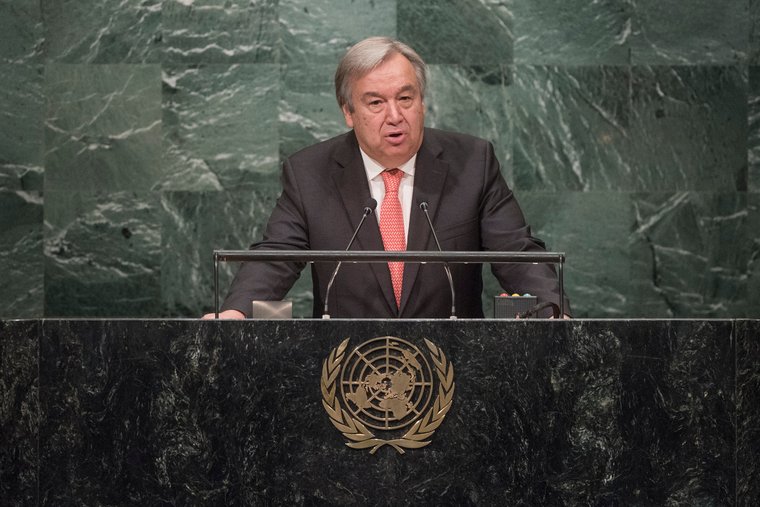
World leaders are gathering in New York for the high-level week of the 81st United Nations General Assembly, with international conflicts, diplomatic tensions, artificial intelligence and the future of global cooperation among the major issues drawing attention.
The high-level General Debate begins on 22 September and runs through 28 September, bringing together presidents, prime ministers and senior government officials from around the world. UN Secretary-General António Guterres has described the current international environment as deeply uncertain. This year’s gathering is also significant for Guterres, as it will be his final high-level General Assembly week before his term ends later this year.
Wars dominate the diplomatic agenda.
The conflicts involving Iran, Ukraine, Israel and the Palestinians are expected to feature prominently in discussions.
Guterres has been calling for efforts to reduce tensions in the Middle East and has emphasised the importance of keeping major international waterways, including the Strait of Hormuz and Bab el-Mandeb, open to navigation. He has also continued to advocate a ceasefire in Ukraine as Russia’s full-scale invasion enters its second year.
Iranian President Masoud Pezeshkian is scheduled to address the General Assembly on 23 September. His appearance follows months after the United States and Israel launched military action against Iran. The status of the Strait of Hormuz and efforts to maintain international shipping routes are expected to remain part of the wider diplomatic discussion.
Ukrainian President Volodymyr Zelenskyy is also on the speakers’ list. European governments are expected to continue discussions on support for Ukraine as the conflict enters another winter. Russia is expected to be represented by Foreign Minister Sergey Lavrov rather than by President Vladimir Putin.
Gaza and Palestinian representation
The conflict between Israel and the Palestinians will also attract significant attention during the General Assembly.
Palestinian Authority President Mahmoud Abbas was denied a US visa and will therefore address the assembly via a pre-recorded video statement. The General Assembly previously voted to allow him to participate remotely. Israeli Prime Minister Benjamin Netanyahu is also scheduled to address the gathering.
The diplomatic exchanges are taking place against continuing international disagreements over Gaza, Palestinian statehood and the role of international institutions in addressing the conflict.
AI is becoming an increasingly important global issue.
Artificial intelligence is emerging as another major issue in international discourse.
Rapid advances in increasingly capable AI systems have prompted governments, technology companies and researchers to debate how technology should be developed and governed. Concerns include cybersecurity, autonomous systems, AI misuse, and the possibility that technological development could outpace safety measures.
Recent discussions among major AI companies have included proposals for greater coordination on development pace and safety standards. However, such cooperation has also raised questions about competition and antitrust rules. A lawsuit filed in the United States has alleged that several major AI companies improperly coordinated to slow development, although those allegations remain claims in litigation.
US-China relations are another part of the AI discussion. The two countries remain engaged in intense competition over advanced artificial intelligence, computing technology and semiconductor capabilities, while experts have also advocated continued dialogue over AI safety and related risks.
Major powers take different approaches to UN participation
Around 120 leaders and senior representatives are expected to participate in the high-level meetings, although several major countries are sending senior officials rather than their heads of government.
India, Germany and South Africa are expected to be represented by other senior officials. Chinese President Xi Jinping is also not expected to attend in person. The differing levels of participation have prompted discussion among international observers about the evolving nature of high-level diplomacy and the importance governments place on the UN gathering.
Venezuela and changing regional politics
Venezuela is also expected to receive attention during the gathering.
Delcy Rodríguez, who became Venezuela’s interim leader following the removal and arrest of Nicolás Maduro by US forces earlier this year, is scheduled to make her first UN address in her new role. She is also expected to meet US President Donald Trump during the General Assembly week, according to US officials cited by NPR.
The developments have added another major issue to an already crowded diplomatic agenda, particularly given Venezuela’s importance to the global energy market and its relationship with the United States.
Race to replace Guterres
The future leadership of the United Nations is another important issue surrounding this year’s General Assembly.
The UN Security Council has conducted several informal rounds of consultations among candidates seeking to succeed Guterres. Among those still in contention are former Costa Rican Vice-President Rebeca Grynspan and Guyana’s former Foreign Minister Carolyn Rodrigues-Birkett. Former Chilean President Michelle Bachelet recently withdrew from the contest, leaving seven candidates, NPR reports.
The selection process requires Security Council agreement before the Council can recommend a candidate to the General Assembly. The Council’s five permanent members retain veto power, making consensus an important part of the process.
A test for international cooperation
Beyond individual conflicts, the General Assembly gives governments a forum to discuss issues ranging from development and climate change to international security and technological governance.
This year’s gathering comes at a time when major powers remain divided over several international questions, while governments also confront challenges that require cross-border cooperation.
The discussions in New York will therefore focus not only on individual crises but also on how countries can maintain diplomatic channels and cooperation in an increasingly divided international environment.