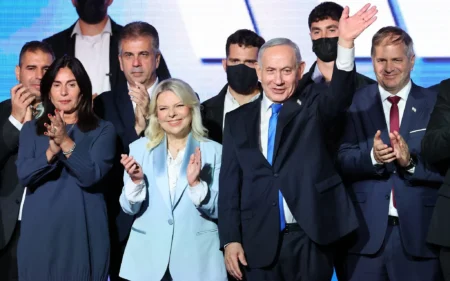

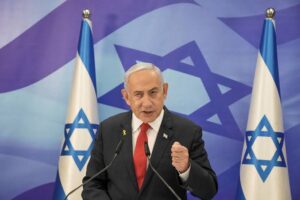





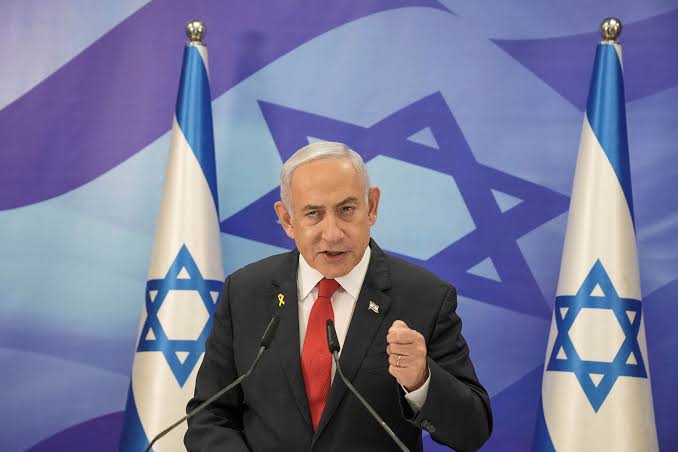
Israeli Prime Minister Benjamin Netanyahu is reportedly considering an unprecedented power-sharing arrangement with opposition leader Gadi Eisenkot in an attempt to break the country’s ongoing political deadlock. Under the proposed arrangement, Eisenkot would serve as prime minister first, while Netanyahu would take the second turn in a rotational leadership agreement.
According to reports by Israeli media outlets, including The Times of Israel and Channel 13, Netanyahu is preparing to signal his willingness to enter a unity government with Eisenkot. The proposal comes amid growing uncertainty over the formation of Israel’s next government and mounting difficulties in securing a parliamentary majority.
The proposal has reportedly divided officials within Netanyahu’s Prime Minister’s Office. Israel’s public broadcaster Kan has also reported that the offer was communicated through unofficial channels, allowing Netanyahu’s Likud party to maintain some distance from the proposal while internal discussions continue.
However, Eisenkot remains sceptical about Netanyahu’s reported offer and is continuing efforts to establish an alternative government. Reports suggest that he is not currently inclined to accept the proposed power-sharing arrangement.
Eisenkot Faces Challenge in Forming a Government
Eisenkot, chairman of the Yashar party, is under pressure to gather sufficient parliamentary support before his mandate to form a government expires on December 6. His party, along with Yair Golan’s Democrats and Avigdor Liberman’s Yisrael Beytenu, holds a combined 36 seats in Israel’s 120-member Knesset.
Even with Naftali Bennett’s B’Yachad party joining the bloc, the total would reach only 48 seats, considerably short of the 61 required for a parliamentary majority.
This leaves Eisenkot with limited options, including negotiating with Arab-led parties, ultra-Orthodox political factions or potentially reconsidering cooperation with Likud.
Eisenkot has reportedly assured his political partners, including Golan and Liberman, that he would not enter a unity government with Netanyahu without their approval.
Liberman Questions Netanyahu’s Intentions
The reported proposal has also attracted criticism from political opponents. Avigdor Liberman has described the possibility of a rotational arrangement as a political manoeuvre, suggesting that Netanyahu could be attempting to delay negotiations and prevent an alternative government from taking shape.
Liberman warned that even if a unity government were established, Netanyahu could create political circumstances that would eventually lead to another election.
Meanwhile, Bennett’s position has added another layer of uncertainty. Although he has publicly supported the idea of a unity government with Likud, disagreements over military conscription and other political issues could complicate negotiations with Eisenkot’s bloc.
Ra’am Emerges as a Potential Key Player
Another important development in the negotiations involves the Arab-led Ra’am party, headed by Mansour Abbas. The party has reportedly indicated its willingness to support an Eisenkot-led government in exchange for ministerial positions and significant investment in Arab communities.
Its demands reportedly include cabinet representation, stronger measures to address crime in Arab communities, development programmes and funding for construction regulation.
Such support could help Eisenkot bridge the gap towards a parliamentary majority, although securing an agreement would require compromises from several political partners.
Political Future Remains Uncertain
Eisenkot has accused Likud of delaying coalition negotiations despite several meetings between the two sides. He has also raised concerns about the government’s approach to military conscription, judicial reforms and the continued presence of hardline political partners.
He has maintained that his bloc remains interested in forming a government but expects meaningful compromises from Likud.
For Netanyahu, offering Eisenkot the first position in a rotational premiership would represent a significant political concession. However, with divisions within Likud and uncertainty among opposition parties, the proposal remains far from a confirmed agreement.
As Eisenkot’s December 6 deadline approaches, the coming days could prove decisive for Israel’s political future. Whether the reported power-sharing offer leads to a unity government or further deepens the political stalemate remains to be seen.