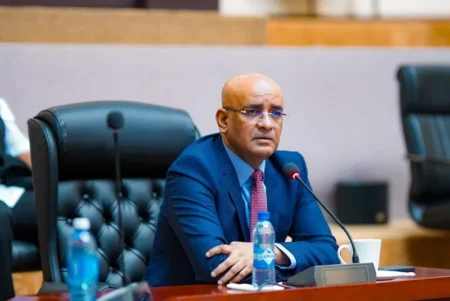
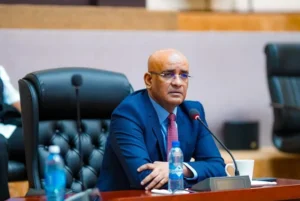
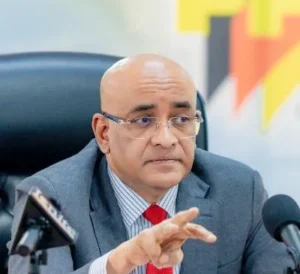






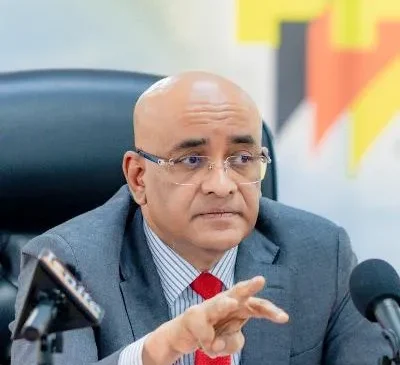
Vice-President Dr Bharrat Jagdeo used a business awards dinner on Thursday night to do two things at once: thank the United States for standing by Guyana on the Essequibo dispute and push back firmly against what he described as a wave of misinformation distorting both Washington’s position and his own record.
Speaking at the Guyana Manufacturing and Services Association’s annual awards ceremony at the Kingston Marriott, with US Ambassador Nicole Theriot in the room, Dr Jagdeo expressed appreciation for Washington’s recent reaffirmation of its support for the 1899 Arbitral Award — the ruling that legally established the land boundary between Guyana and Venezuela, and that remains the cornerstone of Guyana’s claim to Essequibo.
The US Embassy issued that reaffirmation last week, following a Reuters report that a Trump administration official had floated the idea of Guyana ceding Essequibo to Venezuela. The report caused significant local alarm, and Dr Jagdeo moved to calm the waters. He said comments attributed to Ambassador Theriot, as well as remarks by the US Secretary of War in Texas, had been taken out of context and distorted beyond recognition. “That is far from the truth,” he said plainly.
On the ICJ process, the Vice-President was equally direct. He noted that Guyana spent years pursuing bilateral negotiations with Venezuela, but that chapter is closed. The matter is now before the International Court of Justice, and Guyana is awaiting a ruling. “We have made it clear to everyone — we are past the bilateral negotiations stage. That’s why we went to the court, and we are awaiting this decision.” He said the ruling is expected in January, and Guyana is confident it will be favourable.
But Thursday’s remarks were not only about Washington’s position. Dr Jagdeo also addressed a separate controversy that had been swirling on social media earlier in the week — one that struck much closer to home.
A Partnership for National Unity MP, Terrence Campbell, circulated a nine-second clip taken from a nearly three-minute comment Dr Jagdeo made in 2016, when he was opposition leader. The edited excerpt was presented in a way that suggested Jagdeo had personally offered Venezuela a corridor to the Atlantic Ocean — in other words, that he had offered to give away Guyanese territory.
The full context of those remarks tells a different story entirely. Dr Jagdeo was responding to a journalist’s question about diplomatic proposals discussed during the UN Good Offices Process, which ran from 1989 to 1999. He was describing — not endorsing — proposals raised during that mediated process. One such proposal, documented in the Alister McIntyre report on the UN process, called for a corridor for Venezuela toward the Atlantic, possibly including a short stretch of coastline. In 1990, Dr Barton Scotland, then Guyana’s facilitator — appointed under the People’s National Congress government, not any PPP administration — floated that proposal.
In other words, the proposal that Campbell attributed to Jagdeo was actually put forward by a PNC-era government, discussed in a multilateral diplomatic forum, and only referenced by Jagdeo years later in a media interview. Stripped of that context, the clip created the opposite impression of what was said.
Dr Jagdeo did not dwell on the attack’s political dimension. Instead, he used the moment to issue a broader warning about the information environment in which Guyana now operates. “This is the era we live in — misinformation — and it causes a lot of angst among our people because the border issue is close to our heart,” he told the gathering. He urged attendees to think critically and to be alert to content designed to inflame rather than inform.
The underlying territorial dispute dates back to the 1899 Arbitral Award, which settled the boundary between British Guiana and Venezuela. Venezuela has never fully accepted the award’s legitimacy, and tensions over Essequibo have ebbed and flowed for more than a century. Guyana took the matter to the ICJ in 2018, seeking formal affirmation of the award. Venezuela argued the court had no jurisdiction, but the ICJ rejected that claim in December 2020, clearing the way for a ruling on the merits of the case. That is the judgment Guyana now awaits — and Dr Jagdeo’s message on Thursday was that his government will face it with confidence, not anxiety, and certainly not on the basis of a nine-second clip.