





It was only a matter of time, but that doesn’t diminish its significance. Guyana has officially crossed the threshold that energy analysts and government officials have long watched for — and it happened with the arrival of a vessel whose very name carries the weight of the moment. Errea Wittu, meaning “abundance” in the Warrau language, has begun producing oil, and with it, Guyana’s offshore story has entered an entirely new chapter.
The Errea Wittu Floating Production, Storage and Offloading vessel achieved first oil as part of the Uaru Development, Guyana’s fifth offshore project in the Stabroek Block. Its arrival pushes Guyana’s installed production capacity to approximately 1.1 million barrels per day, with the Natural Resources Ministry projecting that total daily crude output will rise from just over 900,000 barrels to around 1.15 million barrels. For a country that made its first major offshore discovery just over a decade ago, that figure is staggering.
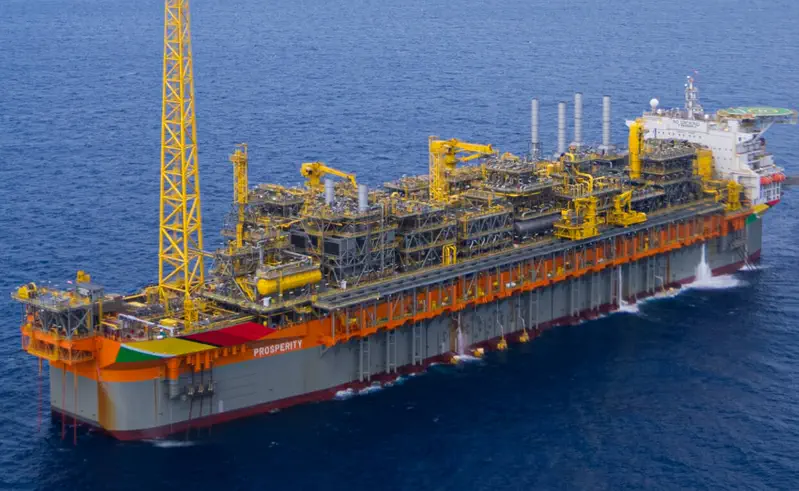
The vessel itself is an engineering feat worth pausing to consider. Built by Japanese shipbuilder MODEC, the Errea Wittu will operate approximately 200 kilometres off Guyana’s coastline, alongside the Liza Destiny, Liza Unity, Prosperity and ONE GUYANA — the four FPSOs already at work in the Stabroek Block. It has a storage capacity of two million barrels of crude oil and is built on a new-build hull. Its topsides are designed to process up to 540 million cubic feet of associated gas per day and to support water injection of up to 350,000 barrels per day. At full capacity, expected in the first quarter of 2027, the vessel will produce 250,000 barrels per day on its own.
The Uaru Development draws resources from three separate fields — Snoek, Mako and Uaru — linked by 44 production and injection wells across up to 10 drill centres. It is a complex, technically demanding undertaking, and its successful start-up reflects years of planning, construction and coordination among ExxonMobil, the Guyanese government and thousands of local and international workers.
ExxonMobil Upstream Company President Dan Ammann did not understate the moment. He described the startup as another major milestone, citing the strength of the Stabroek Block resource, the collaborative relationship with the Government of Guyana, and the contributions of Guyanese workers as the foundations that made it possible. The Natural Resources Ministry echoed that sentiment, framing the development not only as an oil production story but as a broader economic one — with benefits expected to flow into employment, local business participation, and the growth of industries well beyond the petroleum sector. The Government also reaffirmed its commitment to responsible environmental stewardship as the industry continues to scale.
And it will scale. Just as the Uaru celebration was still fresh, another announcement landed. On November 13, ExxonMobil confirmed a final investment decision on the Longtail Project — the eighth development in the Stabroek Block and the one that marks a genuinely new frontier for Guyana. Valued at US$12.5 billion and backed by government approval of its Field Development Plan and a fresh Petroleum Production Licence, Longtail will be Guyana’s first offshore development dedicated entirely to extracting non-associated natural gas. That is a significant distinction. Every project before it has been built around crude oil. Longtail opens an entirely new dimension.
The figures behind Longtail are equally striking. The project is expected to produce approximately 776 million barrels of condensate over a 30-year lifespan and will rely on a purpose-built FPSO capable of processing 1.2 billion standard cubic feet of gas per day. Production is targeted to begin in 2030. ExxonMobil Guyana Limited will operate the project with a 45 per cent stake, alongside Hess Guyana Exploration Limited at 30 per cent and CNOOC Petroleum Guyana Limited holding the remaining 25 per cent — the same partnership structure that has governed the Stabroek Block throughout its development.
With Uaru now in production, the roadmap for the rest of the decade is taking shape. Whiptail, the sixth approved project, is expected to begin production in 2027. Hammerhead follows in 2029. Longtail arrives in 2030. Each one adds not only capacity but also complexity, revenue, and jobs to an economy that is still learning how to manage the kind of wealth most nations never have to grapple with.
The question hanging over all of it — and it is a fair one — is whether Guyana can turn this extraordinary natural endowment into lasting development. The oil will not last forever. The institutions, infrastructure, human capital and diversified economy built in its shadow — those are what will define Guyana’s future long after the last barrel is lifted from the deep waters off its coast.
For now, though, the Errea Wittu is producing, and abundance has officially arrived in Guyana.