






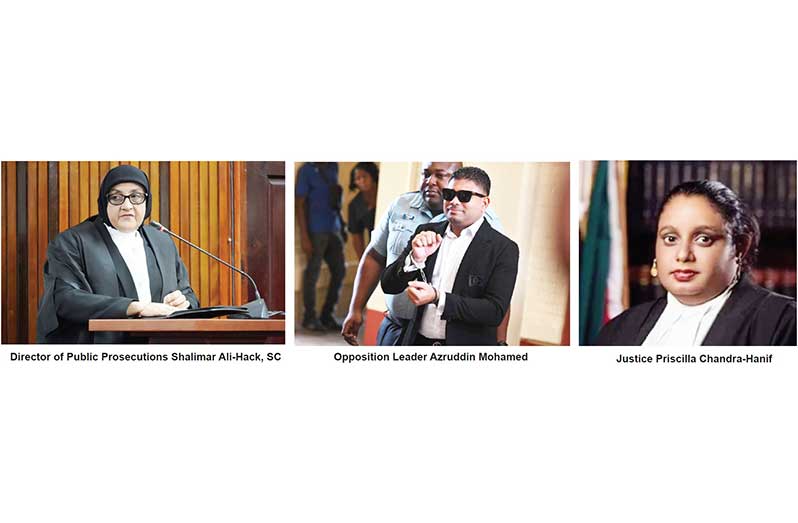
The Director of Public Prosecutions has asked the High Court to strike out six passages of an affidavit filed by Opposition Leader Azruddin Mohamed, arguing that the claims in those passages are either unsupported by evidence, based on hearsay, or simply not the kind of material that belongs in an affidavit.
Mohamed is currently in Lusignan Prison after Magistrate Abigail Gibbs refused him bail on October 30 in connection with a cybercrime charge. He’s accused alongside Police Constable Ryan Greene, 20, of unauthorisedly acquiring and selling recordings from the Safe Country Surveillance System. Those recordings reportedly captured a shooting on October 12 outside the Kitty home of Senior Superintendent Prem Narine, head of the Police Force’s Special Branch, an incident that allegedly involved Mohamed and two of his employees. According to the prosecution, the footage was taken from a computer at the Police Command Centre in Liliendaal and handed to Mohamed for $800,000. A second officer, Constable Ashton Chappelle, also known as Chappy, was separately charged with alleged unauthorised access to and transfer of the recording and has also been remanded.
The latest dispute centres on an 112-paragraph supplemental affidavit that Mohamed filed on November 4 as part of his bid to challenge the bail refusal. On November 9, King’s Counsel Darshan Ramdhani and State Counsel Madana Rampersaud asked Justice Priscilla Chandra-Hanif to remove paragraphs 16, 45, 53, 59 and 61, as well as the opening sentence of paragraph 76.
An affidavit from Deputy DPP Diana O’Brien sets out the prosecution’s reasoning. Her core complaint is that several of Mohamed’s assertions fail to identify their sources. References to complaints received, information circulating on social media, matters he was apparently told about, and claims presented as widely known facts all appear in the document without any named source to support them.
Paragraph 61 raised particular concern. It reportedly accuses government officials and senior police officers of involvement in deleting and destroying surveillance recordings. The prosecution’s position is that no identifiable source supports those accusations, and that the people being accused aren’t even parties to the case.
There’s also an objection to paragraphs 53 and 59, which the prosecution contends contain legal arguments about the interpretation of the Cybercrime Act rather than statements of fact. The DPP’s view is that legal submissions belong in court, not in affidavit evidence.
To support its application, the State has relied on the Civil Procedure Rules 2016 and the Evidence Act. O’Brien acknowledged that Section 73(4) of the Evidence Act permits statements of belief in interlocutory proceedings but argued that this exception doesn’t apply here because Mohamed’s application seeks substantive relief through originating proceedings. The prosecution also cited Rule 30.02(3) of the Civil Procedure Rules, which empowers the court to exclude material it considers scandalous, irrelevant or oppressive.
It’s worth noting that the DPP isn’t seeking to throw out the entire affidavit. O’Brien made clear that most of it concerns matters within Mohamed’s personal knowledge, and the prosecution has no issue with those parts.
The case for Mohamed’s release is being advanced by his mother, Bonita Mohamed, who has filed for judicial review of the magistrate’s bail decision and is seeking to have it overturned by the High Court. She also filed a separate application on November 8 for interim bail while the main judicial review is being considered. The grounds include Mohamed’s compliance with bail conditions in separate extradition proceedings, his family responsibilities, his permanent address, and his role as Leader of the Opposition. Proposed conditions include restrictions on international travel and no contact with his co-accused or prosecution witnesses.
Justice Chandra-Hanif is set to hear both the interim bail application and the DPP’s request to remove the disputed paragraphs on 12 November, with the full judicial review scheduled for 23 November. Mohamed is represented by Senior Counsel Roysdale Forde, together with attorneys Damien DaSilva and Siand Dhurjon.