






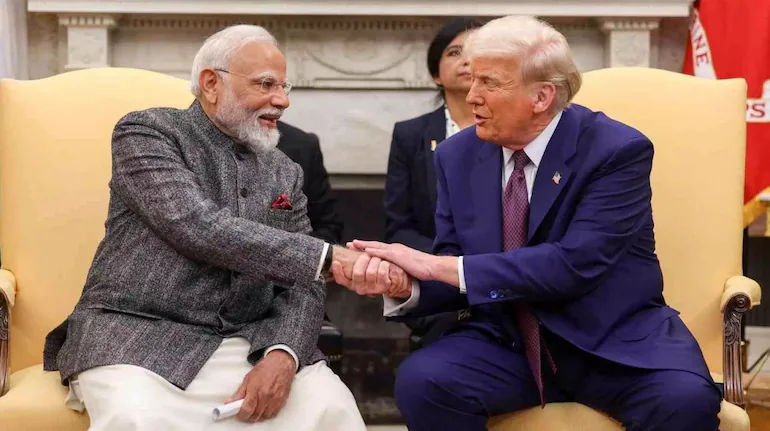
The United States has temporarily stepped back from its threat to impose steep tariffs on countries purchasing Russian oil, providing India with relief from a potential trade setback. The decision by US President Donald Trump marks a significant shift in Washington’s approach, moving from an initial proposal for tariffs of up to 500 per cent to a revised 100 per cent framework and, most recently, a presidential waiver.
The waiver, issued on October 16, 2026, under the Lindsey O. Graham Sanctioning Russia and Iran Act of 2026, came shortly before the new tariff provisions were due to become applicable. Although the move reduces the immediate risk to Indian exporters, it does not guarantee permanent protection from future US trade action.
From a 500% Threat to a 100% Tariff Framework
The original proposal sought to impose tariffs of up to 500 per cent on countries continuing to purchase Russian oil, gas and other energy products. The objective was to put economic pressure on Moscow by penalising its major trading partners and limiting the revenue Russia receives from energy exports amid its ongoing war against Ukraine.
However, concerns about the economic consequences of such a measure led to a revised approach. The updated legislation reduced the proposed maximum tariff to 100 per cent and focused on the five largest importers of Russian-origin crude oil and natural gas, subject to the law’s conditions.
The revised framework also provided the US president with the authority to waive the penalties. This provision ultimately became central to the latest policy shift, allowing the administration to suspend the application of the specified duties rather than immediately impose additional tariffs on countries such as India and China.
Why India Faced the Risk
India’s exposure stemmed from its substantial purchases of Russian crude oil and its strong trade relationship with the United States. Following Russia’s invasion of Ukraine in February 2022, Indian refiners increased their purchases of discounted Russian oil, making Moscow one of the country’s most important crude suppliers.
India depends heavily on imported crude oil to meet its domestic energy requirements. Maintaining access to affordable supplies is therefore essential for its refineries, transport sector and broader economy.
At the same time, the United States is an important destination for Indian exports, including pharmaceuticals, textiles, engineering goods, gems and jewellery, and electronics. An additional tariff of up to 100 per cent on covered Indian goods could have significantly increased their costs in the American market, weakened their competitiveness and affected exporters, businesses and employment.
New Delhi consequently faced a difficult balancing act: protecting its energy security while maintaining access to a major export market.
India’s Earlier Experience With US Tariffs
The latest threat followed an earlier round of tariff measures announced by Trump in 2025. On August 6 that year, the US president ordered an additional 25 per cent tariff on Indian imports, citing India’s purchases of Russian oil. The additional duties took effect on August 27, taking the combined tariff burden on many Indian goods to as high as 50 per cent.
In February 2026, Washington announced changes to the additional tariff arrangements as part of a broader trade understanding with India. The US also announced a reduction in its reciprocal tariff rate on Indian goods from 25 per cent to 18 per cent.
These developments formed part of continuing negotiations over trade, energy purchases and market access. The latest waiver offers further short-term relief, but the broader trade relationship remains subject to policy changes and negotiations between the two governments.
Why Washington Granted the Waiver
The decision reflects the competing pressures facing the US administration. While Washington has sought to restrict Russia’s ability to finance its war through energy exports, higher energy prices have created domestic economic challenges.
The administration has also faced pressure to prevent additional trade restrictions from disrupting global oil supplies and increasing fuel costs. With crude prices rising amid the wider West Asian conflict, imposing steep tariffs on major buyers of Russian energy could have added further uncertainty to international energy markets.
The timing also attracted attention because Trump had announced an arrangement involving Russian diesel supplies shortly before the waiver. The arrangement was presented as a means of increasing fuel availability and easing price pressures. Although the sequence does not establish that the diesel arrangement directly caused the tariff waiver, it highlighted the competing considerations shaping Washington’s energy and sanctions policies.
Trade negotiations with India and the potential consequences for US businesses and consumers also remain relevant to the administration’s calculations.
What the Waiver Means for Indian Businesses
The immediate benefit is that Indian exporters have avoided the additional tariff threat under the specified provisions of the new law. Without the waiver, the prospect of duties reaching 100 per cent could have made many Indian products considerably more expensive for American buyers.
The decision also gives Indian companies greater short-term certainty when planning shipments, negotiating contracts and managing orders from US customers. Businesses that were concerned about sudden increases in import costs can continue operating without the additional duties taking effect under the waived provisions.
However, the waiver does not remove every existing US tariff on Indian products, nor does it automatically settle the wider trade negotiations between the two countries. Exporters must continue to account for the tariffs and other trade rules that remain applicable to their products.
The administration has retained the option of reconsidering the waived measures, leaving India exposed to the possibility of renewed pressure if Washington changes its policy.
Energy Security Remains India’s Priority
For India, the episode reinforces the importance of maintaining a diversified and commercially viable energy supply. Russian crude has offered Indian refiners an alternative source of oil, but dependence on any single supplier can create vulnerabilities when geopolitical tensions affect trade.
India can reduce these risks by assessing supplies from multiple countries, monitoring international oil prices and maintaining flexibility in procurement decisions. Any shift away from Russian crude would need to account for pricing, availability, refining requirements and the potential impact on domestic fuel costs.
The government must also weigh energy considerations against the importance of stable trade relations with the United States and other international partners.
Temporary Relief, Not a Permanent Resolution
The progression from a proposed 500 per cent tariff to a 100 per cent framework and finally to a waiver illustrates how geopolitical objectives can collide with economic realities. The United States sought to pressure Russia by targeting its energy customers, but the potential effects on global oil markets, American fuel prices and bilateral trade relationships complicated that strategy.
For India, the waiver is a welcome development that removes an immediate source of uncertainty for exporters and policymakers. Nevertheless, it should not be interpreted as a permanent exemption from future tariff action.
The coming months will be important in determining how Washington implements its Russia policy, how India manages its energy purchases and whether the two countries can advance their broader trade negotiations. For now, India has gained breathing room, but the balance between energy security and access to the American market remains a significant diplomatic and economic challenge.