






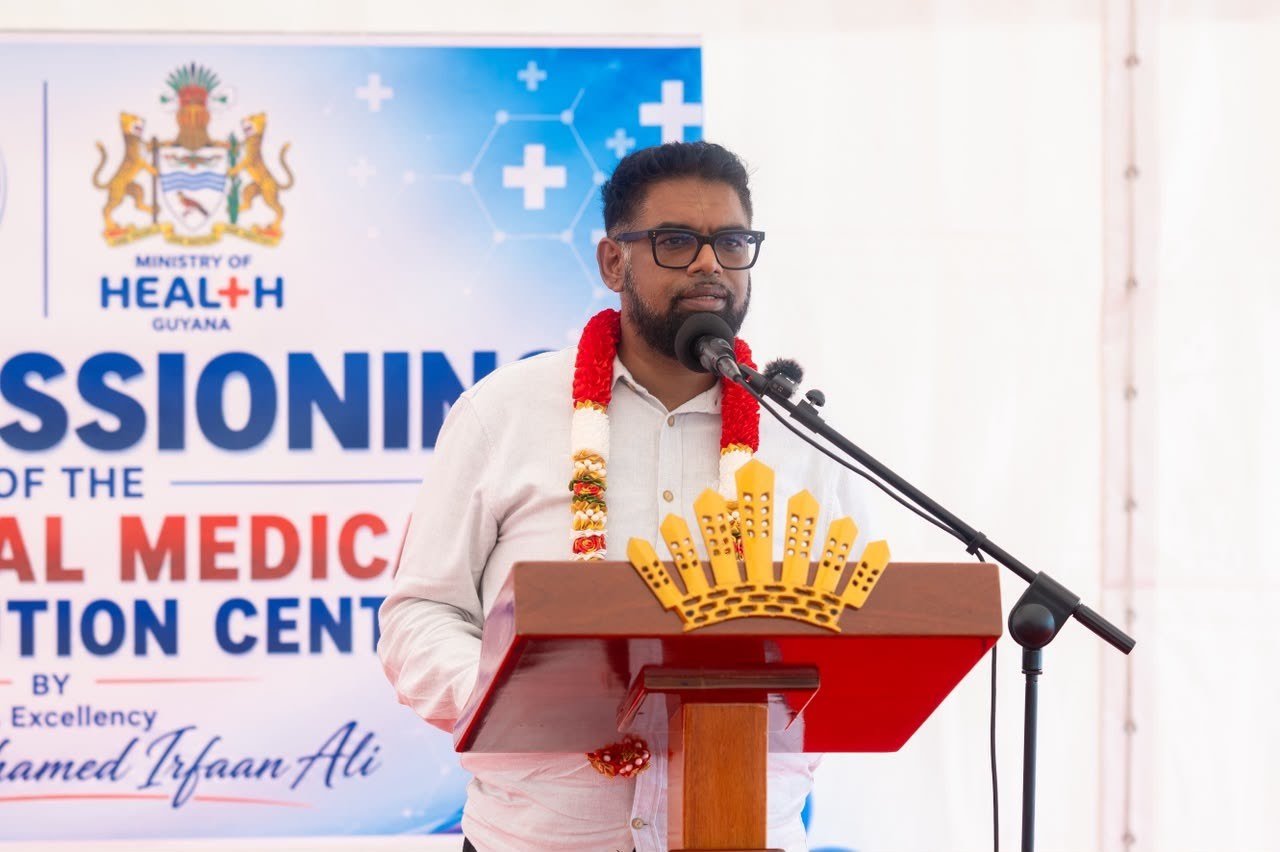
– sets ambitious targets to save lives

President Dr Mohamed Irfaan Ali has called for an aggressive public awareness campaign to ensure at least 3,000 women in Region Two are screened for cancer by the end of the year.
This sets ambitious targets to dramatically increase early detection and improve survival rates as the government continues to expand access to specialised healthcare services across Guyana.
Addressing the gathering at the commissioning of the Ministry of Health’s new drug bond in Region Two on Friday last, President Ali underscored that the government’s investment in modern diagnostic services must be matched by greater public participation in life-saving screening programmes.
“We have the facility here…By the time I come back here in December, we must have at least 3000 women screened and have their results,” the president emphasised.
“We can prevent breast cancer by early screening. You can also treat breast cancer better by early screening. Early identification decreases the risk of the cancer being fatal, increases the chances of survival and increases your ability to fight that cancer,” he added.
With mammography services now available in the region, President Ali revealed that more than 435 mammograms have already been completed, an investment valued at approximately $40,000 per screening.
The head-of-state also placed equal emphasis on prostate cancer detection, noting that it remains the most common cancer affecting men in Guyana but is highly treatable when detected early.
While 335 prostate screenings have been conducted to date, he directed the Regional Health Officer, Dr Ranjeev Singh, to increase that figure to at least 3,000 before year-end through sustained community outreach and public education.
President Ali said the government’s investments in healthcare are centred on protecting lives and ensuring every citizen has access to quality diagnostic services close to home.
He highlighted that Region Two has already recorded more than 500 CT scans in the last six months, over 800 X-rays, the distribution of more than 80,000 eye care vouchers for adults and 12,000 for children, and thousands of laboratory test vouchers.