






– as Guyana deepens value retention
More than 40 companies operating across Guyana’s oil and gas sector received approval for their 2026 annual local content plans on Wednesday.
This reinforced commitments to increase employment, procurement opportunities and capacity development for Guyanese.
The annual plans are required under Guyana’s Local Content Act and outline how reporting contractors and subcontractors intend to fulfil obligations throughout the calendar year through procurement targets, employment opportunities and investment in local capacity.
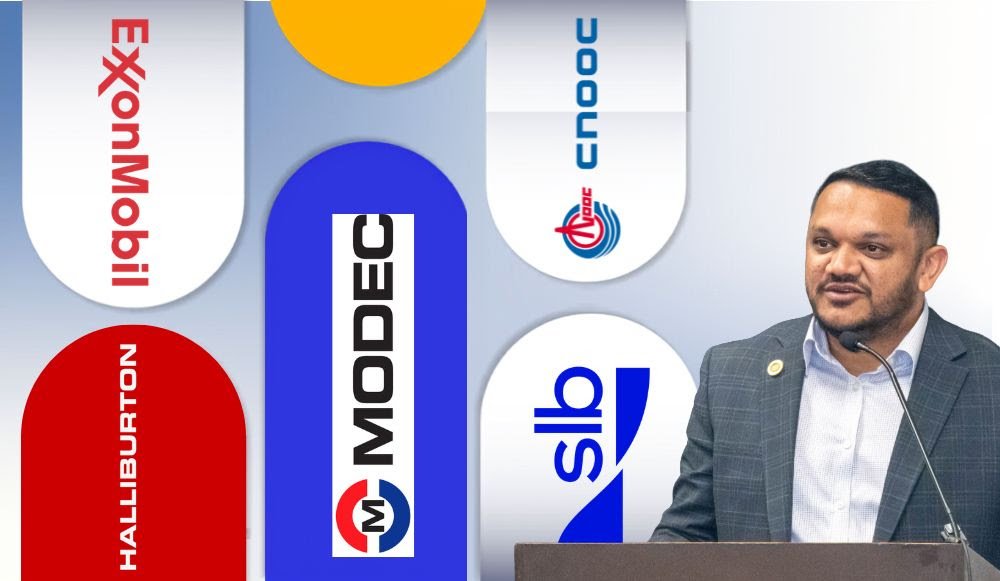
The approval and signing ceremony, hosted by the Ministry of Natural Resources through the Local Content Secretariat at Duke Lodge, brought together operators, contractors and service providers, including ExxonMobil Guyana Ltd, MODEC Guyana Inc, CNOOC Petroleum Guyana Ltd, Guyana Deep Water Operations Inc and Schlumberger.

Delivering remarks at the ceremony, Minister of Natural Resources Vickram Bharrat said the approvals represent more than compliance with legislation. They reflect a deliberate national effort to ensure Guyanese continue to secure meaningful participation in the country’s fastest-growing sector.
He commended the work of the Local Content Secretariat and the ministry’s Petroleum Unit for helping to drive implementation of local content policies while recognising companies for their continued partnership.
Minister Bharrat said the government remains focused on increasing participation as well as ensuring more Guyanese understand how to access opportunities created by the industry.
He announced plans for expanded sensitisation workshops countrywide to better inform communities about the sector and create pathways for employment, training and business development.
“Many Guyanese still truly don’t understand the sector,” the minister said, noting that greater outreach is needed to counter misinformation and improve access to opportunities.
Meanwhile, President and General Manager of ExxonMobil Guyana, Alistair Routledge, said the progress achieved under Guyana’s local content framework over the last five years demonstrates what can be accomplished through sustained collaboration.
He noted that while the Local Content Act established expectations, implementation required continuous engagement among government, international operators, local businesses and increasingly, the education sector.

“The law laid a framework, but laws are not how you get things done. It is implementation and collaboration that made the progress possible,” Routledge stated.
According to Routledge, by the end of 2025, Guyanese accounted for approximately 68 per cent of the workforce supporting the sector, with 1800 working offshore, a significant achievement for an industry that had no footprint in Guyana just over a decade ago.
He also highlighted increasing female participation, noting that one-third of Guyanese workers in the sector are women.
Routledge said future progress will depend heavily on strengthening technical and professional education to ensure the workforce can meet the demands of a rapidly expanding industry.
To support that objective, ExxonMobil Guyana has commissioned an industrial baseline study to assess current workforce capacity, future labour demand and the ability of education institutions to supply the skills needed across sectors.
On the supply side, Routledge said approximately 2,000 local suppliers were engaged in the industry by the end of 2025, contributing to an estimated US$3.6 billion being spent with local businesses.
He said the next phase of local content development will focus on spending as well as understanding how much value remains in Guyana through local ownership, local employment and reinvestment.
Approved annual plans now move into the implementation phase, with companies expected to execute commitments and submit periodic reports to allow ongoing monitoring by the Local Content Secretariat.
Minister Vickram Bharrat said the process remains central to ensuring greater value retention in Guyana while expanding opportunities for workers, businesses and future generations.