






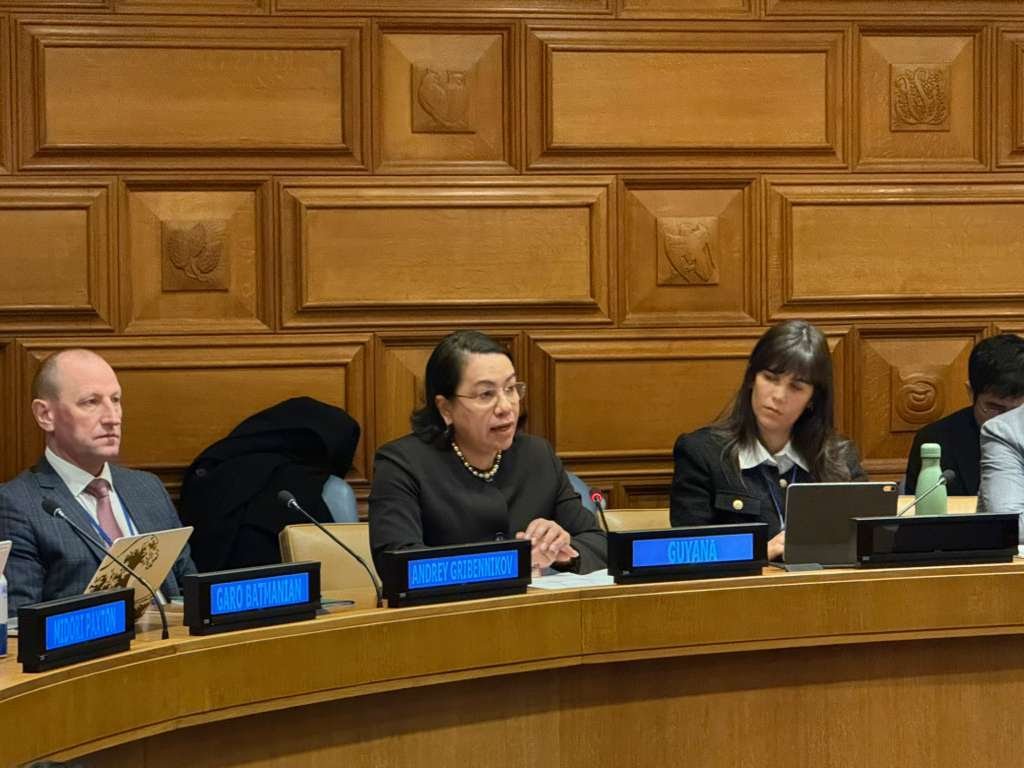
Guyana continues to press the international community to treat standing forests as economic assets rather than an environmental obligation, arguing that protecting forests must see clear financial returns if global climate targets are to be achieved.
Permanent Representative of Guyana to the United Nations, Ambassador Carolyn Rodrigues-Birkett, delivered this charge on Monday, highlighting that the global economy continues to generate stronger and faster returns from activities that remove forests than from those that preserve them.

She was at the time addressing an event hosted by Brazil’s COP30 Presidency in collaboration with the Food and Agriculture Organisation (FAO), United Nations Framework Convention on Climate Change (UNFCCC), United Nations Development Programme (UNDP), and United Nations Environment Programme (UNEP).
“Agriculture, mining, and land conversion generate immediate economic returns,” she told the international forum. “Meanwhile, the global climate services and ecosystem services provided by standing forests remain undervalued and underfinanced.”
“This imbalance is one of the biggest barriers to achieving the 2030 goal of halting and reversing forest loss and, consequently, the goals of the Paris Agreement.”
Against this backdrop, Ambassador Rodrigues-Birkett highlighted Guyana’s Low Carbon Development Strategy (LCDS) 2030 model as evidence that forest conservation can support economic growth and national development once financing systems are properly aligned.

“When we launched our Low Carbon Development Strategy in 2008, the idea that a forest country could build development around valuing ecosystem services was widely viewed as experimental,” she stated.
Nearly two decades later, the model is now producing measurable financial and developmental outcomes. Guyana became the first country to issue jurisdictional carbon credits under the ART TREES standard, with those credits now eligible under CORSIA, the international aviation carbon compliance market.
“To date, Guyana has secured transactions approaching $1 billion by 2030, and has already received about $400 million in revenues. These revenues are invested into national priorities identified through consultation under our LCDS,” she said.
These revenues are supporting investments in drainage and water management infrastructure aimed at opening approximately 100,000 hectares of non-forested land for economic activity. This will also strengthen food security in Guyana and the wider Caribbean region.
Additionally, a minimum of 15 per cent of revenues is guaranteed for transfer to indigenous village accounts. In practice, more than 25 per cent has already been distributed. Those funds are currently supporting more than 3,000 community-designed projects across communities nationwide.

“We believe people must see tangible benefits, and countries must have confidence that long-term sustainable forest stewardship is economically viable,” she reasoned.
The country also used the forum to call for stronger international support for forest financing systems, including jurisdictional REDD+ carbon markets and the Tropical Forests Forever Facility (TFFF).
She warned against destabilising emerging carbon markets at a stage when many systems are only now becoming operational after nearly two decades of international development and negotiations.

“The two mechanisms are complementary, not competing. Jurisdictional REDD+ links finance to measure climate outcomes, while the TFFF seeks to create long-term value for standing forests. Both approaches can support countries with different forest and deforestation profiles, including countries with historically low deforestation rates achieved through sustainable forest management,” the ambassador underscored.
Reference was also made to the Forest and Climate Leaders’ Partnership (FCLP) forest finance roadmap developed alongside Brazil, the UNEP and other partners.
“As we advance this agenda, Guyana stands ready to continue working closely with Brazil, the COP30 Presidency, the FCLP, and other partners on the roadmap to turn ambition into delivery,” she affirmed.
The event was held on the sidelines of the United Nations Forum on Forests (UNFF).