






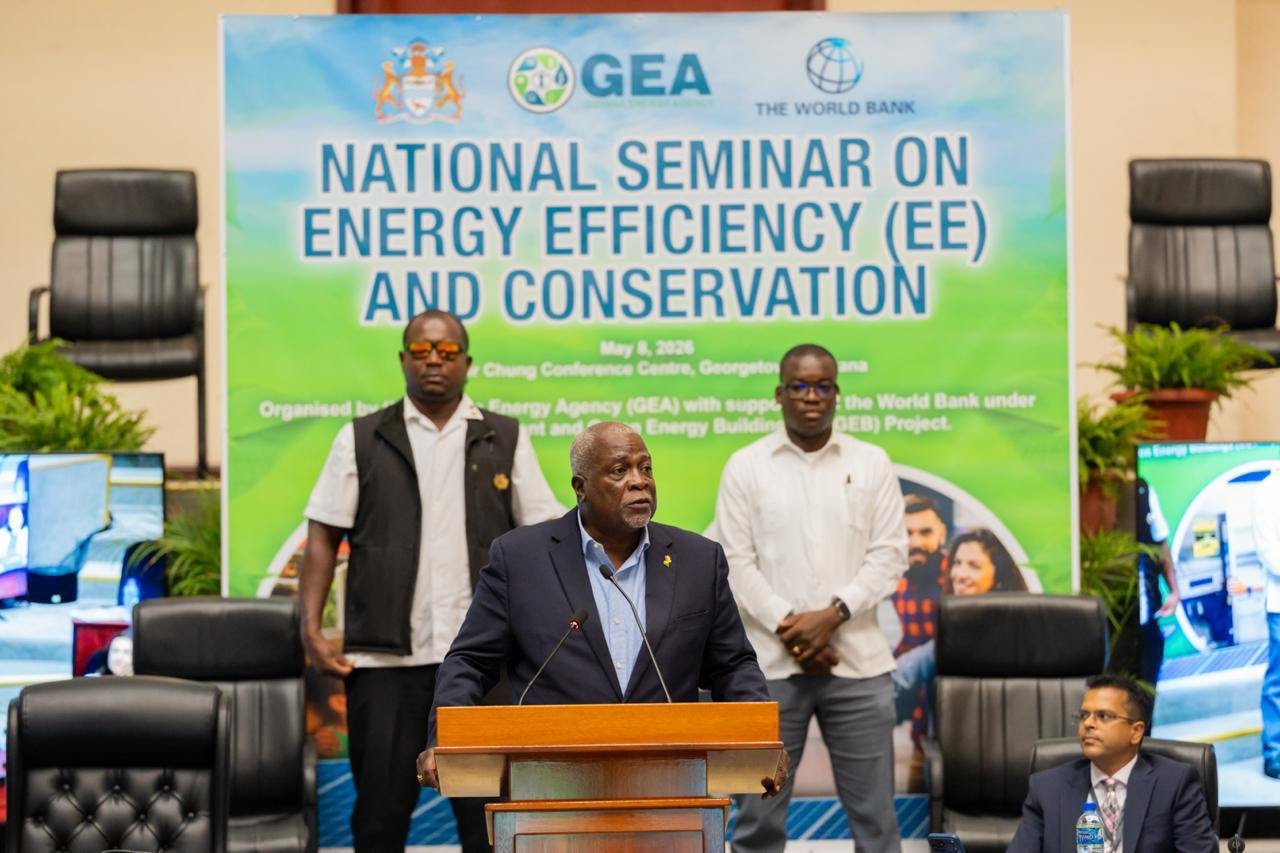
Prime Minister, Brigadier (Ret’d), the Honourable Mark Phillips stressed that energy efficiency and conservation remain essential to Guyana’s efforts to strengthen its energy security, reduce vulnerability to global fuel price shocks, lower costs, and advance a cleaner, more resilient energy future.
During today’s National Seminar on Energy Efficiency and Conservation at the Arthur Chung Conference Centre (ACCC), Prime Minister Phillips reminded that energy efficiency is not merely a technical consideration, but a national priority.
“Energy efficiency is how we win the demand side of this equation. It is not a complement to our energy transition — it is a structural pillar of it. This seminar is precisely about how we build that pillar.”


The Prime Minister, who is performing the functions of President, noted that the seminar was being held at a time of significant global energy stress, marked by geopolitical uncertainty, instability in energy markets, disruptions to global shipping routes, and rising fuel prices.
He explained that sharp increases in global acquisition costs have led to an average 74.8 per cent increase in fuel import costs, with the average acquisition cost of gasoline increasing by 62.4 per cent, while diesel and jet fuel also increased by 70.3 per cent and 102.6 per cent, respectively.
He further explained that the Government has taken steps to shield its citizens, with the excise tax on fuel held at zero per cent since March 2022. He said they will continue to monitor markets and engage with local oil companies on mitigation measures.
“The strategic answer that addresses the root of our vulnerability is to reduce our dependence on imported energy through the twin pillars of renewable energy supply and energy efficiency.”
The acting Head of State also highlighted that since August 2020, the Government has added over 186 megawatts of new generating capacity, constructed solar farms, completed two mini-hydropower plants, installed 46 solar mini-grids, and distributed 37,230 solar home energy systems, adding over 37 megawatts of renewable energy.
He also pointed to the ongoing construction of natural gas-fired power plants totalling 600 megawatts under the Gas-to-Energy Project, plans to install over 136 megawatts of solar power, and the advancement of the 165-megawatt Amaila Falls Hydropower Project.
The Prime Minister, however, underscored that supply-side investment alone will not be sufficient, noting that electricity demand is expected to grow fivefold by 2030 and stressing the need to manage demand growth.
He explained that public buildings, commercial and industrial facilities, and the residential sector all present major opportunities to reduce energy consumption, lower costs, and improve national efficiency. He said that the Caribbean Efficient and Green Energy Buildings Project, supported by the World Bank, stands as an important vehicle through which the Government is advancing energy efficiency in the public sector.
He further stated that Guyana’s Low Carbon Development Strategy (LCDS) 2030 remains the country’s most comprehensive commitment to ensuring that economic growth and environmental stewardship advance together, explaining that energy efficiency supports every dimension of the strategy by helping to decouple economic growth from environmental degradation, while strengthening Guyana’s position as a responsible and climate-conscious developing state.
“Through energy efficiency, renewable energy expansion, and the adoption of cleaner technologies, we can build an economy that is productive, competitive, and environmentally sound.”
Prime Minister Phillips also emphasised that a national energy efficiency agenda cannot be driven solely by the Government but requires a collaborative, “whole-of-society” approach.
He encouraged the private sector to view the energy-efficiency market as a business opportunity, called on financial institutions to develop products such as green loans and revolving credit facilities, and urged regulators to ensure that the necessary frameworks and standards enable the market to grow.
He also used the opportunity to remind citizens that energy efficiency begins with everyday choices in homes, workplaces, and communities.
The Prime Minister also expressed confidence that the seminar would produce practical takeaways and action points to support the continued integration of energy efficiency into Guyana’s national development agenda.
Today’s event was hosted by the Guyana Energy Agency in collaboration with the World Bank.