





The United States has made it unmistakably clear: it is not backing down from its pursuit of the extradition of businessman Nazar Mohamed and his son Azruddin Mohamed.
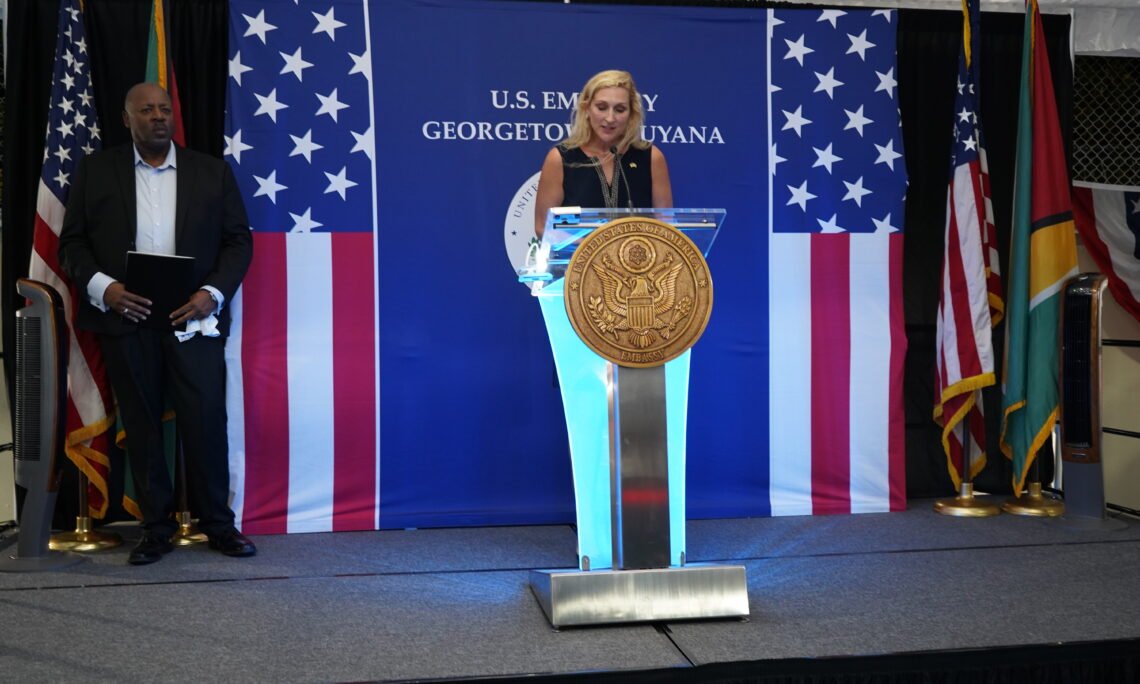
Speaking on the sidelines of the Guyana Energy Conference at the Guyana Marriott Hotel in Georgetown on Wednesday, United States Ambassador to Guyana Nicole Theriot delivered a blunt and unequivocal message: Washington is fully committed to seeing the extradition request through to its conclusion.
The request, she noted, was formally signed late last year by U.S. Secretary of State Marco Rubio—a signal that this is no routine diplomatic paperwork, but a serious matter backed at the highest levels of the U.S. government.
“I want to make it incredibly clear that the US is 100% committed to seeing this through. It is incredibly important to us that these proceedings continue and that a decision is ultimately made,” the Ambassador informed the media and the people in Guyana.
The Mohameds have been indicted by a federal grand jury in the U.S. District Court for the Southern District of Florida on 11 criminal charges, including wire fraud, mail fraud, tax evasion and money laundering. The United States is seeking their extradition so they can answer to those charges in an American courtroom.
While the case is currently before the Georgetown Magistrates’ Court, presided over by Magistrate Judy Latchman, proceedings have been repeatedly adjourned. Defence applications and procedural challenges have slowed the committal process, prompting growing scrutiny of the case’s pace.
Ambassador Theriot acknowledged that delays are not unusual in complex legal matters but underscored that Washington’s resolve has not weakened.

“There have been a lot of delays, including today. That’s understandable. That happens in cases, but let me just tell you, the US government does not spend 10s of 1000s of US taxpayer dollars to request extradition if we’re not serious. We want to see this happen, and we want to see justice served, both for the Guyanese and the US people,” Theriot stated.
Her remarks send a pointed message: this is not a matter that will simply fade with time or procedural manoeuvring. When a Secretary of State signs off on an extradition request, it signals intent—and patience should not be mistaken for weakness.
Azruddin Mohamed, who has long projected confidence in public appearances, now finds himself at the centre of an escalating legal storm. While his legal team continues to test every available avenue in court, the reality remains that the indictments are serious, the requesting state is unwavering, and international scrutiny is intensifying. Repeated adjournments may buy time, but they do not erase charges filed by a federal grand jury.
Parallel proceedings in the High Court and Court of Appeal have further complicated the timeline, as the defence seeks various forms of relief. Prosecutors, however, argue that these legal manoeuvres are contributing to the prolonged delays.
The U.S. Ambassador was careful to stress respect for Guyana’s judicial independence, even while reaffirming Washington’s keen interest in the outcome.
“I think we must be respectful of the Guyanese judicial system, and as they say, the ball is in your court. So, we are content to wait and see what happens. I have every faith that things will proceed and the right decision will be made. We’re watching from afar. We’re not interfering, but we’re very, very interested in the outcome, and we’re fully committed to seeing this through,” she added.
In diplomatic language, the message was measured. In substance, it was firm.
For Azruddin Mohamed, the optics are shifting. What may once have been framed as a local legal contest is now unmistakably an international matter backed by the full weight of the U.S. government. The proceedings may continue to inch forward, but Washington has made it clear: this is not a case it intends to abandon.
The courts in Guyana will ultimately decide the extradition question. But one thing is evident—this is a legal reckoning that is not going away.