





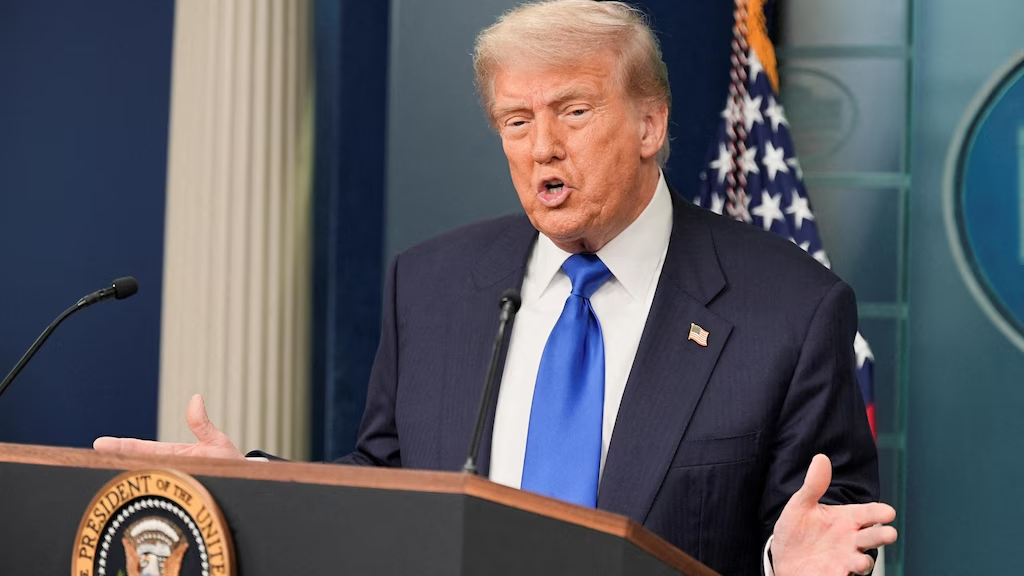
Former U.S. President Donald Trump has once again stirred global debate by claiming that the United States needs to “own” Greenland in order to prevent Russia and China from expanding their influence in the strategically important Arctic region.
Speaking at a recent public interaction, Trump argued that Greenland’s geographic location makes it critical to U.S. national security. He said the vast Arctic island, which is an autonomous territory of Denmark, could become a target for rival powers seeking greater military and economic presence in the Arctic. According to Trump, failing to secure control over Greenland could leave the United States vulnerable to strategic threats from Moscow and Beijing.
Trump’s remarks revive memories of his presidency, when he had floated the idea of purchasing Greenland—a proposal that was swiftly rejected by Danish and Greenlandic leaders, who made it clear that the island was not for sale. At the time, Denmark called the idea “absurd,” while Greenland’s government emphasized its right to self-determination.
In his latest comments, Trump framed the issue not as a real estate deal but as a matter of geopolitical necessity. He claimed that China has shown increasing interest in Arctic shipping routes and mineral resources, while Russia has been expanding its military infrastructure across the Arctic. “If we don’t step in, others will,” Trump suggested, warning that the U.S. could lose strategic ground in the region.
Greenland occupies a crucial position between North America and Europe and hosts key U.S. military installations, including the Thule Air Base, which plays a role in missile defense and early warning systems. Analysts note that climate change, which is opening new Arctic sea routes and access to untapped resources, has intensified global competition for influence in the region.
However, international relations experts have pointed out that outright “ownership” of Greenland is neither legally nor politically feasible. They argue that cooperation with Denmark and Greenland’s local government remains the only realistic path for the U.S. to safeguard its strategic interests in the Arctic.
Trump’s statement has reignited discussions about Arctic security, sovereignty, and great-power rivalry. While his comments have drawn criticism and skepticism, they also underscore the growing importance of the Arctic in global geopolitics—and the increasing attention it is receiving from major world powers.