






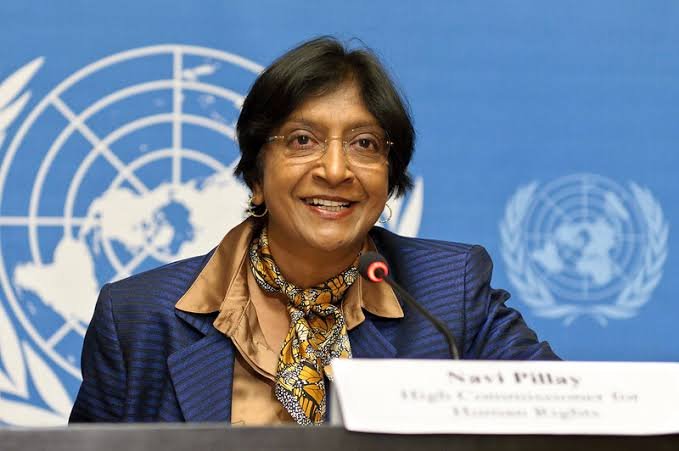
Navanethem “Navi” Pillay, the South African-born jurist and former United Nations High Commissioner for Human Rights, has been awarded the 2026 Nobel Peace Prize in recognition of her longstanding efforts to promote peace, uphold international law and advance accountability for war crimes, crimes against humanity and genocide.
The Norwegian Nobel Committee announced the award on Friday, praising Pillay for her commitment to universal legal principles and her contribution to building a stronger international legal order. Her career has spanned the struggle against apartheid in South Africa, landmark international criminal proceedings and investigations into alleged grave violations of human rights. The Nobel Committee’s official citation</a> describes her work as instrumental in ensuring that perpetrators of serious international crimes can be prosecuted.
At 85, Pillay becomes one of the most prominent figures of Indian Tamil heritage to receive the prestigious international honour. Her achievement also marks another significant moment for South Africa, a country whose history of racial oppression and transition to democracy has shaped her lifelong commitment to justice and equality.
From Durban to the international legal arena
Born on September 23, 1941, in Durban, South Africa, Pillay grew up in a family of Indian Tamil origin during the apartheid era, when racial discrimination was embedded in the country’s laws and institutions.
Her early life unfolded in a society where race determined access to opportunities, education and public institutions. Rather than accepting these restrictions, she pursued a career in law, determined to challenge discrimination and defend people whose rights were being denied.
In 1967, Pillay became the first woman to establish a law practice in Natal Province, now part of KwaZulu-Natal. She also became the first Black woman to serve on South Africa’s High Court, a historic appointment that challenged longstanding racial and gender barriers within the country’s judiciary.
During apartheid, she represented political activists and others who faced persecution under the discriminatory system. Her legal work placed her within the broader struggle for equality and democratic freedoms, including the movement associated with Nelson Mandela and other opponents of apartheid.
Pillay’s career demonstrated how legal advocacy could be used to challenge state power and defend fundamental rights, even when the political environment was hostile to those objectives. Her subsequent appointment to some of the world’s most important international judicial institutions extended that work beyond South Africa’s borders. The International Criminal Court’s official biography</a> documents her pioneering legal career and service in international justice.
A landmark role in the Rwanda genocide tribunal
One of the defining chapters of Pillay’s career came after her appointment as a judge of the International Criminal Tribunal for Rwanda, established by the United Nations to prosecute those responsible for genocide and other serious crimes committed during the 1994 Rwandan genocide.
She served on the tribunal for eight years and became its president, helping advance international efforts to establish individual accountability for atrocities committed during armed conflict.
Her judicial work contributed to the recognition of sexual violence as a central issue in international criminal law. In the landmark Prosecutor v. Akayesu case, the tribunal established that rape and sexual violence could constitute acts of genocide when committed with the required intent and under the circumstances defined by international law.
The judgment was significant because sexual violence had often been overlooked or inadequately addressed in investigations of mass atrocities. It helped establish that such crimes could not be treated as incidental consequences of conflict but could form part of a deliberate strategy to destroy a protected group.
Pillay’s work at the tribunal also helped strengthen the principle that political leaders, military officials and other individuals could be held personally accountable for international crimes.
Her contribution to international criminal justice subsequently led to her appointment as a judge of the International Criminal Court, where she served from 2003 to 2012. The ICC investigates and prosecutes individuals accused of genocide, war crimes, crimes against humanity and, under its jurisdiction, the crime of aggression.
Leading the United Nations human rights office
In 2008, Pillay was appointed United Nations High Commissioner for Human Rights, a position she held until 2014.
As the UN’s senior human rights official, she worked on issues ranging from discrimination and freedom of expression to the protection of civilians in armed conflict. Her responsibilities included raising concerns about human rights violations, supporting international monitoring efforts and urging governments to meet their obligations under international law.
Her tenure coincided with major political upheavals, armed conflicts and humanitarian crises across several regions. The role required engagement with governments, international institutions and civil society organisations, often on issues where human rights concerns were politically sensitive.
Pillay consistently emphasised that human rights protections should apply universally, regardless of nationality, ethnicity, religion, political affiliation or the power held by those accused of violations.
The position also gave her an influential platform to advocate for accountability and stronger international mechanisms to protect vulnerable populations. Her career at the United Nations reinforced her reputation as a jurist whose work connected national legal struggles with broader international standards.
Gaza investigation places international accountability back in the spotlight
Pillay’s recent work has drawn renewed international attention because of her leadership of the UN Independent International Commission of Inquiry on the Occupied Palestinian Territory, including East Jerusalem, and Israel.
In a report released on September 16, 2025, the commission concluded that Israeli authorities and security forces had committed genocide against Palestinians in the Gaza Strip. The report examined events following October 7, 2023, and identified four of the five underlying acts listed in the 1948 Genocide Convention, concluding that the necessary intent to destroy Palestinians in Gaza, in whole or in part, had been established.The UN’s publication of the commission’s findings</a> sets out the report’s legal conclusions.
The commission examined killings, serious bodily and mental harm, the deliberate imposition of conditions of life calculated to bring about physical destruction, and measures intended to prevent births within the group. It also examined statements by Israeli officials and the conduct of Israeli forces as part of its assessment of intent.
Israel rejected the findings, describing the report as false and politically motivated. The commission’s conclusion is a finding by an independent UN inquiry; it should not be confused with a final judgment by an international court.
The report intensified international debate over the application of the Genocide Convention and the responsibilities of governments to prevent and punish genocide. It also renewed scrutiny of whether international legal institutions can effectively address alleged violations when powerful states and their allies contest their findings.
For Pillay, the investigation represented another chapter in a career focused on the legal responsibilities of states and individuals during periods of conflict. Her leadership of the inquiry became a prominent part of the record cited in connection with the Nobel Peace Prize.
Continuing work at the International Court of Justice
Pillay’s international legal work has also extended to proceedings before the International Court of Justice, the principal judicial organ of the United Nations.
The court adjudicates legal disputes between states and provides advisory opinions on questions of international law. Among the cases attracting international attention is the genocide case brought by The Gambia against Myanmar concerning the treatment of the Rohingya people.
The proceedings concern allegations under the Genocide Convention and raise fundamental questions about the obligations of states to prevent and punish genocide. The case is separate from the criminal proceedings conducted by the International Criminal Court, which deals with the responsibility of individuals rather than disputes between states.
Pillay’s involvement in international judicial work reflects the continuing importance of legal processes in addressing allegations of mass atrocities and protecting populations from persecution.
A career connecting apartheid-era South Africa with global justice
The Nobel Committee highlighted a consistent theme throughout Pillay’s career: the pursuit of accountability, from her early legal work defending opponents of apartheid to her service in international tribunals and human rights institutions.
Her professional journey also reflects the broader transformation of international law over recent decades. Courts and tribunals established to address atrocities in Rwanda and the former Yugoslavia helped advance the principle that serious crimes should not go unpunished simply because they were committed during conflict or under the authority of a government.
These institutions have faced significant challenges, including political resistance, questions about enforcement and disputes over their jurisdiction. Nevertheless, their work has helped develop legal standards concerning genocide, crimes against humanity, sexual violence and the treatment of civilians.
Pillay’s career has been closely associated with those developments, particularly the effort to make international legal protections meaningful for people who have little power to defend themselves.
An achievement of significance for South Africa and the Indian diaspora
Pillay’s Nobel recognition carries particular significance because of her background as a South African of Indian Tamil descent.
Her family history reflects the wider presence of people of Indian origin in South Africa, where generations of Indian migrants and their descendants built communities while confronting discrimination and unequal treatment. Under apartheid, Indian South Africans were subjected to racial restrictions alongside other non-white communities.
Pillay’s rise to senior judicial and international positions represents a remarkable professional trajectory in a society that once systematically restricted opportunities on the basis of race.
Her achievement also resonates with the wider Indian diaspora, demonstrating how individuals from historically marginalised communities can shape international institutions and contribute to the development of legal principles that transcend national boundaries.
Her legacy, however, extends beyond her ancestry or national identity. It rests on a career that has addressed the rights of people across ethnic, racial and national divisions.
Nobel Peace Prize to be presented in December
The 2026 Nobel Peace Prize carries an award value of 12 million Swedish kronor, approximately US$1.2 million. The presentation ceremony is scheduled for December 10 in Oslo, Norway, the anniversary of the death of Alfred Nobel, whose will established the prizes.
The Norwegian Nobel Committee’s decision places renewed attention on the role of international law in preventing atrocities, protecting civilians and holding individuals accountable for serious violations.
For Pillay, the honour recognises a professional life that has moved from challenging racial discrimination in apartheid-era South Africa to participating in some of the most consequential international legal processes of the modern era.
Her career underscores a central question facing the international community: whether legal principles intended to protect human dignity can be upheld consistently, even when their application challenges governments and powerful political interests.
With the 2026 Nobel Peace Prize, Pillay’s work becomes part of a wider international conversation about justice, accountability and the continuing struggle to ensure that the law applies to everyone.