






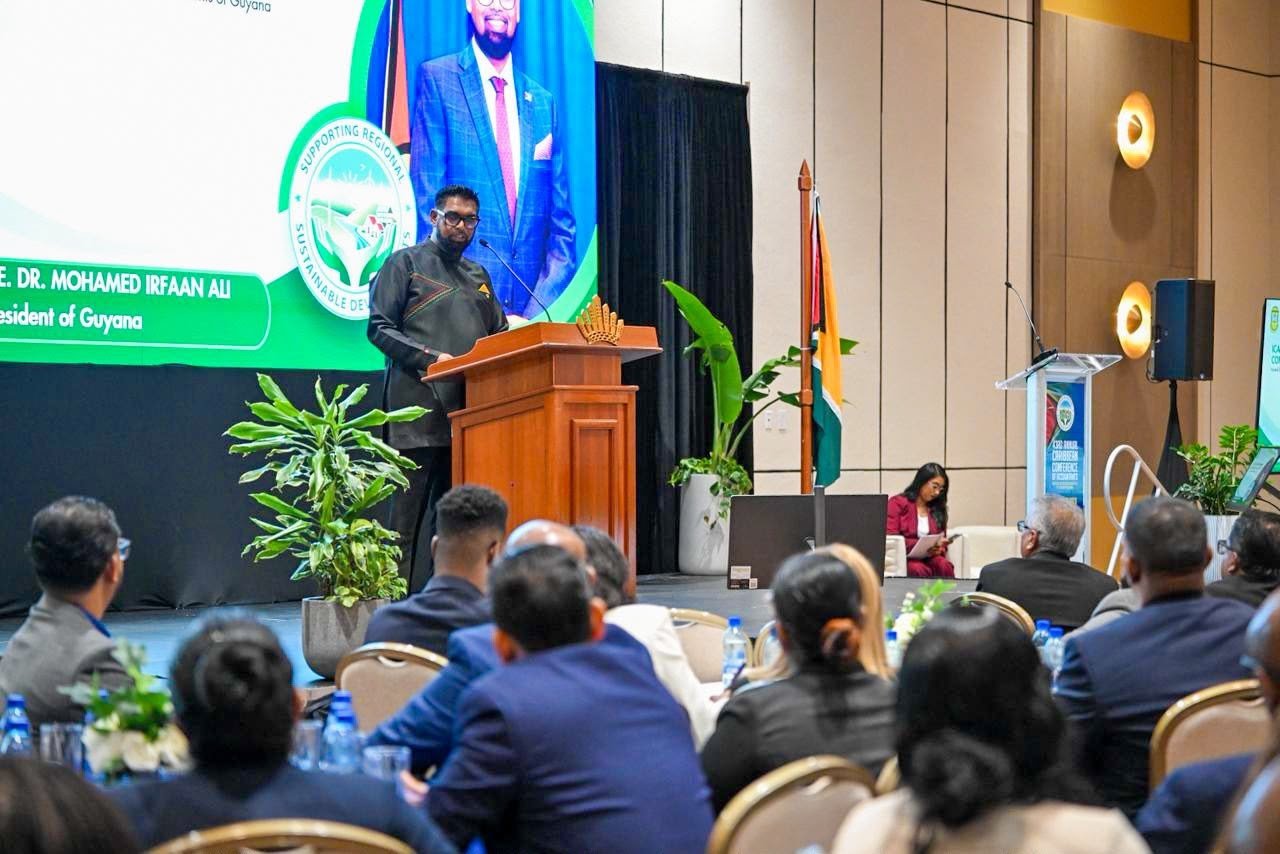
President Dr Mohamed Irfaan Ali on Friday challenged accountants across the Caribbean to redefine their role in a rapidly changing world.
He warned that adaptation to artificial intelligence (AI), climate realities and shifting market conditions will determine the profession’s future relevance.
Delivering the feature address at the opening of the 43rd Annual Conference of the Inter-American Accounting Association (ICAC), President Ali welcomed more than 300 delegates from across the region to Guyana and called for a new era of problem-solving and innovation within the profession.

He said the conference comes at a defining moment for business globally, where managing costs, improving efficiency and making quicker decisions have become critical to competitiveness.
“Professions around the world are changing because of systems…we have to decide whether people drive systems or the system is driving people,” the president told participants.
A central theme of his address was the growing influence of AI and the urgent need for Caribbean professionals to shape the manner in which technology is integrated into regional economies.
“AI is a tool to help us, but if we allow AI to be the tool that directs us, then we will have challenges,” President Ali stated, urging accountants to move beyond traditional functions and embrace broader roles in policy analysis, strategic planning and data-driven decision-making.
He encouraged conference organisers to move beyond structured discussions and create practical, solution-oriented sessions focused on real regional challenges.
Among the areas highlighted was the development of market-based approaches to environmental and climate services.

Additionally, President Ali said Caribbean professionals must help design systems to place economic value on biodiversity and environmental preservation.
“We are definitely the most impacted and affected when it comes to climate change. A body like this…must be able to develop a monetised, market-based model that can be shared across the region,” the president said.
Turning to regional financing opportunities, the president said Caribbean countries must find ways to improve liquidity and pension resources to support sustainable growth.
He pointed to Guyana’s exploration of diaspora bonds and investment vehicles that would allow ordinary citizens to participate in major economic ventures.
The head of state also stressed that accountants must become more analytical and adaptive as automation transforms routine financial work.
Using government as an example, President Ali revealed that AI-supported dashboards now provide executive summaries of delayed projects and cost overruns in seconds.
“If a system can generate all the numbers, then what becomes the role of the accountant? The accountant of the future must use the data…not simply generate it.”
He argued that future accountants must combine financial expertise with market understanding, strategic thinking and policy awareness.
President Ali also praised the partnership between the University of Guyana and ACCA, which allows students pathways into internationally recognised qualifications, saying regional universities must align programmes with changing industry needs.
He said, “You can’t be inward looking…education must prepare students for absorption into the economy.”
The president further called on the profession to preserve public trust and maintain strong ethical standards, warning that professional credibility must not become blurred by political interests.
He reminded participants that accountants remain among the world’s most marketable professionals but said success in the future will depend on producing not simply more accountants but the right accountants.
As Guyana undergoes rapid economic transformation driven by infrastructure expansion, investment and new industries, President Ali said demand for accounting and advisory services will continue to rise.
He challenged the regional accounting community to ensure that the conference produces practical outcomes that strengthen competitiveness, deepen financial inclusion and position the profession as a driver of development across the Caribbean.