





Guyana’s case against Venezuela in the International Court of Justice, the world’s highest international judicial tribunal, has now been fully submitted. The submissions of both parties, presented over the course of the past eight years, concluded on May 11 with the completion of the oral hearings in The Hague. All that remains now is for the Court itself to deliberate, draft its final Judgment, and issue it in a public session.
As is customary, no date for that session has yet been set. The Court will give the parties and the public two weeks’ notice of the scheduling of the session. Normally, it takes six to eight months from the close of the oral hearings to the issuance of the final Judgment. If this holds true in our case, we can expect the Judgment sometime between November 2026 and January 2027. Whatever the Court decides, it will be legally binding on both Guyana and Venezuela. Both States will be obligated to accept and comply with it under the explicit terms of the United Nations Charter and the Statute of the International Court of Justice, to which they have both subscribed.
The very fact that this case reached the ICJ, and that the written and oral phases of the proceedings were carried out to their completion, represents a triumph for the rule of law and the rules-based international order. It has always been Guyana’s firmly held position that disputes between States must be resolved peacefully, finally and in conformity with international law. They must not be allowed to fester indefinitely. They must never be resolved by threat or use of military force.
While we cannot know with certainty how the Court will rule, Guyana is confident – in fact, after the oral hearings last month, Guyana is more confident than ever — that the Court will uphold the legal validity of the 1899 Arbitral Award and the finality and permanence of the international boundary between Guyana and Venezuela that the entire world (with the exception of Venezuela) recognizes, and that it will order Venezuela not to offend, seize, annex or trespass any Guyanese territory, as defined by the 1899 Arbitral Award, or to threaten any such transgressions against Guyana. In short, we expect to be fully victorious in this historic, and for Guyana, existential, case.
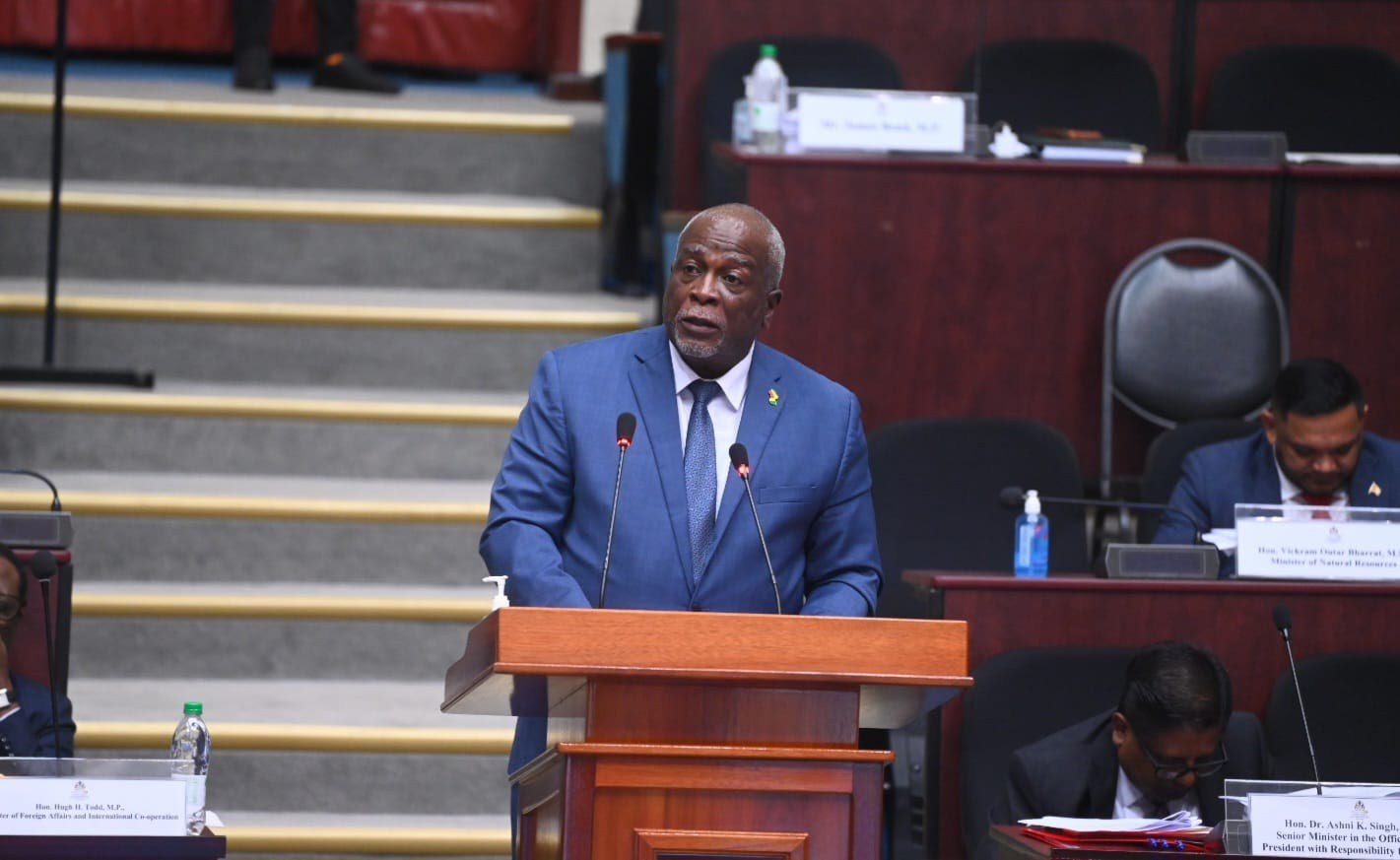
Guyana is very proud of the presentations it made at the recently concluded oral hearings. It believes that its arguments were compelling and convincing, and that they showed the lack of merit in Venezuela’s case both on the facts and on the law. Guyana is grateful to its representatives in these proceedings, headed by Minister of Foreign Affairs and International Cooperation, Hugh Todd; Minister of Legal Affairs and Attorney General Anil Nandlall; and former Minister of Foreign Affairs Carl Greenidge, as Agent.
When the Court issues its Judgment, it will end the controversy that arose in 1962 when Venezuela, for the first time, challenged the lawfulness of the 1899 Arbitral Award and the international boundary it established, after accepting, respecting and complying with the Award and the boundary without protest for 63 years. The oral hearings established that Venezuela made this very belated protest precisely at the time Guyana was nearing its independence, British troops would be departing, and Venezuela would have a significant military advantage with which to press its unfounded claim to nearly three-quarters of Guyana’s territory, the very claim that the tribunal of five pre-eminent arbitrators unanimously rejected in 1899.
Before departing Guyana in 1966, the British took pains to negotiate an agreement with Venezuela to ensure that its challenge to the validity of the 1899 Arbitral Award would be resolved peacefully. The Geneva Agreement of 1966, to which Guyana became a party upon its independence that year, provided first for a four-year period of bilateral negotiations to resolve this dispute. These negotiations were unsuccessful. In the circumstances, the Geneva Agreement further provided that, if Guyana and Venezuela were unable to agree on another means of dispute settlement, the Secretary General of the United Nations would choose the proper means for final settlement of the controversy, with the power to choose new means if any prior means that he selected failed to achieve a resolution. In January 2018, after more than 50 years had passed without a settlement, including a prolonged good offices process supervised by the Secretary-General, Secretary General Antonio Guterres decided that the controversy should be settled by the International Court of Justice. His decision was binding on the two parties.
Guyana then initiated the proceedings in the ICJ in March 2018. Venezuela responded by challenging the Court’s jurisdiction to resolve the controversy, claiming that the Geneva Agreement did not authorise settlement by the ICJ. After considering the arguments of the two parties, the Court issued a Judgment in December 2020 in which it ruled that it had jurisdiction under the Geneva Agreement, and the Secretary-General’s decision to determine the legal validity of the 1899 Arbitral Award, as well as the international boundary between Guyana and Venezuela, and that its decision would be binding on both parties.
Following this, Venezuela again tried to terminate the proceedings by raising an objection to the propriety of judicial resolution in the absence of the United Kingdom, which was not a party to the case. The Court rejected Venezuela’s objection in its Judgment of 6 April 2023.
In October 2023, Venezuela announced that it would hold a national referendum in December 2023 seeking popular approval of its plans to reject the jurisdiction of the ICJ and incorporate Guyana’s entire Essequibo Region into Venezuela as the new Venezuelan state of “Guayana Esequiba”. Guyana immediately petitioned the Court for provisional measures prohibiting Venezuela from taking any such actions, regardless of the outcome of its referendum. In response, the Court ruled unanimously that:
“Pending a final decision in the case, the Bolivarian Republic of Venezuela
shall refrain from taking any action which would modify the situation that
currently prevails in the territory in dispute, whereby the Co-operative
Republic of Guyana administers and exercises control over that area.”
In early 2025, Venezuela announced plans to hold elections in its so-called “Guayana Esequiba” state, including within Guyana’s Essequibo Region. Guyana again requested that the Court issue provisional measures prohibiting Venezuela from transgressing its territory. And again, the Court responded favourably to Guyana’s request by issuing the following Order on 1 May 2025:
“Pending a final decision in the case, the Bolivarian Republic of Venezuela shall refrain from conducting elections, or preparing to conduct elections, in the territory in dispute, which the Co-operative Republic of Guyana currently administers and over which it exercises control.”
Now that the oral hearings have been concluded, we will await the Court’s final Judgment on the Merits with patience, dignity and optimism, as His Excellency the President of Guyana has said. And we will continue to address Venezuela in a spirit of peace, cooperation and friendship, and as sovereign equals. We will respect Venezuela’s sovereignty, as we have always done, and insist that Venezuela refrain from trespassing on, or threatening, Guyana’s sovereignty. And when the final Judgment is issued, we will insist that it be respected and fully complied with, as international law requires. This is the only way forward for our two States: toward a secure, just and lasting peace, an enduring friendship, and a mutually prosperous future for both our peoples.