






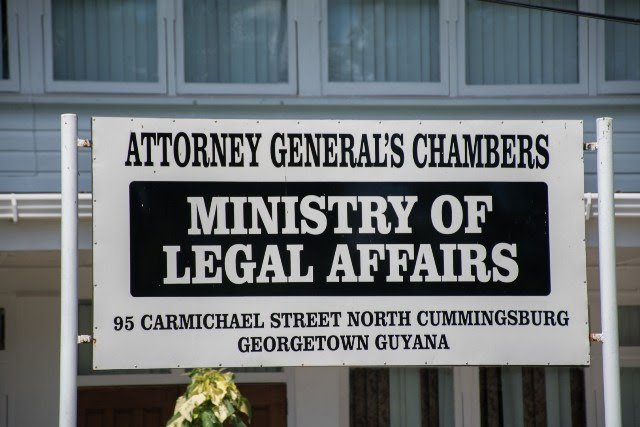
The Hon. Mme. Chief Justice, Roxane George SC (as she then was) delivered a written judgement on 24 June, 2026 in the matter of the International Decade for People of African Descent Assembly – Guyana Country Co-ordinating Mechanism Inc. (“IDPADA-G Inc.”) v the Attorney General, Charles Ramson Jr., Minister of Culture, Youth and Sport and Ashni Singh, Minister of Finance: High Court Action No. 2022-HC-DEM-CIV-FDA-1760.
Contrary to certain public commentary, the judgment did not order the reinstatement or continuation of subventions to IDPADA-G Inc. In fact, the Court ruled that IDPADA-G Inc. has no legal right to continued government funding. The Court further refused the substantive reliefs sought by the Applicant, including claims for breach of contract, substantive legitimate expectation, procedural legitimate expectation, breach of constitutional property rights, mandamus, exemplary damages, and costs.
From the facts the following issues arose for determination by the Court: (a) whether the applicant has standing to institute these proceedings;
(b) whether there was a contract between the government and the applicant for the latter to realise the objectives of the UNIDPAD in exchange for a subvention;
(c) whether the applicant had a legitimate expectation of receiving the subvention from the government;
(d) whether the applicant was entitled to be heard before the cessation of the subvention.
Having dispensed with the first issue, finding that the Applicant, which did not exist at the time it claims benefits were accorded to it, would not have had standing to bring the claim save for the admissions of the Respondents that payments were made to the Applicant, the Court proceeded to address whether there was a contract between the Government and the Applicant for the latter to realise the objectives of the UNIDPAD in exchange for a subvention.
The Attorney General submitted that “no case of contract has been made out either in the pleadings or by evidence and the issue of a breach cannot arise. In any event, assuming there was a contract, it would have been nudum pactum and void ab initio as there is no consideration flowing from the applicant, the alleged promisee.” The Court in agreeing with this submission held that there was no written contract, no clear offer, no acceptance, no consideration, and no sufficiently certain terms capable of creating a binding contractual obligation. The claim for breach of contract therefore failed.
Importantly, the Court rejected the claim that IDPADA-G Inc. had a substantive legitimate expectation to continued public funding. The Court found that the alleged promise was not specific and was, at most, a policy statement. The Court further recognised that budgetary allocations for the International Decade were allocations for a public cause and not allocations conferring a private proprietary entitlement on IDPADA-G Inc.
The Court accepted the State’s central contention that the Government’s support was for the programme and cause associated with the United Nations International Decade for People of African Descent, and not an irrevocable legal entitlement vested in IDPADA-G Inc. The Court expressly agreed with the State’s submission that former President David Granger’s 2016 statement outlined Government support for a cause, not a promise of financial support to the Applicant or to any specific organisation.
George CJ (Ag) (as she then was) stated:
[64] I agree with the submission for the respondents that the President’s statement outlined the Government’s support for a cause, that is, a programme of activities associated with the UNIDPAD, and not to the applicant. The transcript of the speech that was exhibited reveals that the President did not make a promise to any particular group or persons, and most definitely did not make a promise to the applicant or its predecessor, IDPADA-G. Importantly, the President did not make any statement about providing financial support to any group or person. It was a policy statement that did not include a promise to any particular group. To quote from the judgment of Anderson JCCJ cited earlier, President Granger made a general policy address which would be less likely to generate substantive legitimate expectations. As noted earlier, reference was made to an organisation, without specifying to which organization the statement was being made. Further, President Granger could not have made a promise to the applicant or IDPADA-G so since they were both non-existent at the time of his 2016 speech.
[71] Having considered the representations made by President Granger and Ministers Jordan and Norton, as well as the name in which the bank account was created, it is clear that the government budgeted the subvention in favour of the cause, and not the applicant specifically. I therefore hold that the arrangements between the government and IDPADA-G could not create a substantive legitimate expectation. In this factual matrix, a legitimate expectation to the continued allocation of the subvention to the applicant cannot arise, though it is acknowledged that payments continued to be made into the IDPADA-G account unto September 2022.
The Court also rejected the claim that the cessation of the subvention violated the Applicant’s constitutional right to property. It further held that neither IDPADA-G Inc., nor IDPADA-G established any right to continued subventions from 2023 onwards.
The only relief granted was a limited procedural order. The Court held that, as a matter of procedural fairness, IDPADA-G (the unincorporated body), not IDPADA-G Inc., the Applicant, should have been given notice and an opportunity to respond before the cessation of the subvention. On that limited basis, the Court ordered that the remaining instalments for October, November, and December 2022 be paid to IDPADA-G.
No order for costs was made against the State. In fact, the Court noted that IDPADA-G Inc. was not the proper party to have instituted the proceedings and that its substantive claims were without merit.
The Attorney General’s Chambers therefore clarifies that the judgment substantially vindicates the State’s position on the core legal issues. The Government remains free, as a matter of policy and in accordance with law, to determine how public funds allocated for national programmes and public causes are to be utilised for the benefit of the widest possible cross-section of citizens. In this regard, the Court stated:
[77]…Since the subvention was for the cause, the government as a matter of policy could decide that it would seek to execute the policy through another executing agency. To direct that the government must make a budgetary allocation to the applicant or IDPADA-G, moreso in the sum of $100,000,000 as the applicant claims, would amount to judicial overreach.
[79] It cannot be that the payment of such a grant is to be construed as a mandatory obligation for the government to fulfil regardless of the budgetary situation. This is to say, there being no evidence to support the claim of a substantive legitimate expectation, there cannot be a concomitant claim to procedural legitimate expectation which in effect is a claim that the principles of natural justice are to be applied. Therefore, the government was and remains free to change its policy regarding the utilisation of the budgetary allocation for the UNIDPAD.
The Respondents were represented by Ms. Deborah Kumar; Ms. Shoshanna V. Lall; Ms. Ronetta Sargent; and Ms. Loretta Noel who were all lead by the Hon. Attorney General, Mr. Mohabir Anil Nandlall, SC, MP, who appeared in person.
Needless to say, the Government of Guyana remains committed to the cause of the United Nations General Assembly Resolution 68/237 ‘Proclamation of the International Decade for People of African Descent’ and continues to allocate annual budgetary sums which are disbursed directly to dozens of organisations representing Afro-Guyanese. These very organisations had complained to the Government that they did not benefit from over $500 million that the Government had disbursed in relation to the United Nations Resolution to IDPADA-G Inc. and petitioned the Government to cease financial allocations to the organisation and disburse those funds to the multiple representative organisations directly.
The financial accounts of IDPADA-G Inc. showed that over eighty percent (80%) of the monies received were spent on salaries, rent, meals, and other expenses in relation to the running of the organisation rather than on direct benefits to ordinary Afro-Guyanese.