





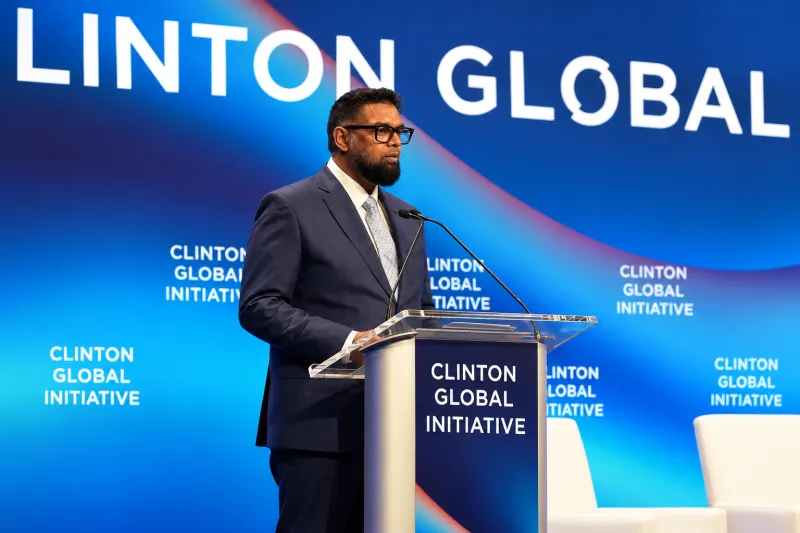
President Dr Mohamed Irfaan Ali has urged the international community to view partnerships as a key tool for small developing states to overcome limitations in finance, technology and human resources and contribute to solving global challenges.
Addressing the Clinton Global Initiative (CGI) Annual Meeting in New York on Wednesday, Ali said a country’s ability to make an impact should not be determined solely by its size or population.
The President used Guyana’s experiences in healthcare, climate action, energy, food security and technology to demonstrate how international cooperation can help smaller countries undertake projects that would otherwise be beyond their individual capacity.
“Guyana is indeed a small state, but we are learning that the power of a country is not measured only by size and population. Power can also be measured by the partnership a country builds,” Ali said.
He described partnerships as “a great equaliser of our age”, arguing that the central question for small states should not be whether they can undertake major initiatives alone, but whether they can bring together the right partners to achieve them.
“The question, therefore, is not whether a small state can do everything itself. The question is, can we build partnerships that allow us to do what we could never do alone?” he said.
Ali said smaller developing countries often lack the resources to independently finance advanced laboratories, specialised medical technology and large-scale research programmes. However, he said they can provide suitable environments for testing and implementing new approaches while contributing political commitment, skilled personnel and the ability to bring stakeholders together.
Healthcare partnerships
The President pointed to healthcare as one of the clearest examples of Guyana’s partnership-driven approach.
He said the country had moved to strengthen its collaboration with the Mount Sinai Health System and Hess Corporation through a five-year extension aimed at supporting the transformation of Guyana’s public healthcare system by 2030.
According to Ali, the initiative has already resulted in the collection of baseline medical information for every primary school child, with secondary school students expected to be included next.
He also highlighted a robotic cardiac surgery conducted through telemedicine between Guyana and India, which he described as the longest-distance procedure of its kind.
International partnerships have also supported Guyana’s efforts to expand its healthcare workforce, he said, with universities, institutions and training programmes contributing to increased numbers of nurses, patient care assistants, laboratory technicians and doctors entering the system.
Climate and biodiversity
Ali said the same partnership model is being applied to environmental protection and biodiversity.
He noted that the Global Biodiversity Alliance, launched by Guyana two years ago, has grown to 140 members comprising countries, research organisations and academic institutions.
Guyana, he said, is increasingly positioning itself as a source of experience and knowledge in tropical forest management, biodiversity conservation and forest carbon credits.
With forests covering approximately 85 per cent of the country’s land area, Ali said Guyana has an opportunity to demonstrate how forest-rich nations can contribute to global climate and biodiversity efforts.
Energy and food security
The President also highlighted Guyana’s efforts to diversify partnerships and sources of financing for its energy development.
He said the country is working with partners in the Middle East and the United States, including the US Export-Import Bank, as it develops its energy sector.
In agriculture, Ali said Guyana is seeking to establish itself as a food-security hub for the Caribbean and wider region.
He cited cooperation with Brazil’s Brazilian Agricultural Research Corporation (Embrapa) and the Inter-American Institute for Cooperation on Agriculture (IICA) as examples of partnerships designed to accelerate access to agricultural technology, expertise and financing.
“It gives us the quickest pathway to technology, to people, to human assets, and, of course, to finances,” Ali said.
Expanding digital government services
Ali also highlighted Guyana’s efforts to use technology to make government services more accessible.
He said the government intends to make all public services available through a single digital platform, MyGuyana, by next year.
The President also pointed to investments in hinterland communities, saying these have contributed to an almost 95 per cent reduction in medical evacuations from one of Guyana’s most remote locations.
The CGI Annual Meeting brings together government leaders, business executives, philanthropists and other stakeholders to develop and advance initiatives addressing major global challenges.
Ali concluded his presentation by encouraging participants to explore Guyana’s development experience and learn more about what he described as “the Guyana story.”