






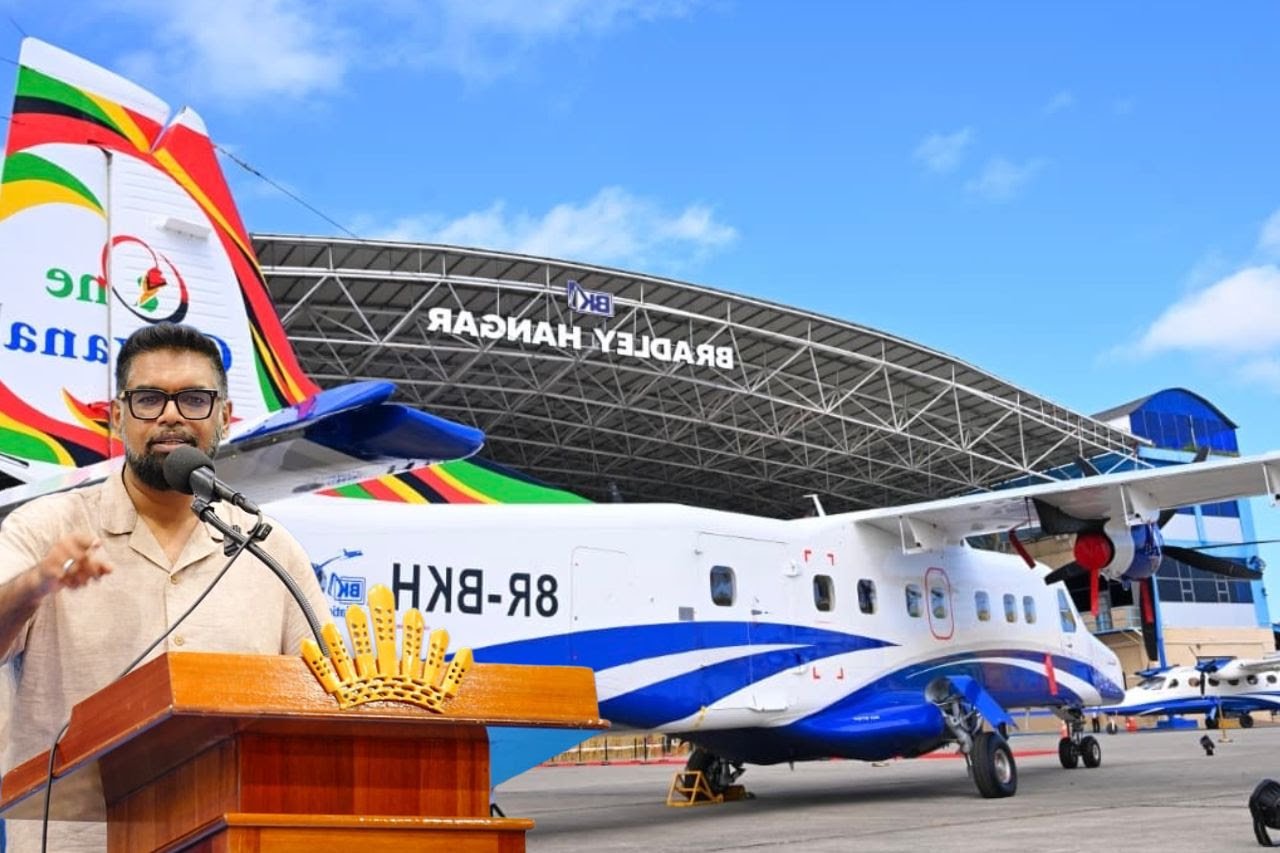
President Dr Mohamed Irfaan Ali on Saturday called for greater ambition and regional positioning within Guyana’s aviation industry as he delivered the keynote address at the commissioning of JAGS Aviation’s new Hindustan H-228 aircraft.
The two Dornier 228 aircraft each seat 19 passengers and are expected to significantly enhance service delivery. They also introduce a first for domestic aviation in Guyana, featuring onboard washroom facilities an added level of comfort for passengers travelling long distances.

The planes were procured from Hindustan Aeronautics Limited in India, further strengthening bilateral ties.
The president said the investment represents more than fleet expansion, describing it as another signal of Guyana’s broader economic transformation and its ambition to become a regional aviation hub.
Commending JAGS Aviation’s continued growth, the head of state said local aviation companies should begin looking beyond domestic operations and position themselves to compete regionally.
“It is a local company that I believe has the potential to become more than a local carrier, and indeed I believe that our aviation players should come together to look towards developing a regional carrier, because Guyana’s ambitions now seem limitless,” he stated.
President Ali said the government’s long-term strategy is to ensure Guyana becomes a premier aviation gateway connecting the Caribbean, South America, North America and Africa.

According to him, the country’s aviation development agenda includes strategic investments in airport infrastructure, air traffic management systems, expanded airline connectivity, digitisation and emerging technologies.
The president outlined a 10-pillar aviation development framework, anchored by the goal of transforming Guyana into a regional aviation and logistics hub.
He highlighted major initiatives already underway, including the construction of a new terminal at the Cheddi Jagan International Airport, development of municipal airports and investments in aviation training and safety systems.
“Terminal Two is a new state-of-the-art terminal that will reshape this region. It will celebrate our heritage, our culture, our biodiversity, our ecosystem. It is not just a terminal, it is built as an experience,” he said.
President Ali also announced that plans remain on course for a national aviation school, which he said is intended to serve not only Guyana but the wider region.
“That will be the premier school for all of the region,” he said, adding that language training, including Spanish, should form part of the curriculum to improve competitiveness.

The head of state said aviation remains critical to Guyana’s development because of the country’s geography and growing economic opportunities.
He said, “We are a country of vast forests, mighty rivers, scattered communities and immense distances. In such a landscape, aviation is not a luxury — it is a lifeline.”
He noted that aviation’s role is evolving beyond supporting mining operations and now includes tourism, trade, investment and improved access to hinterland communities.
President Ali said increasing visitor arrivals and growing investor interest in sectors such as tourism, manufacturing and food production require stronger transportation infrastructure and greater private sector alignment.
He praised JAGS Aviation for continuing to invest despite changing market conditions and pointed to the company’s focus on developing human capital.
“The only way a company can grow and reinvent itself is through investment in human capital,” the president said.
Congratulating the company on the commissioning of the aircraft, President Ali said such investments support Guyana’s wider development agenda by improving connectivity, expanding economic opportunities and strengthening national integration.
“These aircraft will help move people and goods across our beautiful country. They will strengthen connectivity, support economic activity and contribute to ensuring that development reaches every region and every community.”
Jags Aviation now operates a fleet of 14 aircraft, continuing its expansion following the acquisition of two Tecnam P2012 Traveller planes from Italy last year.