






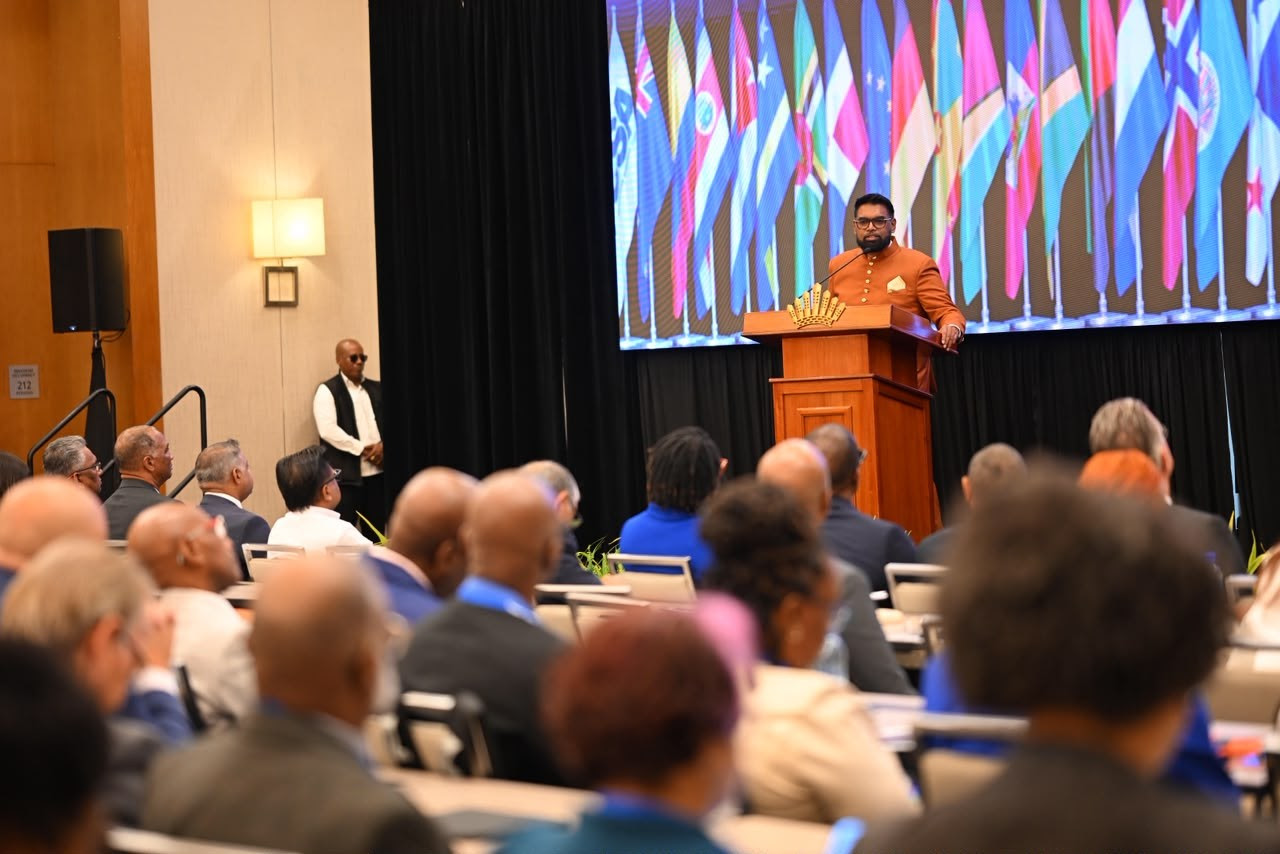
Georgetown, Guyana — President Dr Mohamed Irfaan Ali has called for an urgent regional investment plan to modernise Caribbean ports, improve shipping connectivity and strengthen the region’s competitiveness in international trade.
The President made the proposal on Monday while delivering the keynote address at the opening of the 56th Annual General Meeting, Conference and Exhibition of the Caribbean Shipping Association (CSA), held at the Guyana Marriott Hotel in Kingston, Georgetown.
He proposed that the plan be supported by regional and international financial institutions, including the Caribbean Development Bank (CDB), the Inter-American Development Bank (IDB) and IDB Invest.
The initiative would identify financing mechanisms, fiscal incentives, banking support and public-private partnership models to accelerate investment in port infrastructure across the Caribbean.
President Identifies Five Major Challenges Facing Caribbean Shipping
President Ali outlined five key challenges affecting the region’s maritime sector: high shipping and connectivity costs, uneven port infrastructure, limited inter-Caribbean trade, climate-related disasters and geopolitical instability.
He argued that these challenges require a coordinated regional response supported by long-term planning and increased capital investment.
The President also pointed to delays in port development across the Caribbean, noting that an earlier study by the IDB found that many regional ports were already decades old.
He stressed that governments and regional institutions must prioritise modernisation to ensure ports can accommodate changing trade demands and support economic growth.
High Shipping Costs Affect Businesses and Consumers
The President highlighted the impact of expensive shipping on household budgets and business operations throughout the Caribbean.
Citing a May 2026 International Monetary Fund working paper, he noted that shipping costs in Caribbean countries, with Jamaica identified as the exception, were above global averages.
These additional costs can contribute to higher prices for food, construction materials and other imported goods, while making regional businesses less competitive.
President Ali said reducing shipping costs and improving connectivity should therefore be treated as economic priorities, rather than solely as maritime industry concerns.
Public-Private Partnerships Key to Port Modernisation
President Ali called for a financing framework that enables private investment to contribute to infrastructure serving the wider public interest.
He proposed bringing governments, lenders, investors and shipping industry stakeholders together to establish practical funding arrangements for modernising ports.
The framework could include public-private partnerships, fiscal incentives, access to commercial financing and support from development banks.
He also questioned whether sufficient engagement with financing institutions was taking place, emphasising the need to connect regional discussions with organisations capable of supporting implementation.
Guyana Showcases Port Investment Opportunities
The President pointed to Guyana’s own port development as an example of how public policy and private capital can work together.
He said investments in shore bases, laydown yards and port facilities along the Demerara River over the previous four to five years had approached or exceeded US$1 billion.
The government is also working with Bechtel on plans for a deepwater port and holding discussions with potential investors, including the Export-Import Bank of the United States (US EXIM) and the Qatar Investment Authority.
President Ali encouraged Caribbean countries to remain open to investment, develop partnerships and create frameworks that allow capital to be directed towards priority infrastructure projects.
He said Guyana’s experience demonstrates the importance of creating conditions in which investors can participate in projects that support wider economic development.
Regional Cooperation Needed to Strengthen Trade
The proposed investment plan is intended to address weaknesses in regional connectivity and help Caribbean countries move goods more efficiently between markets.
Modern ports could improve cargo handling, strengthen supply chains and make it easier for businesses to access regional and international customers.
Improved infrastructure and coordination could also help countries prepare for climate-related disruptions and other risks affecting maritime transport.
President Ali’s proposal places regional cooperation and access to financing at the centre of efforts to build a more resilient and competitive Caribbean shipping industry.
Caribbean Shipping Association Conference Continues in Georgetown
The four-day Caribbean Shipping Association conference runs until October 28 under the theme “Building a More Connected, Resilient, and Competitive Caribbean.”
More than 450 stakeholders are participating in discussions involving shipping, logistics, port operations, investment and maritime development.
President Ali was accompanied at the opening ceremony by Senior Minister in the Office of the President with Responsibility for Finance Dr Ashni Singh and Minister of Public Utilities and Aviation Deodat Indar, alongside diplomatic representatives and private-sector leaders.
The gathering provides a regional platform to discuss shared maritime challenges and explore investment opportunities aimed at strengthening Caribbean trade and economic resilience.