






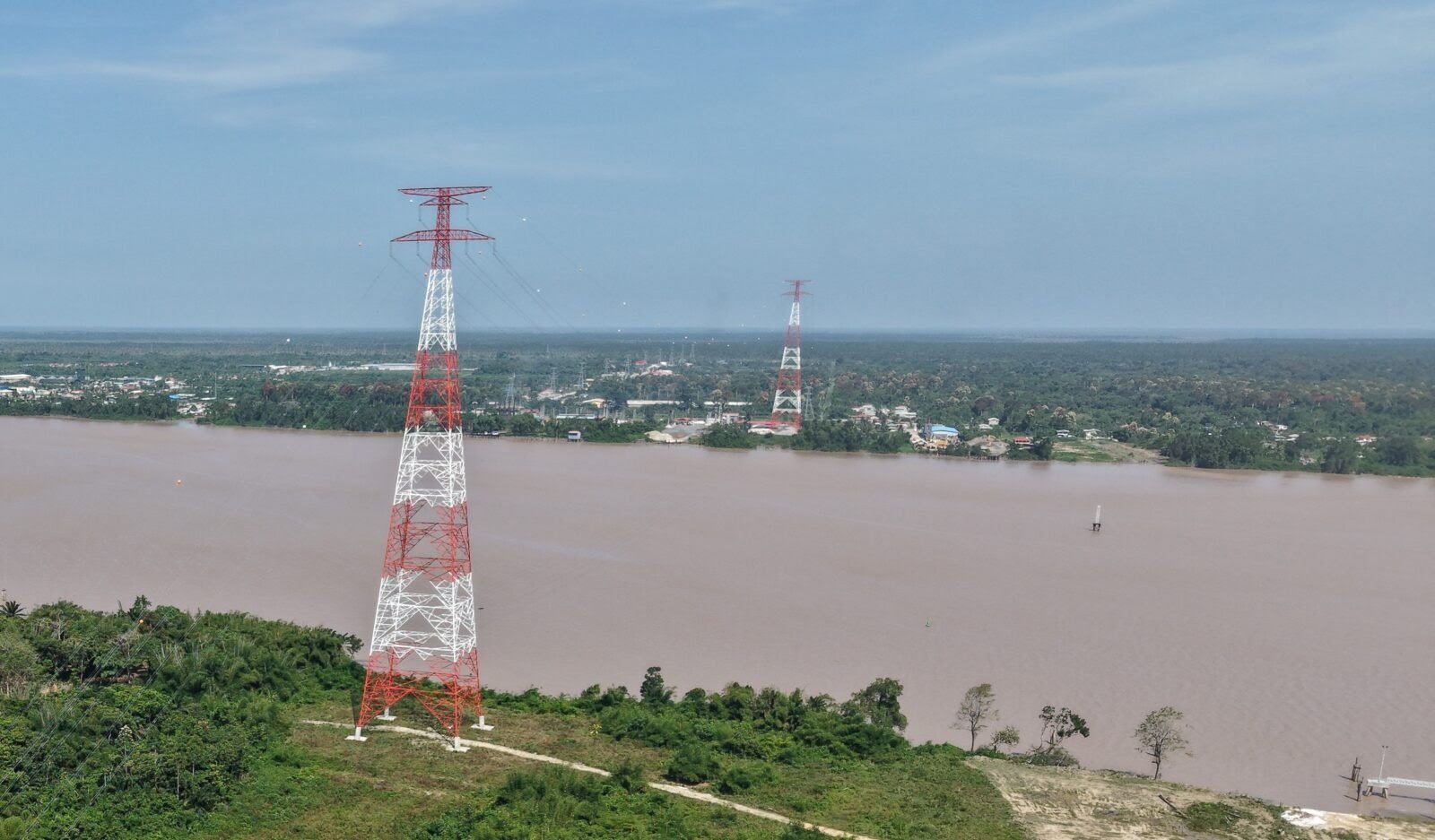
Guyana’s electricity network is undergoing one of its most significant transformations with the construction of more than 70 kilometres of new high-voltage transmission infrastructure designed to move power efficiently across the Demerara-Berbice Interconnected System (DBIS), improve reliability, and support future economic expansion.
The transmission network forms a critical component of the Gas-to-Energy (GTE) Project and will connect new substations, industrial zones, residential developments, and existing GPL infrastructure through a series of 230-kilovolt (kV) and 69-kV transmission lines.
At the centre of the network is a new double-circuit 230-kV transmission corridor stretching approximately 24 kilometres between Wales and Goedverwagting. The line will serve as the primary bulk power evacuation route, carrying electricity generated at Wales across the Demerara River and into the national grid.

The transmission corridor is expected to significantly strengthen the backbone of the DBIS, enabling large volumes of power to be moved more efficiently between the western and eastern sections of the grid while improving system stability.
Supporting the main transmission corridor are approximately 46 kilometres of new 69-kV transmission lines linking a series of substations that will distribute power to residential, commercial and industrial consumers.

A dedicated transmission link will connect the GTE Power Plant Substation to the Wales Industrial Substation, ensuring a reliable electricity supply to businesses operating within the Wales Development Zone and supporting future industrial expansion in the area.
Another transmission line will connect the Wales Industrial and Wales Residential/Commercial substations, improving service reliability for communities and businesses along the West Bank of Demerara while reducing pressure on existing infrastructure.
The network will also extend southward through a 19-kilometre transmission line linking the Wales Residential/Commercial Substation to the Vreed-en-Hoop Substation, creating an additional pathway for power flows and enhancing grid resilience.
On the eastern side of the Demerara River, a new transmission system connecting the Goedverwagting Substation with the Sophia and Golden Grove substations will dramatically increase power transfer capacity.
The upgraded corridor will replace an existing transmission line with a capacity of approximately 48 megavolt-amperes (MVA) with infrastructure capable of transmitting roughly 200 MVA, allowing the network to accommodate growing electricity demand from expanding housing schemes, businesses and industries.
The transmission infrastructure will be supported by four new substations, including a major 230/69/13.8-kV facility at Goedverwagting, which will act as a key interconnection point between the new transmission network and the existing DBIS.
Additional substations at Wales will serve industrial, residential and commercial developments while facilitating the integration of power generated from the Gas-to-Energy Project into the national grid.
To oversee the increasingly complex electricity system, GPL is also implementing the Guyana National Control Centre (GNCC), which will function as the country’s central dispatch and monitoring hub.
The facility will provide operators with real-time visibility of generation, transmission and distribution assets across the DBIS through advanced supervisory control and energy management systems.
The control centre will enable coordinated management of electricity flows, voltage and frequency regulation, outage response and contingency planning while supporting the integration of natural gas generation, battery storage and future renewable energy projects.
Together, the new transmission lines, substations and national control centre are expected to modernise Guyana’s electricity infrastructure, creating a more reliable and resilient grid capable of supporting the country’s rapidly expanding economy and growing energy demand.