






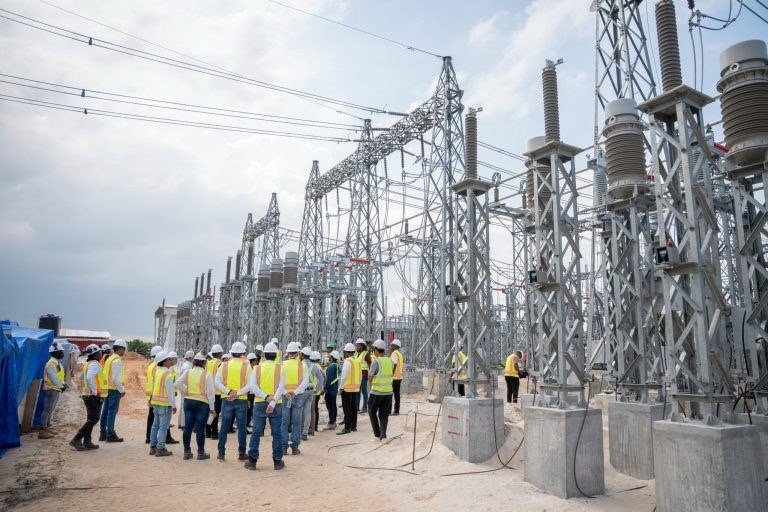
Construction of the Gas-to-Energy project continues to advance, with extensive quality-control measures being applied to soil stabilisation, piling and concrete works to ensure the long-term integrity of the facility.
Minister of Public Utilities and Aviation, Deodat Indar, recently visited the project site.
Minister Indar received updates from Country Manager and Board Member of Lindsayca Guyana Inc. Luis Pirela, and Engineer from Engineers India Limited (EIL) Murugesh Ayyaswamy.

Pirela explained that extensive soil modification was undertaken before foundation works commenced, a process which lasted approximately 18 months.
He noted that about 10,000 piles have since been installed, with some extending up to 38 metres into the ground.
Pirela said stringent quality-control measures are also being applied to the concrete works, with both the concrete supplier and Lindsayca conducting independent testing.

“There is a redundancy on testing. The company that provides the concrete does a lot of testing, and then we do independent testing and validate it,” he said.
Approximately 44,000 cubic metres of concrete have so far been placed at the facility, with Pirela reporting that there have been no deviations from the approved concrete mix design requiring corrective action.
He further explained that major equipment foundations are supported by deep piles, with individual piles capable of carrying more than 200 tonnes.
“One turbine alone has more than 400 piles,” Pirela said.
Meanwhile, Ayyaswamy outlined the technical monitoring undertaken during the foundation works.
He noted that soil stabilisation was closely monitored using instruments and technical experts, with the data collected determining the level of stabilisation required.
Following this process, pile testing, including compression and lateral tests, was conducted and reviewed by technical specialists before piling proceeded.

He said additional reinforcement measures were applied to selected piles based on their location and expected loads.
On the concrete works, Ayyaswamy said EIL reviewed the design mix before it was approved for use, while engineering teams from Delhi and visiting pile specialists were involved in reviewing and witnessing relevant tests.
Concrete samples are tested after pouring to verify strength, including seven-day and 28-day tests to ensure the required design strength is achieved.
“All these things are going well, and all are recorded. We are going and witnessing the tests,” he said.
Ayyaswamy added that the quality-control records and test results will form part of the documentation handed over to the Government of Guyana upon completion of the project.
The continued monitoring and testing are intended to ensure that the project’s foundations and major structural components meet the required engineering and quality standards as construction progresses.