





This week oral arguments commenced at the International Court of Justice (ICJ). On the first day of arguments, presented by Guyana’s side, the high quality of Guyana’s presentation, argument and case before the ICJ was apparent. It was a compelling case and absolutely demolished the claims of Venezuela. As Guyanese, we all must have felt a sense of pride that Guyana appeared before the highest court in the world and distinguished itself. Venezuela will also have a chance to present its case this week. The political leadership of Guyana’s delegation was made up of persons who have been and continue to be members of the governing party (PPP) and the PNC. These two parties were the main parties when Venezuela manufactured a controversy in 1962.
Guyana is confident that the court, when it makes its ruling, will rule in our favour. Guyana has tried desperately to follow the rule of law and allow a global institution established to deal with such matters to help resolve the issue. Guyana has made it clear that it is willing to accept the ruling of the ICJ. Venezuela, in spite of its presence and in spite of using its opportunity to present its case in its manufactured controversy, has made it clear that it is unwilling to accept the ruling of the ICJ if it is not in their favour. The vast majority of countries in the world have supported Guyana in the controversy. There are fewer than a handful of countries that have sided with Venezuela. Even among that handful of countries, they have stated that the ICJ is the preferred manner in dealing with the controversy, and, therefore, Venezuela risks losing much of the support they might have gotten from fewer than a handful of countries.
America has made it clear that it supports Guyana’s contention that the 1899 tribunal and the 1905 border commission had settled the matter. But that the ICJ is the best way to resolve the controversy that Venezuela has manufactured. It must be hoped that the Delcy Rodríguez Government will act sensibly and accept the ruling of the ICJ, whichever way the court rules. It is in this regard that the diplomatic front looms large. Guyana must continue to strengthen and further elevate our diplomatic efforts to ensure that the global community rejects any effort by Venezuela to not accept the rulings of the ICJ, regardless of whether it is in favour of any party in the controversy or not. Like Guyana, Venezuela must do the same and accept that the court has the final say. America and others must ensure that they use their influence now to cajole Venezuela in adhering to the rule of law.
This brings us to CARICOM and the Commonwealth. Both CARICOM and the Commonwealth have repeatedly for decades affirmed their unconditional support for Guyana. On one hand, CARICOM and the Commonwealth have stated unambiguously that they support the borders of Guyana as determined in 1899. On the other hand, both CARICOM and the Commonwealth have stated that they support Guyana’s decision to have the ICJ rule on the controversy manufactured in 1962 by Venezuela. Firstly, it is reassuring that these organisations, amounting to more than 50 countries, have repeatedly stood on Guyana’s side. Second, however, is that some CARICOM leaders have allowed President Rodríguez and her Government to use them to promote Venezuela’s narrative. President Rodriguez’s visits to two CARICOM countries with high-profile meetings with those leaders featured the Venezuelan President’s display of a lapel brooch that incorporated almost three-quarters of Guyana as part of Venezuela.
The brooch diplomacy of having Barbados and Grenada showing no objection to Venezuela’s narrative was and continues to be disappointing. The hurriedly put together statement from the CARICOM secretariat that CARICOM remains firmly on Guyana’s side in the controversy cannot erase the hard cold facts. The truth is that the leaders of those countries allowed themselves to be used by Delcy Rodriguez to demonstrate to her citizens that Barbados and Grenada did not object to the narrative that Essequibo belongs to them.
We note that the delegation from Venezuela prominently displayed the lapel brooch showing Essequibo as part of Venezuela. Brooch diplomacy continues everywhere. Ambassadors in various countries representing Venezuela continue to wear similar pins. This places in context President Irfaan Ali’s letter to CARICOM rejecting Delcy’s arrogant, abrasive, and in-your-face physical display of Venezuela’s narrative. Her visits to important CARICOM states were not normal state visits. It was in anticipation of the ICJ hearing and shouting from the top of the mountain that Essequibo belongs to Venezuela. The leaders in Barbados and Grenada gave Delcy an opportunity to use their presence and their countries to push this abusive narrative, which is a rejection of the position Barbados and Grenada have repeatedly taken. The excuse that the leaders did not want to embarrass their guest is unacceptable.
Guyana’s case before the ICJ has made it clear that the 1899 border settlement was one that the Venezuelan Government celebrated not just initially, but for more than 60 years. Throughout that period they published official maps showing the borders as determined by the 1899 settlement. The purported letter which they are now using and which they claimed surfaced after the death of their representative in the 1899 tribunal supposedly showed up in 1948. For more than 14 years after that letter, Venezuela continued to abide by the 1899 settlement. After 1962, successive leaders in Venezuela have utilised their claims based on some bogus assertions in a mysterious letter as a way of mobilising political support.
But before 1899, neither Spain nor Venezuela had any presence in the territory they now want. The fact is Essequibo was always part of Guyana, is still part of Guyana and will continue to be part of Guyana. There are no “ands, ifs, or buts”.
Subscribe to Updates
Get the latest news from DemocracyGuyana.com
Essequibo has always been and will always be a part of Guyana
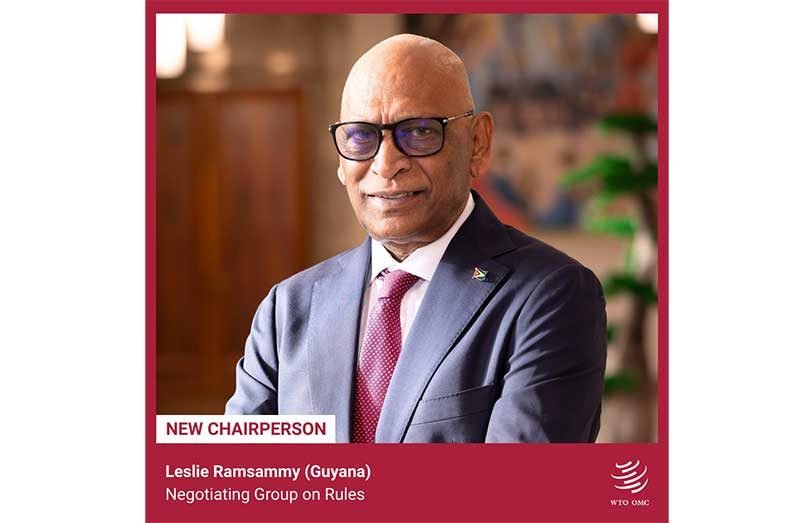
New chairperson, Dr. Leslie Ramsammy