






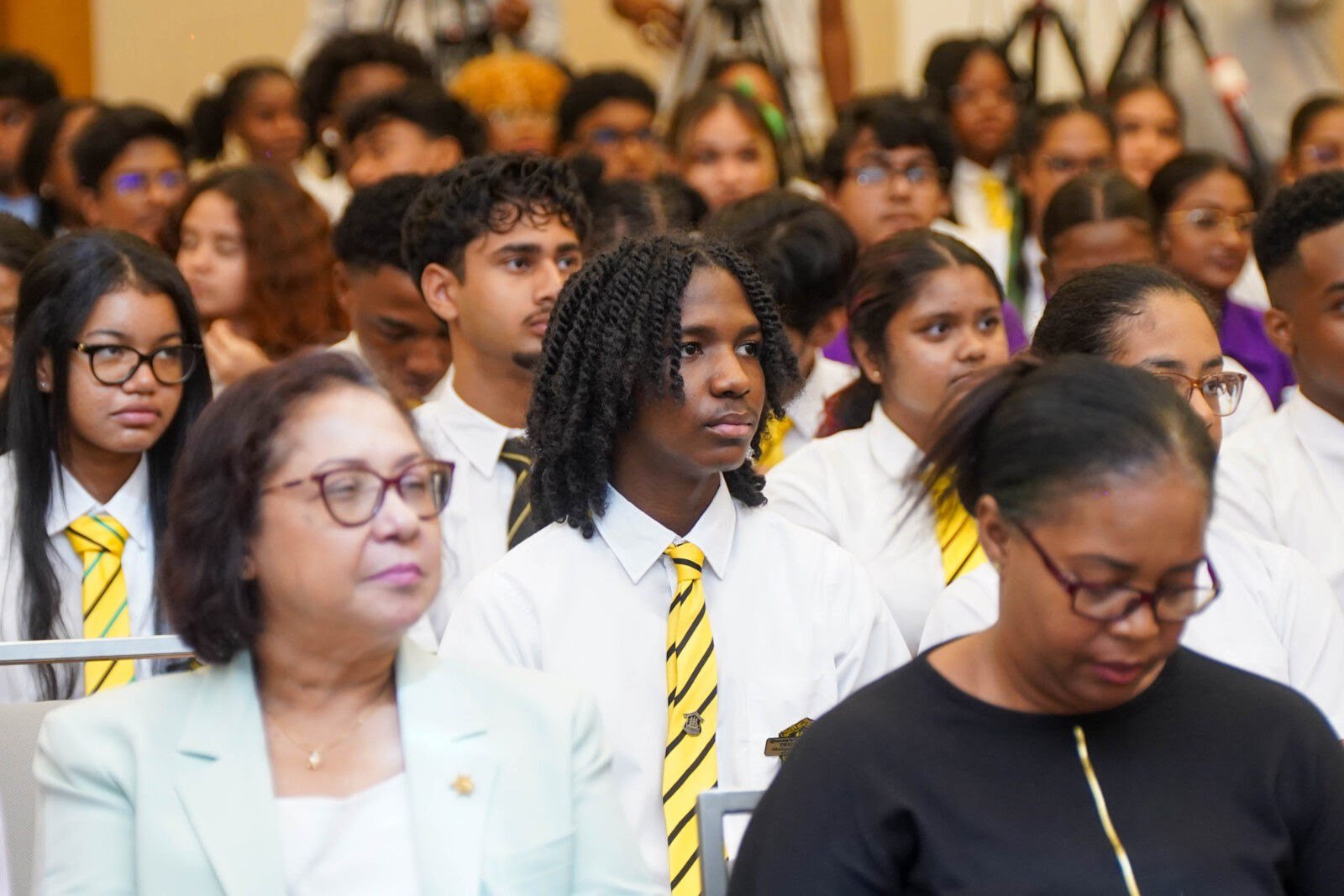
Guyana has recorded a slight improvement in mathematics performance at the Caribbean Secondary Education Certificate (CSEC) examinations, with the national pass rate rising from 32 per cent in 2025 to 34.5 per cent in 2026.
Chief Education Officer Saddam Hussain made the announcement at the preliminary results on Tuesday.

“Our math result this year is 34.5 per cent. I want you to keep that figure in mind,” he said.
He said 23 of the 35 subjects offered at CSEC also recorded improvements this year, while 12 declined.
An improvement compared to the 15 subjects which recorded declines in 2025.
Among the subjects recording improvements were Additional Mathematics, Agricultural Science, Chemistry, English, Family and Resource Management, Food, Nutrition and Health, French, Industrial Technology Building, Mechanical Engineering, Music, Physical Education, Social Studies, Spanish and Technical Drawing.
French recorded a 16 per cent improvement, while Music increased by 33.3 per cent and Technical Drawing by 12 per cent.
Additionally, Biology, Human and Social Biology, Office Administration, Theatre Arts, Visual Arts and Physics remained relatively constant.
However, Hussain said mathematics was one of the key areas of focus for the Ministry of Education, which has introduced several initiatives to improve student performance.
These include additional instructional support, virtual teaching and the provision of learning materials.

One of the major interventions was the ‘Maths Tents’ programme, which allowed experienced teachers in Georgetown to provide virtual mathematics lessons to students in hinterland communities.
About 17 classes across the country benefited from the initiative, with teachers using internet connectivity and smartboards to deliver lessons to students in other regions.
The programme was also supported with textbooks, geometry sets, calculators and other learning resources.
Hussain said the ministry has seen significant improvements at several schools.
Rosignol Secondary recorded a 35 per cent increase in mathematics performance, while Bartica Secondary improved by 57 per cent.
Belladrum Secondary moved from a zero per cent pass rate to 81.49 per cent, while Fort Wellington Secondary increased from 5 per cent to 82.15 per cent.
Leguan Secondary recorded a 28 per cent improvement, Black Bush Secondary 24 per cent, while South Ruimveldt Secondary moved from 8 per cent to 60 per cent.
As a result, the ministry will now examine whether students’ participation in the Maths Tents was directly linked to their examination performance.
“We are now correlating attendance at the ‘Maths Tents’ to the results to see how far it has gone,” Hussain said.
Another intervention being examined is the modularisation of mathematics by the Caribbean Examinations Council (CXC).
The approach was piloted at four schools this year, allowing students to complete the mathematics syllabus in three modules rather than sitting the entire examination at once.
The four schools recorded pass rates significantly above the national figure of 34.5 per cent.
Aurora Secondary recorded an 88 per cent pass rate, Bygeval Secondary 100 per cent, Richard Ishmael Secondary 87 per cent and St Ignatius Secondary 71 per cent.
The schools had an overall pass rate of about 90 per cent under the modular approach.
The ministry is expected to continue assessing the effectiveness of its interventions, including targeted virtual instruction, the Maths Tents and mathematics modularisation, as it seeks to produce sustained improvements in student performance.