






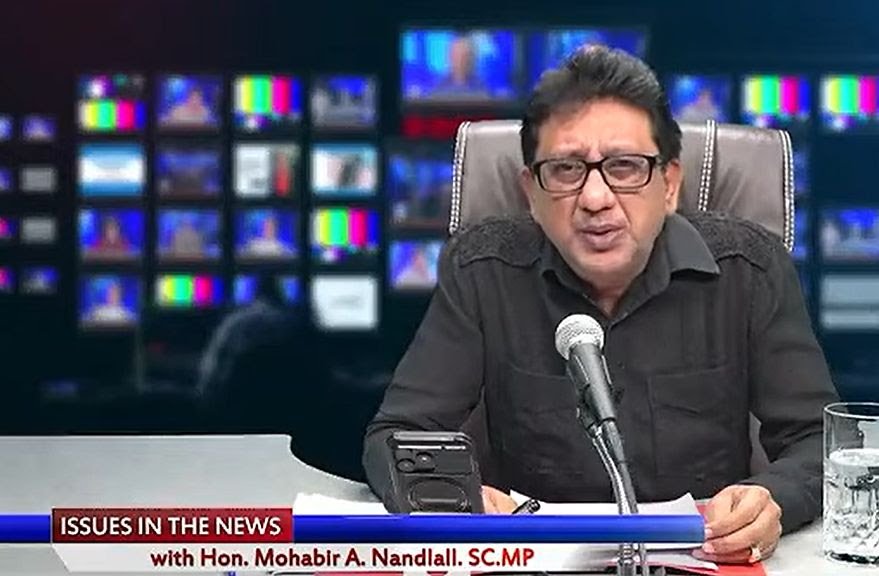
Attorney General and Minister of Legal Affairs Anil Nandlall has revisited several defining moments in Guyana’s political history, highlighting what he described as the decades-long struggle of the People’s Progressive Party (PPP) and other democratic forces to protect free and fair elections and democratic governance.
Speaking on his weekly programme “Issues in the News,” Nandlall traced the country’s electoral history from the period immediately following Independence, focusing particularly on the 1968, 1973 and 1980 elections and their lasting impact on Guyana’s democratic institutions.
He began with the 1968 General Elections, which he identified as a major turning point in Guyana’s post-Independence political history.
According to Nandlall, the introduction of overseas voting shortly before those elections created an avenue for alleged manipulation of the electoral process. The PNC won 30 seats, while the PPP secured 19 and the United Force four.
The Attorney General said the experience demonstrated the need for strong electoral laws, safeguards and institutions capable of protecting the integrity of elections.
Recalling the 1973 elections.
Nandlall also reflected on the 1973 elections, pointing to the absence of international observers and the introduction of proxy and postal voting, which he said were among the mechanisms through which the electoral process was allegedly manipulated.
He further recalled the political tensions and repression associated with the period, including the detention and prosecution of political opponents and the killing of prominent political figures, including Dr Walter Rodney in 1980.
The 1980 elections, he said, represented another significant chapter in Guyana’s electoral history. The PNC secured 41 of the 53 seats, while the PPP won 10 and the United Force two.
Nandlall argued that understanding these episodes remains important to protecting Guyana’s democratic institutions and ensuring that similar developments are not repeated.
“This is our history. And unless we accept this as our history, then we may continue to allow these atrocities to return,” the Attorney General said.
From historical struggles to the 2020 elections
Nandlall also connected Guyana’s earlier electoral history to the events surrounding the 2020 General and Regional Elections, which resulted in prolonged legal and political disputes.
The 2020 results were challenged through election petitions, with the courts becoming central to the subsequent legal process. One of the petitions was dismissed by the High Court in January 2021 over non-compliance with requirements for service, while subsequent proceedings reached the Caribbean Court of Justice (CCJ).
The Attorney General has previously emphasised the importance of the legal framework governing election petitions and the role of the courts in determining electoral disputes.
He said the experience reinforced the importance of maintaining strong institutions, transparent electoral procedures and legal safeguards capable of protecting the electorate’s choice.
Democracy and electoral safeguards
Nandlall’s reflections come as Guyana continues to strengthen its electoral framework following the contentious 2020 election period.
In 2026, he pointed to reforms implemented after the 2020 elections, including measures aimed at increasing transparency in the tabulation process. He referenced observations by The Carter Center following the 2025 General and Regional Elections, including greater transparency through the public posting of Statements of Poll and their timely publication on the Guyana Elections Commission’s website.
For Nandlall, Guyana’s electoral history provides an important lesson: democratic institutions and safeguards must continually be protected and strengthened.
He maintained that the PPP’s longstanding involvement in the struggle for free and fair elections forms an important part of the party’s political history, while stressing that the broader objective should be the preservation of democratic governance and the integrity of the electoral process.
The Attorney General’s account places the country’s present-day electoral safeguards within a much longer historical context, spanning decades of political change, legal challenges and efforts to ensure that the will of Guyanese voters is reflected in the outcome of elections.