






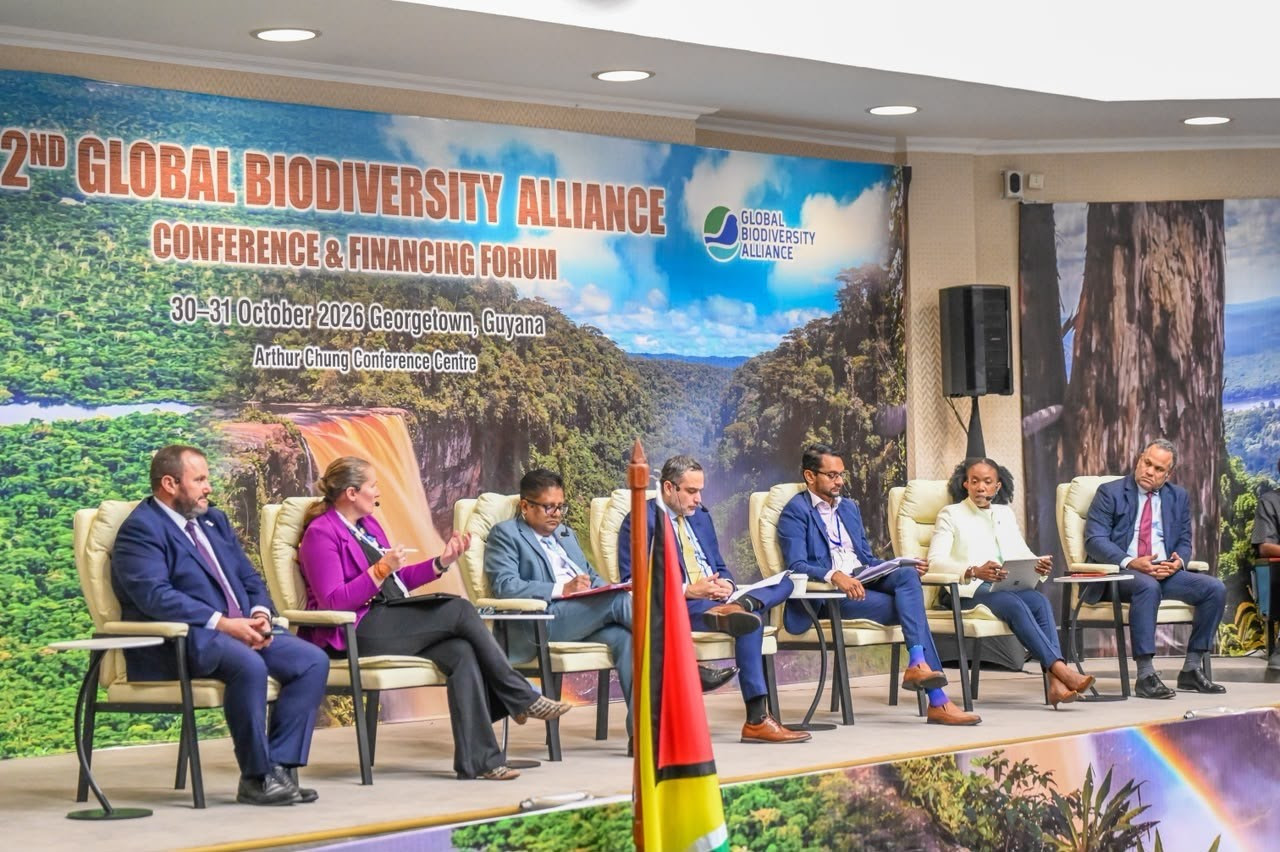
Senior Minister within the Office of the President with Responsibility for Finance, Dr Ashni Singh, has called on countries to embed biodiversity conservation into their economic policies, national investment programmes and financial decision-making, stressing that environmental protection must be recognised as an essential component of sustainable economic development.
He made the remarks on Saturday while chairing a high-level panel discussion on the final day of the Global Biodiversity Alliance (GBA) Summit at the Arthur Chung Conference Centre (ACCC), where regional finance ministers, international development partners and private-sector representatives examined strategies for mobilising investment in nature conservation.
Dr Singh said achieving meaningful progress requires countries to move beyond environmental commitments and establish the institutional arrangements, monitoring systems and financing structures necessary to deliver measurable results.
He emphasised that biodiversity considerations must be incorporated into the wider development agenda, rather than being treated as a responsibility confined to environmental ministries.
The Finance Minister also highlighted the importance of strengthening public-private partnerships and developing innovative financial instruments capable of attracting private capital towards conservation initiatives.
Director of Environment at the World Bank Group, Valerie Hickey, underscored the importance of demonstrating the economic value of natural resources through credible data, scientific evidence and natural capital accounting.
She explained that properly measuring the value of ecosystems would allow governments to make more informed policy decisions while creating opportunities for investment in biodiversity protection.
Hickey stressed that natural resources must be recognised within economic systems if they are to attract the financing required for their preservation.
Meanwhile, Minister of Finance of the Commonwealth of The Bahamas, Michael Halkitis, highlighted debt-for-nature financing as one of the mechanisms available to countries seeking to generate additional resources for environmental protection.
Drawing on his country’s experience, he called for greater recognition of the long-term economic benefits of conserving marine ecosystems, arguing that marine protected areas should be viewed as investments rather than immediate financial burdens.
Barbados’ Minister of Economic Affairs and Planning, Marsha Caddle, also stressed the need to incorporate biodiversity targets directly into national development strategies and public investment plans.
She explained that environmental objectives included only in standalone conservation policies risk receiving limited funding when competing with other national priorities. Integrating them into national investment frameworks, however, would ensure that biodiversity protection receives consideration alongside other major development programmes.
The discussions highlighted the importance of aligning environmental objectives with fiscal policies, public expenditure and private-sector investment to ensure that conservation commitments translate into practical outcomes.
Held under the theme “Investing in Nature: Accelerating Biodiversity Finance for Sustainable Development,” the two-day summit brought together international leaders, policymakers, financial institutions and development partners to explore sustainable financing solutions and strengthen global cooperation on biodiversity conservation.