






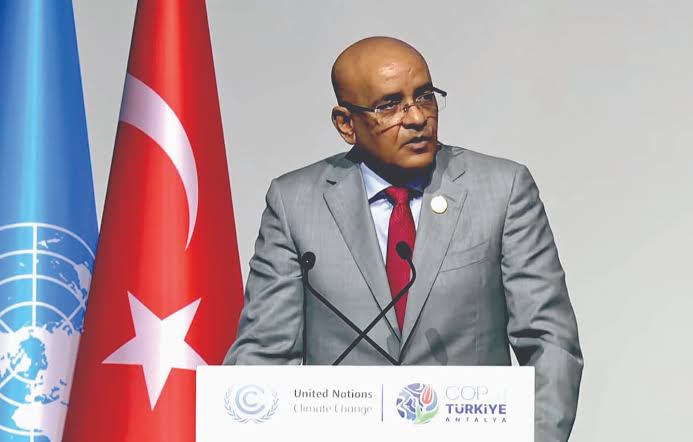
After thirty-one years of climate summits, Guyanese Vice-President Bharrat Jagdeo arrived in Antalya, Türkiye, with a message that was equal parts hopeful and frustrated. The world, he told fellow delegates at the United Nations COP31 climate conference, has spent decades making promises. The time to keep them is running short.
It was not the kind of speech that draws polite applause and is forgotten by lunch. Jagdeo, who has built a reputation as one of the developing world’s most outspoken voices on climate finance, did not mince words. He acknowledged the genuine commitment he saw in the summit halls, the negotiators’ energy, the stacks of policy papers and the earnest conversations in every corridor. And then he pointed out the uncomfortable truth at the centre of it all: the same arguments that dominated climate talks a decade ago still dominate them today.
“Many of the issues we debated years ago remain unresolved,” he said in Guyana’s national statement at the summit. For anyone who has followed the tortured history of international climate negotiations, the statement landed like a stone dropped into still water.
To understand why Jagdeo speaks the way he does, you need to understand where Guyana sits in the global climate picture. The country is home to one of the largest intact tropical rainforests on Earth — a vast carbon sink that absorbs and stores enormous quantities of greenhouse gases. In recent years, it has also been the site of one of the most significant oil discoveries in the Western Hemisphere. Guyana is both one of the planet’s great environmental assets and a nation on the verge of becoming a substantial fossil fuel producer.
That tension shapes everything Dr Jagdeo says at a climate conference. He is not speaking as a detached observer. He is speaking as a leader trying to chart a course for a small, developing country that wants to protect its forests, grow its economy, generate electricity for its people, and do all of this while wealthier nations debate the finer points of carbon accounting.
His central argument is shared by many developing nations but rarely expressed so bluntly: the global energy transition cannot be built on wishful thinking. It must account for real countries, real people and real economic constraints.
One area where Jagdeo expressed genuine optimism was forest conservation. For years, the idea that wealthy nations would pay tropical countries to keep their forests standing has been more aspiration than reality. But he pointed to the Forest Finance Roadmap — developed through a partnership between Brazil, the United Nations Environment Programme and the Forest and Climate Leaders’ Partnership — as evidence that the machinery to make this work is finally being assembled.
The roadmap sets out six concrete financing pathways for forest-rich nations, including mechanisms that recognise the rights and roles of Indigenous Peoples and local communities. For Guyana, the most important of these is jurisdictional carbon markets — systems that enable governments to generate verified carbon credits based on emissions reductions across entire regions rather than individual projects.
“For us, our main pathway is jurisdictional carbon markets,” Jagdeo said. But he was careful to flag the obstacles that remain. For these markets to work at scale, he argued, wealthy countries need to pass legislation supporting CORSIA — the international carbon offsetting scheme for aviation — open compliance markets to forest credits, and finally operationalise Article 6 of the Paris Agreement, the framework that governs international carbon trading.
It was a pointed message. Guyana can protect its forests. It has been doing so. What it needs is for the countries on the other side of the transaction to honour their end of the deal.
If Jagdeo was diplomatic about forest finance, he was bracingly direct about fossil fuels. The COP28 summit in Dubai produced a historic agreement to “transition away” from fossil fuels, described as just, orderly and equitable. It was hailed at the time as a turning point. At COP31, Jagdeo was essentially asking: what does that mean for a country like Guyana?
His answer was that the transition cannot be treated as a simple on-off switch. Fossil fuel demand, he said plainly, will not disappear overnight. The pressures on global electricity systems are, if anything, intensifying. The explosive growth of artificial intelligence, data centres and electrified industries is adding new layers of demand to power grids worldwide. This is not a theoretical problem for the distant future. It is happening now, complicating the already difficult maths of decarbonisation.
“If we are to achieve global net zero by 2050, we cannot reduce the solution to a binary choice between fossil fuels and no fossil fuels,” he told delegates.
What he called for instead was a comprehensive strategy — one that addresses fossil fuel demand and production simultaneously, while expanding renewables, accelerating electrification, halting deforestation and embracing new technologies. Carbon pricing, he said, has an important role to play, though it need not be the sole instrument governments reach for.
It was a nuanced position, and one that is easy to caricature. Critics of oil-producing nations who make this argument sometimes suggest it is simply a convenient way to delay action. But the underlying logic is harder to dismiss than its critics often acknowledge. A transition that leaves developing nations behind, or that asks the poorest countries to bear the heaviest burdens, is not equitable — it is simply unequal, dressed up in progressive language.
The number itself carries weight. Thirty-one COPs. Three decades of negotiations, declarations, frameworks, protocols and agreements. What has it all produced?
Dr Jagdeo’s answer, implicitly, is that the system has produced more process than progress. The gap between what governments promise in conference halls and what they deliver at home remains stubbornly wide. Climate finance pledges go unmet. Carbon market rules remain contested. Adaptation funding for vulnerable nations trickles in, far below what is needed.
His closing challenge to the assembled delegates was as simple as it was stark. After all this time, the measure of success at a climate summit cannot be the elegance of the final communiqué. It must be whether the countries in that room can go home and do what they said they would.
“After thirty-one COPs,” he said, “we must judge success not by the agreements we reach, but by whether countries can deliver on them.”
Whether the world’s leaders are ready to be judged by that standard is, as it always has been, the question that hangs over every climate summit. In Antalya, Dr Bharrat Jagdeo ensured they could not say they had not been asked.