





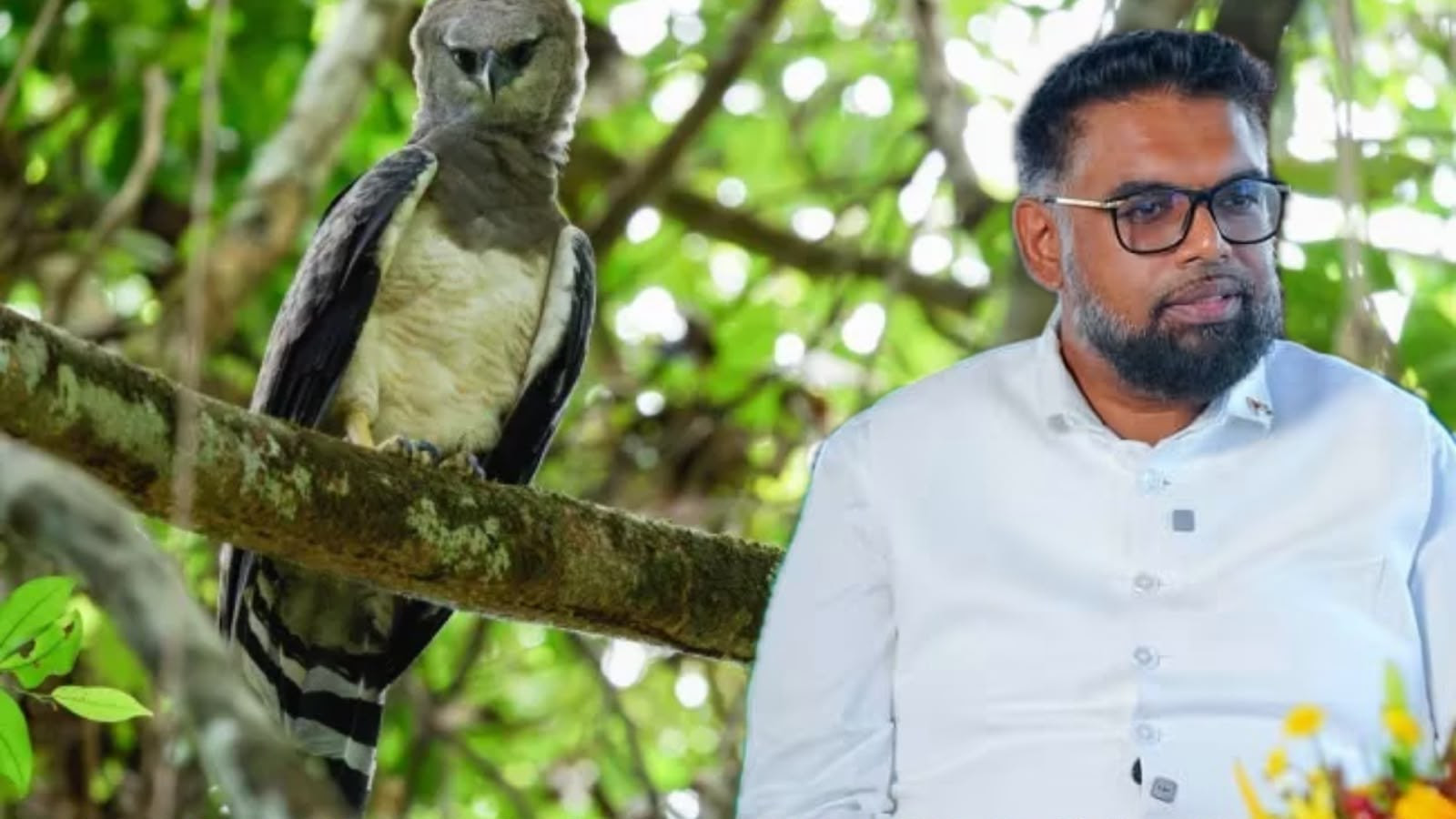
President Dr Mohamed Irfaan Ali is advancing Guyana’s leadership in international environmental protection as the Guyana-led Global Biodiversity Alliance (GBA) continues to expand its global influence, attracting more than 140 partners within just over a year of its official launch.
The Alliance is now preparing to establish a common international framework for recognising the economic value of biodiversity, protecting natural ecosystems and mobilising financial resources to support conservation and restoration efforts worldwide.
President Ali, who founded the initiative and serves as its inaugural Chair, announced that the second Global Biodiversity Alliance Conference and Financing Forum will take place on October 30 and 31, 2026, at the Arthur Chung Conference Centre in Georgetown.
The two-day gathering, under the theme “Investing in Nature: From Global Commitments to Practical Action”, will bring together governments, international organisations, researchers, investors, environmental experts, Indigenous representatives and business leaders to examine practical solutions for financing biodiversity protection.
 The GBA was formally launched with the endorsement of the Georgetown Declaration at the inaugural Summit in July 2025
Speaking during Friday’s edition of the Starting Point podcast with journalist Kiana Wilburg, President Ali explained that Guyana intends to facilitate international agreement on a common approach to biodiversity valuation and conservation financing.
“This is really Guyana positioning itself to be a facilitator of a global action, of global thinking, and a global formula,” the president stated.
The ultimate objective is to develop a framework capable of being integrated into the United Nations system and international Conference of the Parties (COP) processes, thereby strengthening global cooperation on biodiversity conservation.
President Ali first introduced the Global Biodiversity Alliance during the 79th United Nations General Assembly in September 2024, outlining Guyana’s ambition to establish an international mechanism that recognises biodiversity as an important economic and environmental asset.
The initiative was formally launched in July 2025 during its inaugural summit in Georgetown, where participating stakeholders endorsed the Georgetown Declaration, establishing the foundation for international cooperation.
Since then, the Alliance has expanded rapidly, attracting more than 140 partners, including governments, academic institutions, scientific organisations, international agencies and environmental policy experts.
The United Nations system joined the initiative in May 2026 as its 97th member, while the United Kingdom has also committed its participation. India is expected to join the growing international partnership.
 The Alliance’s creator and inaugural Chair, President Dr Mohamed Irfaan Ali speaks with Journalist, Kiana Wilburg
President Ali emphasised that biodiversity protection has become an urgent global priority, pointing to estimates that the planet has already experienced losses exceeding 60 per cent in biodiversity.
He explained that many developing countries face significant economic pressures and often lack viable financial alternatives to activities that damage natural ecosystems.
Unlike other natural resources that have established commercial markets, biodiversity remains largely excluded from conventional economic valuation systems, despite its importance to environmental stability and human survival.
“This is such an important asset for the survival of the planet, for the balance of the planet, but there is no value on this asset,” President Ali observed.
He argued that the international community must establish financial mechanisms that recognise the contributions of countries protecting forests, wildlife, ecosystems and other natural resources that provide essential benefits to the world.
Since the inaugural summit, the Alliance’s research partners have been developing scientific frameworks to assess biodiversity loss while exploring economic and financial models capable of supporting conservation efforts.
These proposals will be presented during the upcoming conference, with discussions expected to focus on international valuation standards, conservation financing, monitoring systems and mechanisms for identifying areas experiencing significant biodiversity decline.
The Alliance also intends to promote investment in restoring damaged ecosystems and recovering lost biodiversity, similar to how reforestation programmes seek to restore degraded forest areas.
President Ali stressed that meaningful international solutions require participation from all sectors whose activities influence biodiversity.
Accordingly, the conference will include representatives from forestry, mining and investment industries alongside scientists, policymakers, environmental organisations and Indigenous communities.
“If we are to have an open, frank, and genuine discussion to address the needs of all stakeholders… all the stakeholders must be around the table,” he stated.
The president acknowledged that achieving international agreement on biodiversity valuation will be considerably more challenging than implementing Guyana’s Low Carbon Development Strategy (LCDS) 2030.
While the LCDS represents a national development framework that has gained international recognition through forest conservation and carbon financing, the Global Biodiversity Alliance seeks to establish a coordinated approach involving countries with different economic priorities, environmental circumstances and development objectives.
“That is the most difficult thing to do, is to get all of these stakeholders to agree on one approach,” President Ali explained.
Nevertheless, he expressed confidence in Guyana’s ability to lead the initiative, highlighting the country’s longstanding commitment to environmental conservation and its success in maintaining extensive forest cover and largely intact biodiversity.
Guyana’s experience in developing internationally recognised forest-carbon financing mechanisms under the Low Carbon Development Strategy provides an important foundation for advancing broader discussions on biodiversity protection.
The Global Biodiversity Alliance represents another major step in the country’s efforts to demonstrate that environmental conservation and economic development can progress together through innovative international partnerships.
President Ali reiterated that protecting the planet must remain a shared global responsibility, but environmental policies should not prevent developing countries from improving living standards and pursuing legitimate economic opportunities.
“The planet is something that we all have to take care of, but not at the expense of the development aspirations of our people,” the president declared.
As international delegates prepare to gather in Georgetown, Guyana is seeking to move global biodiversity discussions beyond declarations and commitments towards measurable action, sustainable financing and a common framework that rewards countries for protecting and restoring the natural environment.
The upcoming conference is expected to strengthen Guyana’s growing international reputation as a leader in environmental policy while advancing President Ali’s vision of placing biodiversity conservation at the centre of global economic and development discussions.