






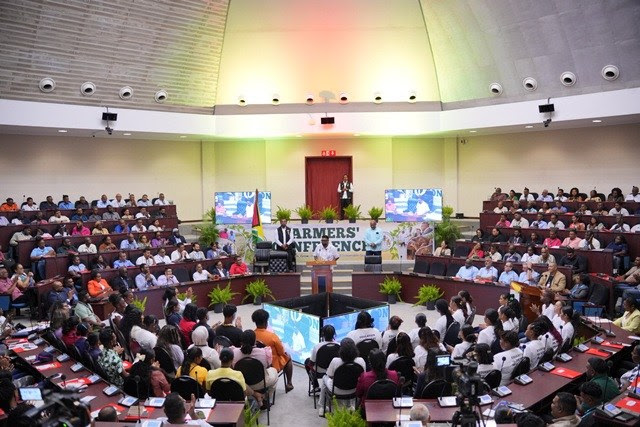
Georgetown, Guyana — Guyana is pursuing lower-cost agricultural financing, increased domestic food production and expanded export opportunities as the Government works to strengthen food security and establish the country as a regional food hub.
President Dr Mohamed Irfaan Ali said the Government is negotiating with commercial banks to secure preferential lending rates for farmers, particularly those seeking to expand into medium- and large-scale agricultural production.
The plans follow discussions at the recent Farmers’ Conference, where the President outlined initiatives to improve poultry production, expand coconut cultivation, strengthen storage infrastructure and create new markets for locally processed products.
Government Pursues Affordable Loans for Farmers
President Ali said the Government is exploring incentives for commercial banks to make agricultural financing more affordable, using a model similar to arrangements that support low-income housing loans.
Republic Bank has committed to setting aside resources for agricultural lending at a preferential interest rate, although negotiations on the rate are continuing.
Demerara Bank is already offering poultry loans at an interest rate of five per cent, and the Government is seeking further reductions through proposed incentives.
The President also disclosed that agriculture accounted for nearly 30 per cent of applications received by the newly launched Development Bank, indicating growing interest in the sector among young people, women and individuals who have not traditionally worked in agriculture.
Agricultural Production Records Significant Growth
President Ali highlighted increases in agricultural output since 2020, attributing the gains to government investment, supportive policies and the work of farmers.
According to the figures presented by the President, rice production increased by 18 per cent, coconut production grew by almost 250 per cent, fruit production rose by nearly 10 per cent, and vegetable production increased by approximately 21 per cent.
Poultry production also expanded by more than 110 per cent, while honey production and opportunities for processing, packaging and exports have grown.
The President stressed that rising domestic demand makes continued improvements in production and productivity essential.
Guyana Targets Greater Self-Sufficiency in Poultry and Onions
The Government is working to produce half of the country’s poultry hatching egg requirements locally by the end of 2027, with the goal of meeting nearly all domestic demand by the end of 2028.
A major private investment in aquaculture is also expected by the end of 2026, potentially strengthening Guyana’s position in the regional industry.
Meanwhile, successful onion production in Region Nine could allow the country to meet its entire domestic onion requirement for the first quarter of 2027 without relying on imports.
The President has also directed the Minister of Agriculture to advance plans for a 30-acre coconut seedling facility to support the expansion and renewal of coconut cultivation.
Local Agro-Processors Set to Reach More Overseas Markets
The Government is working with regional distributors, including Massy and ANSA McAL, to expand access to markets for Guyanese agricultural and processed food products.
Under the proposed arrangements, approximately five containers of agro-processed products are expected to be shipped by the end of 2026.
President Ali also pointed to pepper products from an agro-processing business in Black Bush Polder that are now being sold in supermarkets in Qatar, demonstrating the potential for local businesses to reach international consumers.
He encouraged the wider use of long-term purchasing agreements to help farmers secure more predictable prices while ensuring processors receive a reliable supply of agricultural products.
New Storage Facilities to Strengthen Food Security
The Government is expanding storage capacity to reduce the impact of extreme weather, crop and livestock diseases, and disruptions in international markets.
Current initiatives include rice storage facilities in Regions Two and Three, a national honey storage facility, additional cold-storage capacity and a regional food hub for fresh produce. Private-sector investment in poultry storage is also increasing.
These projects form part of a broader strategy to establish a three-month food supply buffer and position Guyana as a regional centre for food storage and distribution, with stronger commercial links to northern Brazil and the Caribbean.
Infrastructure Must Deliver Higher Productivity
President Ali emphasised that agricultural infrastructure investments must translate into measurable improvements in production.
Farm-to-market roads and drainage systems, he said, should support the cultivation of additional land, increase yields and improve farmers’ access to markets.
He called for individual farms to have clear productivity plans developed in collaboration with farmers.
The President also highlighted initiatives at the Guyana School of Agriculture to provide students with practical experience in modern technologies, scientific advances and model farming operations.
He said sustained agricultural development will require cooperation among the Government, farmers, financial institutions, processors and retailers to increase production and keep food affordable.
The Government’s longer-term objective is to build a stronger, more productive agricultural sector by 2030, reducing dependence on imported food while expanding Guyana’s role in regional food production and distribution.