






GUYANA is moving early to secure key equipment for future electricity-generation projects as rising global demand for turbines is lengthening waiting times for countries seeking to expand their power systems.
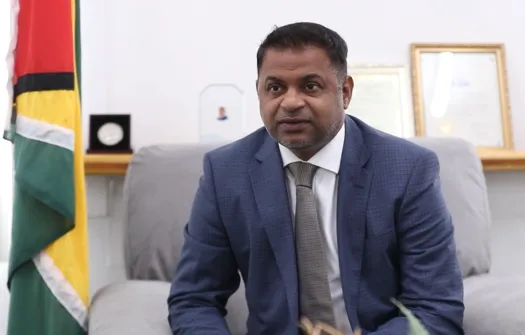
Minister of Public Utilities and Aviation, Deodat Indar, said the Government has already taken steps to reserve turbine manufacturing capacity for a proposed additional 300-megawatt (MW) power plant.
Minister Indar made the disclosure during his appearance on the Energy Perspectives podcast, explaining that the rapid growth of data centres worldwide has significantly increased demand for the turbines used in power generation plants.
“We already did what we call a slot arrangement with the manufacturers of the turbines to secure those because they have great demand for them because of data centres,” Indar said.
The minister explained that Guyana cannot wait until a project is ready for construction before ordering major generation equipment, given the time required for manufacturing and delivery.
Minister Indar said the country’s electricity needs are expected to increase considerably as the economy continues to grow and new industries come on stream.
He projected that Guyana could need between 1,600MW and 1,700MW of generation capacity by 2030. This would require the Government to advance several additional power projects beyond the current Gas-to-Energy development.
The proposed 300MW gas-fired generation facility and the 165MW Amaila Falls hydropower project are among the developments identified as part of the country’s longer-term generation plans.
Minister Indar stressed that the expansion of generation capacity must be carefully phased to match the pace of economic growth.
“You have to stagger the build-out to match economic demand for power,” he said.
He noted that a single-generation project could require an investment of more than US$1 billion, without factoring in the additional costs of supporting infrastructure such as gas pipelines and transmission networks.
In the short term, attention remains focused on the 300MW Gas-to-Energy facility under development in Wales.
Minister Indar said testing of the project is expected to begin in December. The plant will initially produce 228MW from four 57MW gas turbines.
Its output is expected to reach 300MW following the addition of two steam turbines, enabling the facility to operate at its planned combined-cycle capacity.
However, the minister said the project should be seen as one stage in a much broader expansion of Guyana’s electricity system rather than as the final solution to rising demand.
The Government’s generation plans must also remain flexible, as major industrial investments can quickly increase electricity demand across the country.
Minister Indar cited a potential bauxite-processing operation that could consume about 100 MW on its own.
Other large-scale, energy-intensive developments could also push electricity demand substantially higher than previously projected.
“These sectors, which are huge consumers of energy, when they come into the country, when you put that into your planning model, spike demand, and you have to cater for that,” the minister said.
He said that government planners therefore have to continually update electricity-demand projections as new investments are confirmed and the economy expands.
The approach is intended to ensure that additional generation, transmission infrastructure and related investments are developed at a pace that can accommodate Guyana’s changing energy requirements, while avoiding delays caused by shortages of critical equipment, such as turbines.