





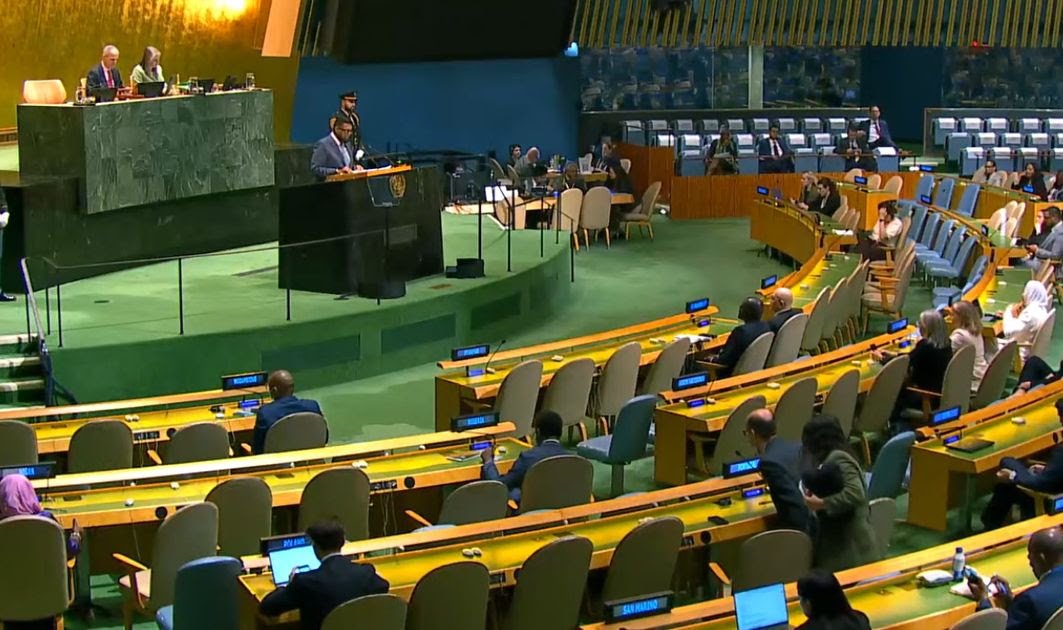
President Dr Mohamed Irfaan Ali has called on Venezuela to respect the decision of the International Court of Justice (ICJ) in the long-running border controversy, saying Guyana will accept and abide by the Court’s forthcoming ruling.
Ali made the statement on Thursday during his address to the general debate of the 81st United Nations General Assembly (UNGA) in New York.
The President used the international platform to explain Guyana’s decision to pursue the matter before the ICJ, emphasising that the move followed decades of attempts to settle the controversy through diplomatic and bilateral channels.
“Recourse to the ICJ came after decades of efforts to resolve the controversy bilaterally, including through a mixed commission and the good offices of the UN Secretary-General,” Ali said.
His remarks came less than 24 hours after Venezuela’s acting President Delcy Rodríguez addressed the same Assembly and called for Guyana to return to negotiations under the 1966 Geneva Agreement.
Guyana points to 1899 Award
Ali reiterated Guyana’s position that the 1899 Arbitral Award constitutes the final settlement of the country’s land boundary with Venezuela.
He said Guyana has nevertheless faced what he described as repeated provocations and aggression over the years, while maintaining that Georgetown has consistently pursued a peaceful resolution.
“Guyana has always advanced the peaceful settlement of the controversy in relation to our border with Venezuela,” the President said.
The dispute was subsequently referred to the ICJ by the United Nations Secretary-General under the terms of the Geneva Agreement.
The Court has since ruled twice on its jurisdiction to hear the case, allowing the proceedings to continue.
Hearings concluded
Thursday’s address marked Ali’s first appearance before the UN General Assembly since the ICJ concluded oral hearings in the case in May 2026.
Guyana participated in those proceedings, with Ali stressing that the country did so in accordance with international law.
“Now that we have both participated in the hearings, which were completed in May 2026, we urge Venezuela to abide by the forthcoming ruling in accordance with their obligation under the UN Charter, as Guyana will do,” he said.
The case, which Guyana instituted in 2018, asks the ICJ to affirm the validity and binding nature of the 1899 Arbitral Award and the international boundary established between the then-British Guiana and Venezuela.
In 2020, the Court determined that it had jurisdiction to hear the case. A further objection raised by Venezuela was dismissed in 2023.
The ICJ has also issued provisional measures at Guyana’s request, including an order in 2025 concerning Venezuela’s plans to conduct elections in the disputed Essequibo region.
Looking beyond the dispute
Ali said Guyana hopes the conclusion of the judicial process will create an opportunity for improved relations between the two neighbouring countries.
“We look forward to a new era of neighbourly relations in the interests of our peoples, the development of our countries, and the stability and prosperity of our region,” he said.
The President’s remarks came as leaders from the United Nations’ 193 member states gathered in New York for the annual general debate.
The 81st session is being held under the theme, “Restoring trust, managing transformation: a United Nations that delivers for all.”