






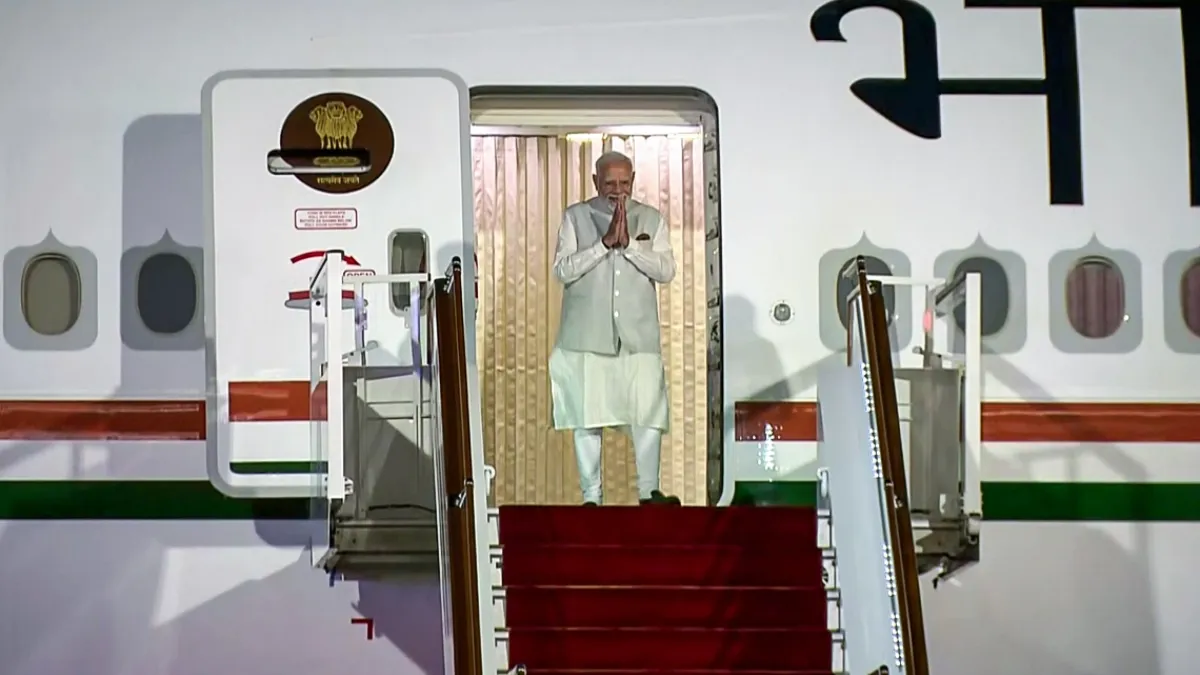
Prime Minister Narendra Modi has arrived in Bishkek, Kyrgyzstan, for a two-day visit to attend the 26th Shanghai Cooperation Organisation (SCO) Summit, scheduled for August 31 and September 1. The visit is part of Modi’s four-day Central Asia tour, which also included a visit to Uzbekistan.
Modi was received at the airport by Adylbek Kasymaliev, Chairman of the Cabinet of Ministers of Kyrgyzstan. A traditional Kyrgyz cultural performance was also organised to welcome the Indian Prime Minister. The visit comes at a significant time as the SCO marks its 25th anniversary and brings together leaders of major Eurasian countries.
Focus on Regional Security and Cooperation
During the SCO summit, Modi is expected to highlight India’s priorities on regional security, counter-terrorism, connectivity and economic cooperation. The 10-member organisation includes India, China, Russia, Pakistan, Iran, Belarus, Kazakhstan, Kyrgyzstan, Tajikistan and Uzbekistan. India and Pakistan became full members of the grouping in 2017, while Iran joined in 2023 and Belarus became a member in 2024.
The summit is taking place against a backdrop of heightened geopolitical tensions and growing competition among major powers. Chinese President Xi Jinping and Russian President Vladimir Putin are among the other prominent leaders attending the gathering. The meeting provides an important platform for India to engage with both countries as well as Central Asian partners.
Modi-Putin Meeting Likely to Draw Attention
One of the closely watched engagements during the summit is expected to be a meeting between Modi and Russian President Vladimir Putin. Reports indicate that the two leaders are scheduled to hold bilateral discussions on the sidelines of the SCO summit. Defence cooperation, energy, trade and wider regional and global developments are expected to feature prominently in their talks.
Modi is also expected to meet Iranian President Masoud Pezeshkian during the summit. Iranian state media has reported that the two leaders are set to hold discussions on the sidelines of the SCO gathering, adding another important dimension to India’s diplomatic engagement in Central Asia and the wider Eurasian region.
Strengthening India’s Central Asia Engagement
The Kyrgyzstan visit follows Modi’s state visit to Uzbekistan on August 29 and 30, where he held talks with President Shavkat Mirziyoyev. Discussions in Tashkent focused on strengthening bilateral cooperation in areas including trade and investment, defence, digital connectivity, energy, education and people-to-people relations.
The broader Central Asia tour reflects India’s efforts to deepen its strategic and economic engagement with the region. Central Asia has gained increasing importance for India because of its location, energy resources, connectivity potential and role in wider Eurasian security.
India has been a full member of the SCO since 2017 and has consistently used the organisation as a platform to raise concerns related to terrorism, regional stability and connectivity while promoting greater economic and cultural cooperation.
A Significant Diplomatic Gathering
The Bishkek summit brings together leaders from across Eurasia at a time of significant shifts in the global geopolitical landscape. For India, the SCO provides an opportunity to maintain dialogue with countries with which it has complex relationships while simultaneously strengthening partnerships across Central Asia.
Modi’s participation is therefore expected to focus not only on the summit’s multilateral agenda but also on a series of bilateral engagements. These meetings could provide opportunities to discuss trade, energy security, connectivity, defence cooperation and regional conflicts.
As the summit gets underway, attention will remain on Modi’s interactions with Putin, Xi and other SCO leaders, as well as the outcomes of the discussions on regional security and economic cooperation.