






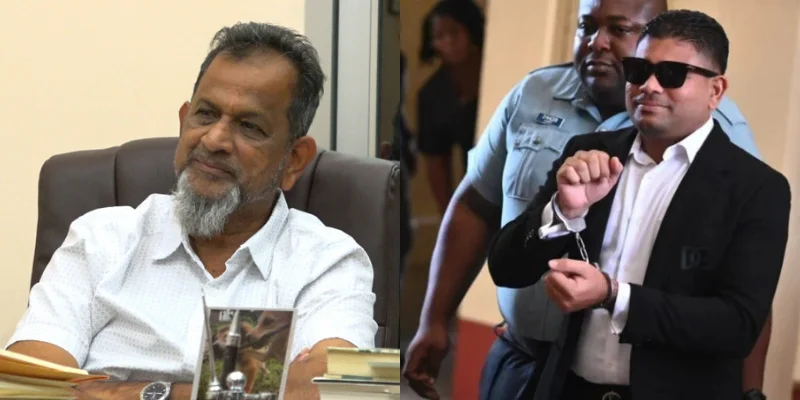
President Dr Irfaan Ali has firmly rejected allegations about his privately owned farm, calling them part of an attempt by the US-sanctioned Mohamed family to pressure him amid ongoing extradition proceedings.
According to the President, members of the Mohamed family allegedly attempted to pressure him by threatening to release information about his agricultural investment unless the Government softened its stance on their legal matters. If these allegations are accurate, such actions constitute an unacceptable attempt to influence public office through intimidation rather than facts.
At the same time, in any democracy, questions about public officials and their assets deserve to be addressed transparently. Accountability strengthens institutions, not weakens them. However, there is an important distinction between legitimate scrutiny and political theatre.
The father and son have been indicted by a federal grand jury in the US District Court for the Southern District of Florida on 11 counts, including wire fraud, mail fraud, tax evasion and money laundering—the allegations centre on the operations of Mohamed’s Enterprise and its gold exports to the United States.
Against that backdrop, Azruddin Mohamed’s repeated attempts to present himself as a champion of integrity invite inevitable comparisons.
As the old saying goes, “Pot calling the kettle black.” This is a classic way to call out hypocrisy. It applies when someone, in this case Azruddin Mohamed, criticises another public figure for a fault or mistake that Azruddin Mohamed is also guilty of.
That phrase seems particularly relevant when someone facing such serious allegations attempts to lecture others on transparency and ethics. Before trying to occupy the moral high ground, it would be reasonable first to address the allegations surrounding his own family’s affairs.
Azruddin Mohamed has also attempted to direct criticism at Vice President Dr Bharrat Jagdeo. Yet criticism is persuasive only when it is supported by evidence, consistency and credibility. Personal attacks and political rhetoric, without substance, rarely convince the public.
Vice President Dr Bharrat Jagdeo has spent decades in public service and remains one of Guyana’s most experienced political leaders. Whether or not one agrees with his policies, he has consistently made himself available to the media, regularly answering difficult questions at press conferences and engaging directly with issues affecting the country. His willingness to face public scrutiny stands in sharp contrast to those who seek to shape public opinion through social media allegations rather than evidence.
Attempts by Azruddin Mohamed to discredit Dr Jagdeo appear more like a political strategy than a genuine effort to promote accountability. Credibility matters in public discourse. When an individual whose family faces serious criminal allegations in the United States seeks to position himself as an authority on integrity and good governance, the public is entitled to question his credibility. Criticism carries weight only when it is backed by consistency, transparency and a clean record.
The People’s Progressive Party/Civic (PPP/C) has repeatedly stated that neither political pressure nor personal attacks will influence the Government’s commitment to upholding the rule of law. Party supporters view the continued attacks on both President Dr Irfaan Ali and Vice President Dr Bharrat Jagdeo as politically motivated attempts to distract from the serious legal issues facing the Mohamed family. Guyanese deserve debates grounded in facts and policies—not in sensational allegations or attempts to divert attention from one’s own challenges.
Whether one supports the People’s Progressive Party/Civic (PPP/C) or not, political debate should be grounded in facts rather than distractions. If there are legitimate questions about the President’s assets, they should be addressed through the appropriate legal and institutional channels. Likewise, if allegations exist against members of the Mohamed family, they should be allowed to proceed through the judicial process without political interference.
Today, Azruddin Mohamed again made public allegations against Minister Bishop Edghill and members of his family. If Minister Edghill believes these statements are false or defamatory, the appropriate course of action is to pursue the available legal remedies. In a democratic society, disputes involving serious allegations should be resolved through the rule of law rather than through exchanges on social media or other public platforms.
Ultimately, Guyanese deserve politics grounded in accountability, evidence and integrity—not in blackmail, deflection or hypocrisy. Those seeking public trust must first demonstrate that they are willing to hold themselves to the very standards they demand of others.
Before making repeated accusations against the PPP, Azruddin Mohamed should remember that the party is a democratic institution with nearly 60 years of history and a long-standing place in Guyana’s political landscape. Political criticism is part of democracy, but allegations of corruption should be supported by credible evidence. Reckless accusations can have serious legal consequences.
Regarding the allegations involving Azruddin Mohamed, these matters should be addressed through the proper legal process rather than in the political arena. The People’s Progressive Party has leaders who are expected to defend the party’s reputation when they believe it has been unfairly attacked.
Vice President Dr Bharrat Jagdeo has consistently been one of the party’s strongest defenders, and many PPP supporters view him as someone who will continue to safeguard the party’s principles, unity, and legacy for years to come.