






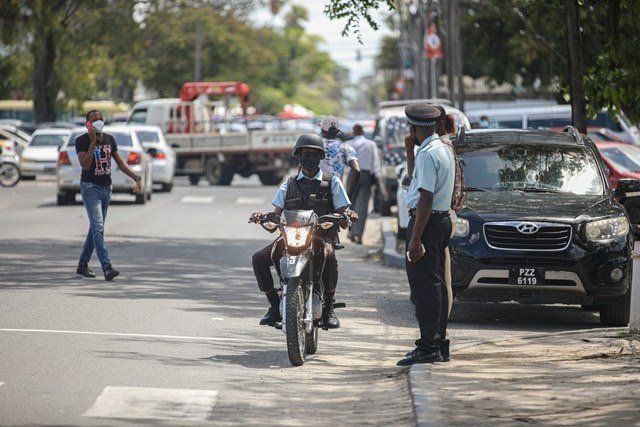
The Guyana Police Force (GPF) announced on Friday its intensified efforts to improve road safety as fatal accidents continue to claim lives across Guyana.

As the Guyana National Road Safety Stakeholders Consultation got underway at the Police Officers’ Mess Annexe at Eve Leary in Georgetown, Deputy Commissioner of Police Ravindradat Budhram said road safety is a shared responsibility which requires collective action.
He noted that road accidents, whether minor, serious or fatal, continue to occur daily countrywide. The latest statistics show a four per cent increase in fatal accidents during the current reporting period, while road fatalities have risen by seven per cent.
According to the Permanent Secretary of the Ministry of Home Affairs, Andre Ally, 56 fatal accidents and 62 deaths were recorded in the first 170 days of 2026. During the same period last year, there were 54 fatal accidents and 58 deaths.
Speeding accounted for 75 per cent of all fatal accidents recorded so far this year.
Deputy commissioner Budhram said the police force has begun implementing the internationally recognised Safe System Approach, which acknowledges that while human error is inevitable, deaths and serious injuries on the roads are preventable.

The approach focuses on stronger legislation, safer infrastructure and vehicles, responsible road users, effective enforcement, public education and the use of AI technology to create a safer transport system.
Other measures introduced by the GPF also include the deployment of 21 operational speed cameras, the issuance of more than 27,000 electronic traffic tickets and the suspension of 22 drivers’ licences for serious traffic offences.

The force has also expanded road safety education programmes in schools and communities while increasing patrols in accident hotspots and high-risk corridors to curb speeding, impaired driving, distracted driving and other dangerous behaviours.
To improve accountability during traffic enforcement, officers are now equipped with body-worn cameras.
Accordingly, the learner driver’s programme has been reassigned and digitised following longstanding public criticism. It is being delivered through the Guyana Digital School platform.
Despite these advancements, the deputy commissioner stressed that technology and enforcement alone will not change road user behaviour.
“Lasting improvements in road safety require every stakeholder to play a role. We must work together to foster a culture that complies with traffic laws, motivated not by fear of penalties but by a shared commitment to preserving life,” he said.
Looking ahead, the GPF 2027–2030 strategy will further modernise traffic management by expanding speed camera coverage nationwide and traffic collision and accident hotspot/mapping under the Safe Country Initiative.
The strategy also includes the introduction of a demerit point system, the deployment of speed governors (speed limiters), the expansion of electronic ticketing for heavy-duty vehicles and the use of artificial intelligence and data analysis to support smarter, evidence-based policing.
The consultation is being held under the theme, “Transforming road safety culture through information, technology, education, enforcement, infrastructure, and policy.”