






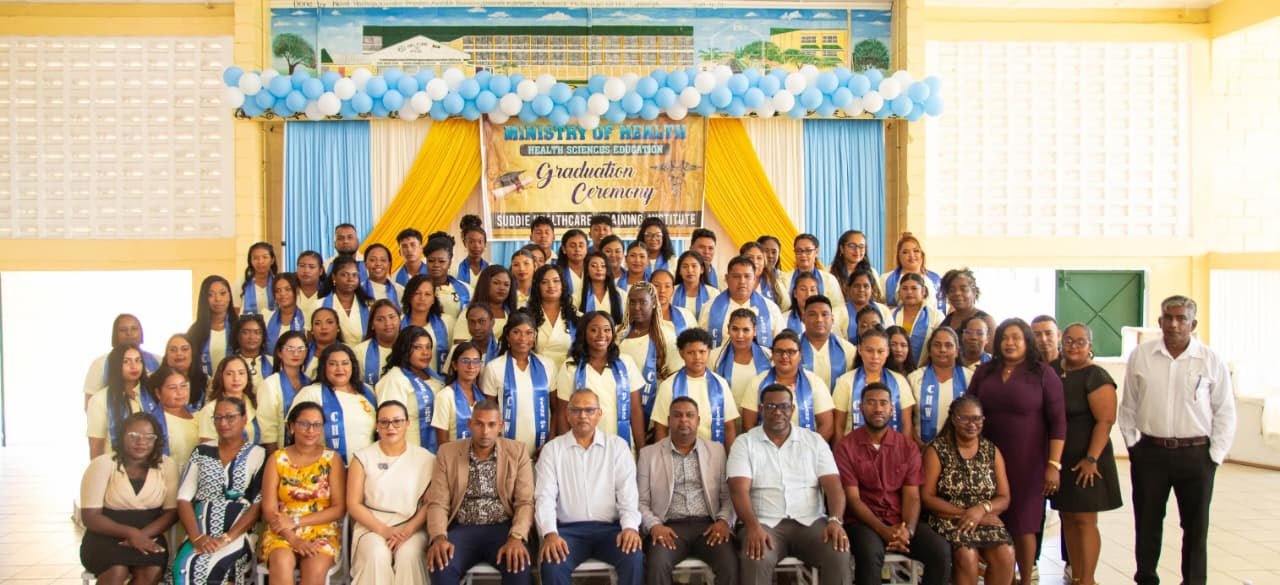
Training in Guyana’s health sector has grown rapidly in recent years, as the government moves to match its major infrastructure investments with a larger and more specialised workforce.
Speaking on the ‘Starting Point’ Podcast on Sunday, Minister of Health Dr Frank Anthony said the country is producing more healthcare professionals through expanded training programmes and international partnerships.
He stated that the three nursing schools in Linden, Georgetown and New Amsterdam traditionally graduated about 200 nurses annually. That figure has since increased dramatically.

“This year in July, 800 people will be graduating, and once they are successful with their certification, all 800 will be employed by the Ministry of Health. Shortly thereafter, we have a second batch that is coming on stream,” Minister Anthony disclosed.
He explained that this increase was facilitated through collaboration with the Pan American Health Organisation (PAHO), the World Health Organisation (WHO) and the University of São Paulo, which supported the development of online nursing training.
The ministry also partnered with Coursera to host nursing programmes, allowing students to complete theoretical training online while accessing practical sessions in person. Ten simulation centres have been established nationwide to support this new online approach. These centres are equipped with mannequins and relevant tools to provide hands-on training.
Minister Anthony added that the ministry is training registered nurses, midwives, nursing assistants and pharmacy assistants through approximately 20 different programmes.

Additionally, the government increased medical training opportunities at the University of Guyana (UG). Undergraduate medical intake has doubled from about 60 students to 120, with further expansion planned.
Minister Anthony said special attention is being given to students in hinterland regions, where access to tertiary education has traditionally been more difficult. Thus, under a new initiative, pre-medical programmes lasting two years will be introduced in all regions.
Students who complete the programme will become eligible for entry into medical school. Beginning in September, students will also be able to complete pre-clinical medical sciences training within their own regions under the supervision of UG before partaking in clinical studies.
Further, postgraduate and specialist medical education is also being expanded. Currently, about 18 postgraduate programmes are being offered jointly by the ministry, UG, and the Georgetown Public Hospital Corporation (GPHC).
“We have now seen persons coming in from the Caribbean to join these programmes, and that’s a good thing. It validates what we have been doing,” he said.
He added that the government recently signed a new agreement with the European Union valued at Euros 2.1 million to strengthen medical training.
Under this arrangement, European medical professionals will travel to Guyana to study and work alongside local staff, while Guyanese healthcare workers will receive opportunities for advanced training at universities across Europe.